
Essays · Olfactory Art
Jean Kerléo. Keeper of lost smells.
To keep a smell is to keep a time.
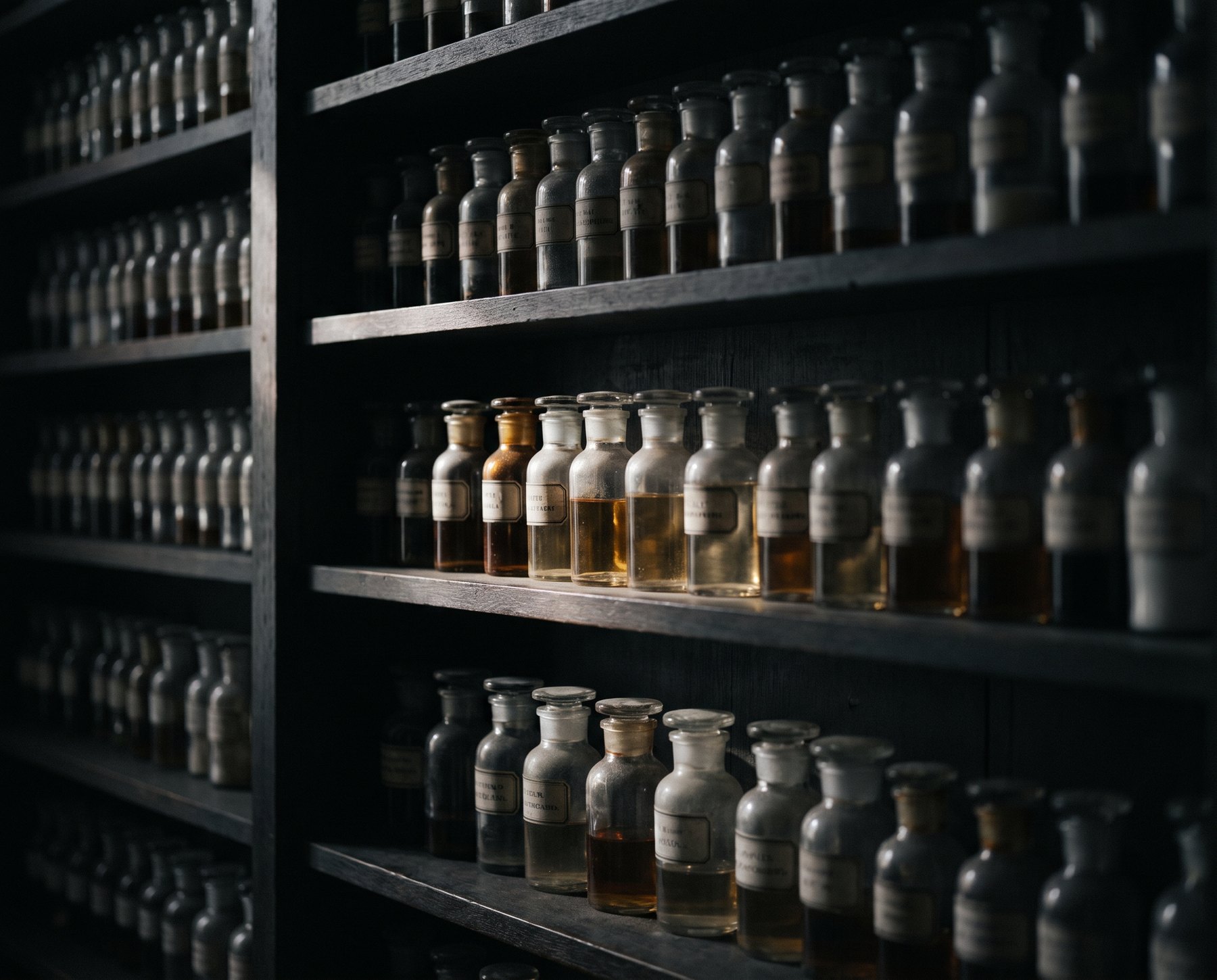
An archive for something that evaporates
On 26 April 1990, in Versailles, a place called the Osmothèque was inaugurated. It describes itself as the first conservatory of perfumes in history: an archive, not a shop, not a museum of pretty bottles.
The Osmothèque states its idea plainly: a place devoted to the memory of smells, to record and gather perfumes existing or yet to come, and to trace certain great lost perfumes and bring them back to life.
Three bodies stood behind its beginning: the Société Française des Parfumeurs, the association of French perfumers; the Comité Français du Parfum; and the Paris Ile de France Chamber of Commerce and Industry. The Osmothèque runs as an association under France's 1901 law.
The name Jean Kerléo is bound up with the place. The Osmothèque itself mounted an olfactory exhibition in his honour. For someone in the trade, that is a rare kind of credit: not a bronze plaque, but a room to smell.
A dark cellar, twelve degrees, argon
Perfume is a fragile object. Light changes its colour and its smell. Oxygen ages it. Heat drives it off. To keep it, one has to resist all three.
The Osmothèque keeps its samples in a cellar. The temperature is fixed at twelve degrees. No daylight. Each sample is sealed under argon, an inert gas, so oxygen cannot touch it. The perfumers who work there, called osmothécaires, open and smell them again at intervals to check.
The collection now holds more than four thousand perfumes, about eight hundred of them discontinued. In 2015 the figure was over three thousand two hundred, with four hundred lost. The archive grows, and the share of what is lost grows with it.
The catalogue holds names from the history of the trade: Houbigant's Fougère Royale of 1884, Coty's Le Chypre of 1917, Millot's Crêpe de Chine of 1925, Jacques Fath's Iris Gris of 1947. Most people alive today have never smelled them anywhere else.
Rebuilt, but never guessed
For perfumes that have gone out of production, the Osmothèque rebuilds from the original formula. Perfumers follow that text exactly, material by material, proportion by proportion.
The rule is stricter than one might expect. If one material in the original formula can no longer be found, the perfume is not rebuilt. The Osmothèque does not interpret or make a near copy. It is an archive, not a storyteller.
This makes it closer to a library of manuscripts than a museum. The formula is the text. The rebuilt vial is a reading of that text aloud. If a word is missing, the keeper chooses silence over filling the gap.
Opened to be smelled
An archive of smell means something only when the smells are smelled. The Osmothèque holds around one hundred and fifty talks with smelling each year, led by the osmothécaires. Visitors do not look at pictures. They receive strip after strip and move through history by nose.
Since 2008 its president has been Patricia de Nicolaï, herself a perfumer. It remains a small association: beyond the osmothécaires, a team of three runs the shared work. The archive has moved to a new address in Versailles.
Something about this place is hard to put into words. An old painting stands before us as an object. An old smell goes inside us, as it went inside its first wearer. There is no distance of glass. A person in Versailles today and a person in Paris in 1884 breathe in the same thing.
Surveys such as The Art of Scent bring smell into the gallery. The Osmothèque works more quietly: it simply keeps those smells in existence, so that one day someone can open them.
Olfactory Art