
Essays · Contemporary Art
Jenny Holzer. Installation for Bilbao.
To keep someone's clothes is to keep them.
Guggenheim Museum Bilbao · Guggenheim Museum Bilbao
Nine columns of light
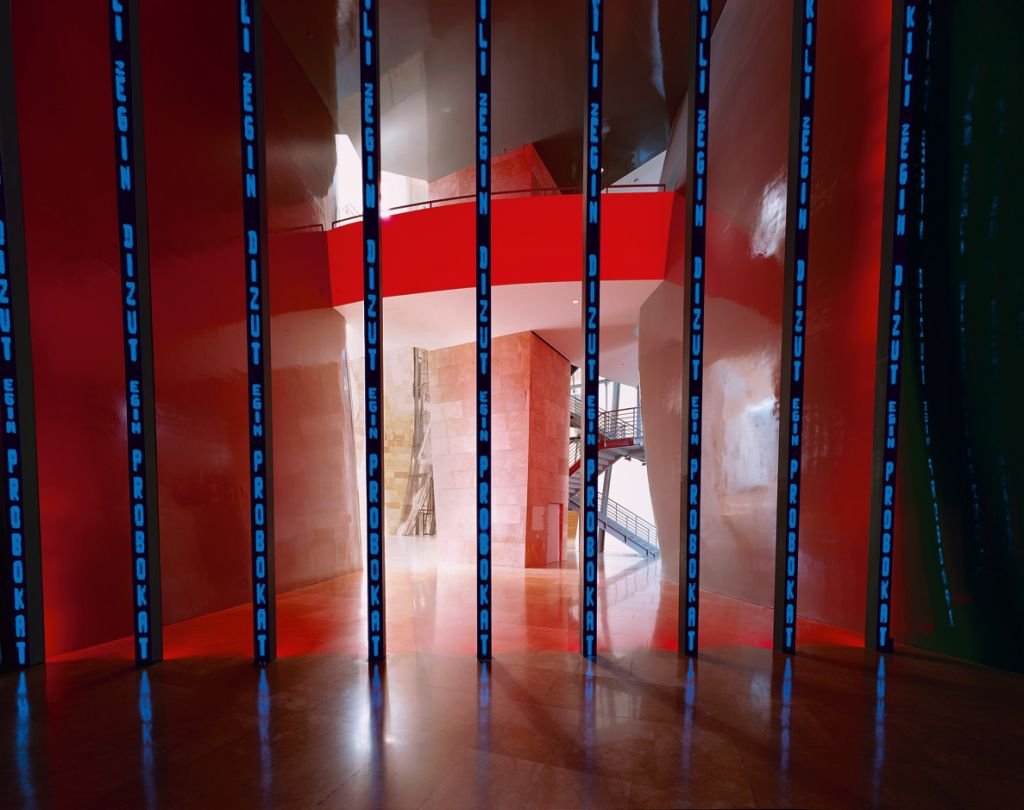
At the Guggenheim Museum Bilbao, in a tall, curving gallery designed by Frank Gehry, nine columns of light stand upright. Each is a double sided LED sign more than 12 metres high. Words run along each column without stopping.
This is Jenny Holzer's Installation for Bilbao. The museum dates it 1997/2017: the year the museum opened, and twenty years later.
The text runs in three languages: Basque, Spanish and English. Basque is the language of the Basque Country, where Bilbao lies. Setting it beside two larger languages is a deliberate choice.
The work is part of the museum's permanent collection, in Gallery 101. Anyone who visits the Guggenheim Bilbao can walk past it.
Lines from Arno
The words come from Arno, a sequence of texts Holzer first wrote for a benefit project for AIDS research. In 1996 Arno was adapted for an outdoor projection in Florence. A year later it came to Bilbao.
The lines in Arno are short, written in the first person, addressed to someone else. I say your name. I save your clothes. No proper names, no specific circumstances. The reader does not know who is speaking, who is being spoken to, or where that person has gone.
The tone is clear, though. It is the voice of someone left behind after the other has died. The lines speak of intimacy, of death, of loss. They do not tell a story. They record the small things people do when they miss someone: say the name, keep the belongings, repeat.
Holzer had worked with words and LED signs for years before this. She was used to placing short sentences in public space, where passers by read them without meaning to. In Bilbao, the most private lines run on the largest columns of light.
Straight among curves
Gehry's building has almost no straight lines. Walls bend, ceilings curve, metal and stone surfaces keep turning. Holzer's nine columns are perfectly straight, evenly spaced, rising from the floor.
The museum describes the columns as cutting across the gallery, an imposing but permeable barrier. Visitors can stand before them as before a wall, or step through the gap between two columns to the other side.
Light from the words falls on the polished stone floor and stretches into long streaks of colour. The room changes with the colour of the text. The lines move too fast to be read in one go. A viewer catches a sentence, loses it, catches another.
The museum frames the work as a negotiation of the fragile border between private and public. Words whispered to someone who has died now run on columns taller than a four storey building, in a crowded museum.
Language turned into light
Printed words stay still. These do not. They appear, pass, vanish and return. Reading the work is like listening to someone repeat one thing over and over, as if saying it many times might make it hurt less, or make it more real.
That repetition is close to how we remember someone who has died. Not one great memory, but small pieces that return many times a day. The name. The shirt. A habit.
When Holzer wrote Arno, AIDS was still taking many lives. In the same years other artists found ways to speak of loss through very ordinary things, like Felix Gonzalez-Torres and his pile of sweets weighing as much as the man he loved. Holzer chose words and light.
Installation for Bilbao does not name the person remembered. Because of that, anyone standing before it can fill in a name of their own.
Contemporary Art