
Essays · Contemporary Art
Jeremy Deller. The Battle of Orgreave.
A memory performed again by those who carry it.
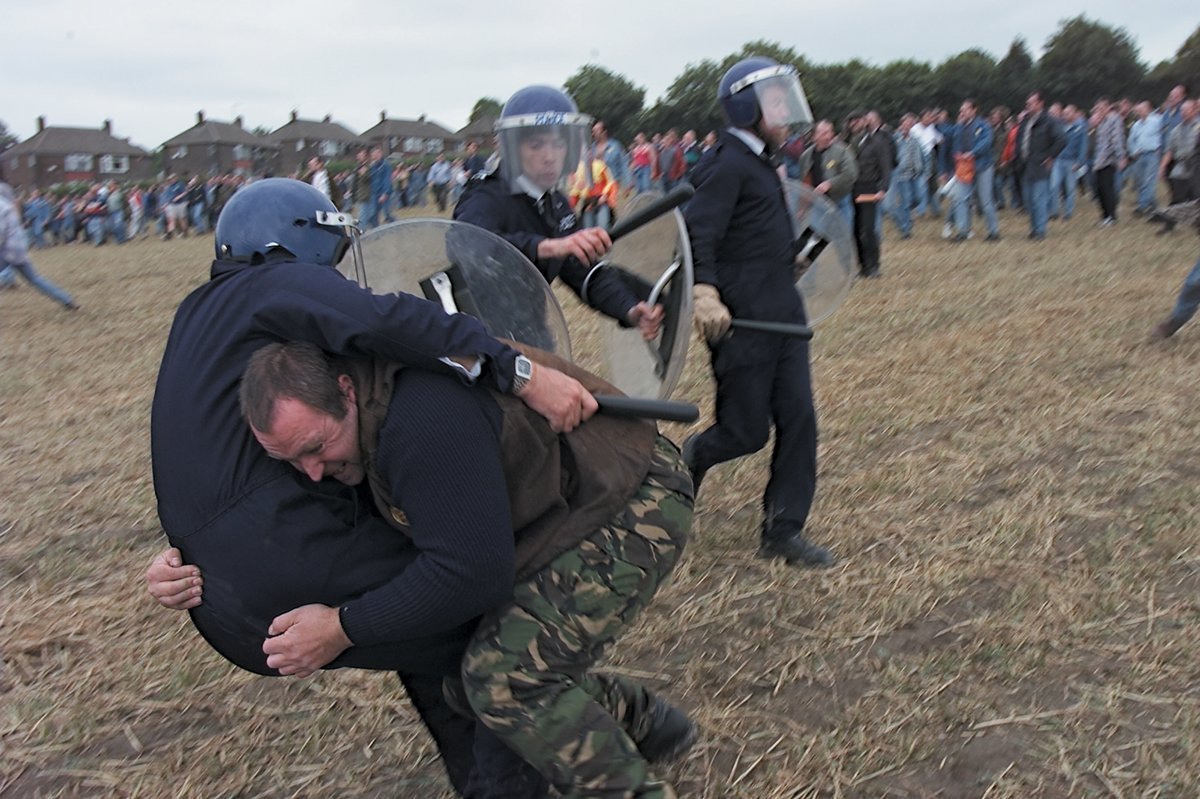
courtesy Artangel · Artangel
One June day, twice
On 18 June 1984, in the middle of the great miners' strike in Britain, pickets gathered in large numbers at the coking plant in Orgreave, South Yorkshire. They wanted to stop coke leaving the plant. The police were there in force. The day became one of the most violent clashes of the period, with horses, truncheons, injuries and arrests.
Seventeen years later, on 17 June 2001, a field nearby filled with people again. More than 800 took part. Many were former miners who had been there in 1984. A few were former policemen who had been there too. The rest came from historical re-enactment societies across England, people used to wearing armour and replaying medieval or civil war battles.
The idea was Jeremy Deller's. The staging on the ground was led by Howard Giles, a re-enactment specialist and former director of English Heritage's events programme. Artangel produced it.
Staging chaos
Deller described the project as recreating something that was essentially chaos. The phrase names the difficulty. An old battle has formations and order. A clash between pickets and police does not. It moves in surges, retreats, rushes forward.
To stage it, you have to ask the people who were there. Who stood where. When the horses charged. Which way the crowd ran. The preparation was also a gathering of accounts, from more than one side.
One detail is worth pausing on: the same field held men who had been on strike and men who had worn police uniform that year. Both sides of one memory stood close again. Nothing in the work explains how that felt. But the fact that it happened is already a question.
The re-enactment took place in front of spectators, almost like a village fair. The people in the field knew what they were replaying.
From field to screen
Director Mike Figgis filmed the whole event. The film, produced by Artangel Media and Channel 4, was broadcast on 20 October 2002. It set the re-enactment beside testimony from those involved, so viewers could see both the performance and the real wounds behind it.
In 2002 Deller also published a book, The English Civil War: Part II. The title shows how he saw 1984: not a disturbance, but a conflict inside the country, worth recording alongside its other civil wars.
The work is now part of The Artangel Collection. It has been shown at John Hansard Gallery in 2013, and at Modern Art Oxford and Tate Britain in 2015.
Whose memory
History is usually told by the loudest voices: newspapers, the state, the evening news. Orgreave is an event where the official version and the memory of those involved sit far apart.
Deller did not write a rebuttal. He handed the event back to the people who carry it. He let them stand on the ground again, in June sun, and retrace old steps.
You could call it performance. You could also call it a memorial without a stone. What makes the work last is that it refuses to let the past close. It shows a collective memory that is still warm, still contested, and still needs human bodies to survive.
Like other archives of memory, such as Christian Boltanski's Les Archives du Cœur, The Battle of Orgreave does not hold an event. It holds people.
Contemporary Art