
Essays · Olfactory Art
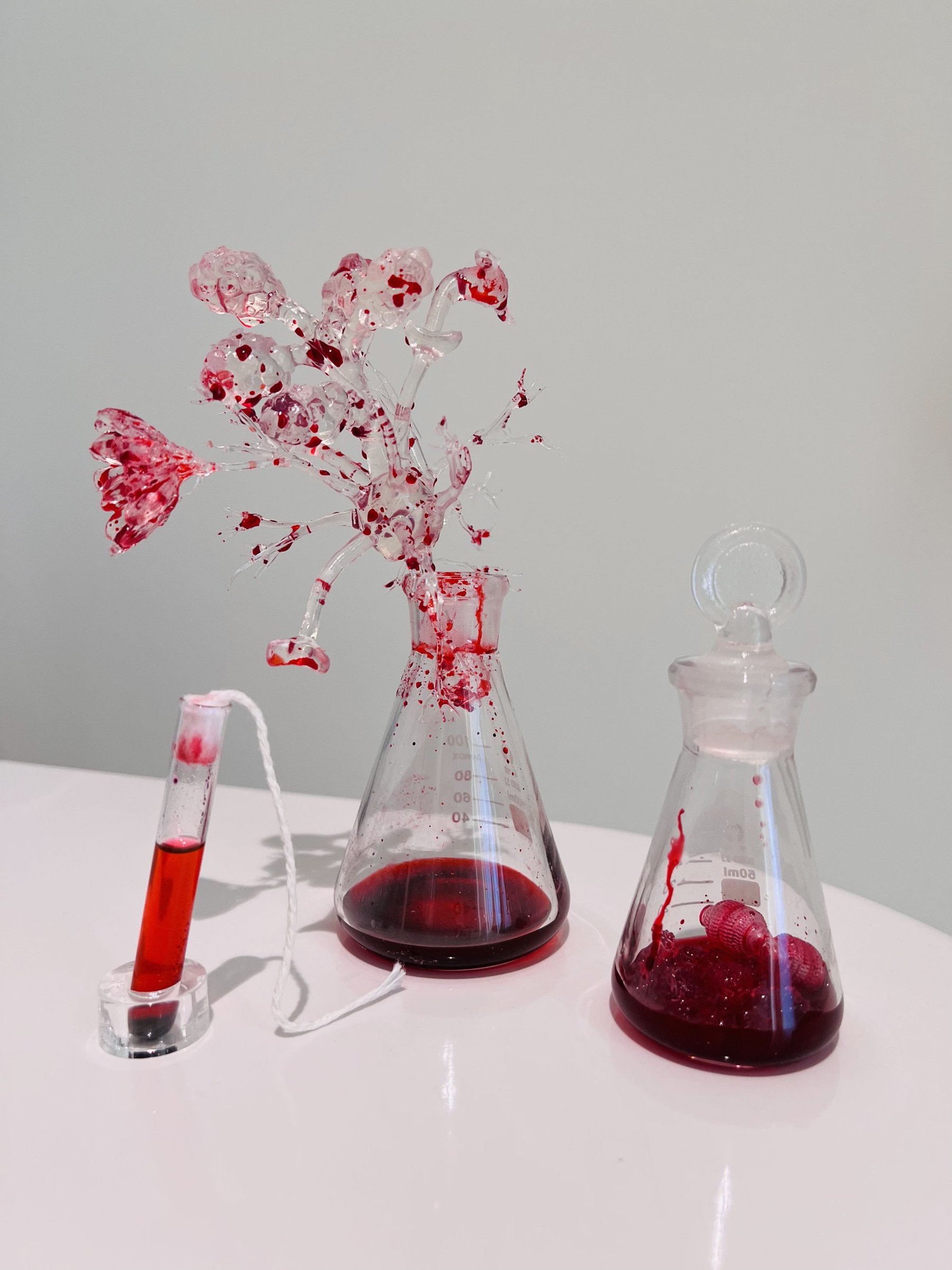
Jiabao Li. Menstrual Garden.
A hidden smell is still a smell.
Olfactory Art Keller · Olfactory Art Keller
A garden in the gallery
From 17 November 2022 to 7 January 2023, Olfactory Art Keller in New York held a group exhibition with an unhedged title: Bodies Odors Trauma Disease. Four artists took part: Jiabao Li, Curatela Placebo, David Falsberg and Mary Jones.
Jiabao Li's work is called Menstrual Garden. The exhibition describes it as a scientific investigation and a multisensory installation. Both halves matter equally.
Li is an artist working between art, technology and the life sciences. Many of her projects begin in a laboratory and end in a gallery. Menstrual Garden follows that path.
Three smells of a cycle
The olfactory part of the work recreates three smells. Fresh menstrual blood. Stagnant menstrual blood. And one the work calls the smell of menstrual pain.
The first two come from matter. They can be analysed, measured, rebuilt. The third is stranger. Pain has no molecule of its own to smell. Naming it is the artist's choice: a way of saying that pain is also part of the body, also present, also worth bringing into the room beside the other two.
The three smells stand together like three moments. The start. The lingering. The moment the body speaks up. The smeller does not need to menstruate to understand. They only need to lean in and breathe a smell they were taught not to mention.
The exhibition asks a direct question: what gives menstrual blood its particular smells? The work does not answer with a paragraph. It answers with the smells themselves.
Ten proteins, enlarged
The visual part of the garden is a set of 3D printed sculptures. They model the ten most common proteins found only in menstrual blood, as well as proteins grown from stem cells found in the artist's own menstrual blood.
Proteins are too small for any ordinary microscope to show their shape. In the gallery they become objects with size, volume and shadow, standing like plants in a garden. That is where the name comes from.
According to the project description, Li tracked the proteins in her own menstrual blood over a long period. That data became form. The artist's body is at once the sample, the subject and the presenter.
During the exhibition, the biochemist Cooper Galvin joined a presentation. The work also asks: could stem cells in menstrual blood hold a fountain of youth? It is a question left open, not a promise.
Why a smell is hidden
In many places menstruation is still spoken of quietly. Pad advertisements once used blue liquid in place of red. Its smell is hidden even more carefully, under layers of floral scent. Menstrual Garden does not argue with those habits. It simply puts the material on the table.
Olfactory art has often worked with body odour, as when Sissel Tolaas and Christina Agapakis grew cheese from bacteria on human skin. Li goes into a more guarded territory. And she brings laboratory tools, so the frankness of the work rests on evidence.
What stays after the garden is not discomfort. It is a simple realisation: this smell was always there. We have only just been allowed to smell it.

Olfactory Art