
Essays · Olfactory Art
Jim Nutt. Now! Hairy Who Makes You Smell Good.
A promise about smell, printed on paper that has none.
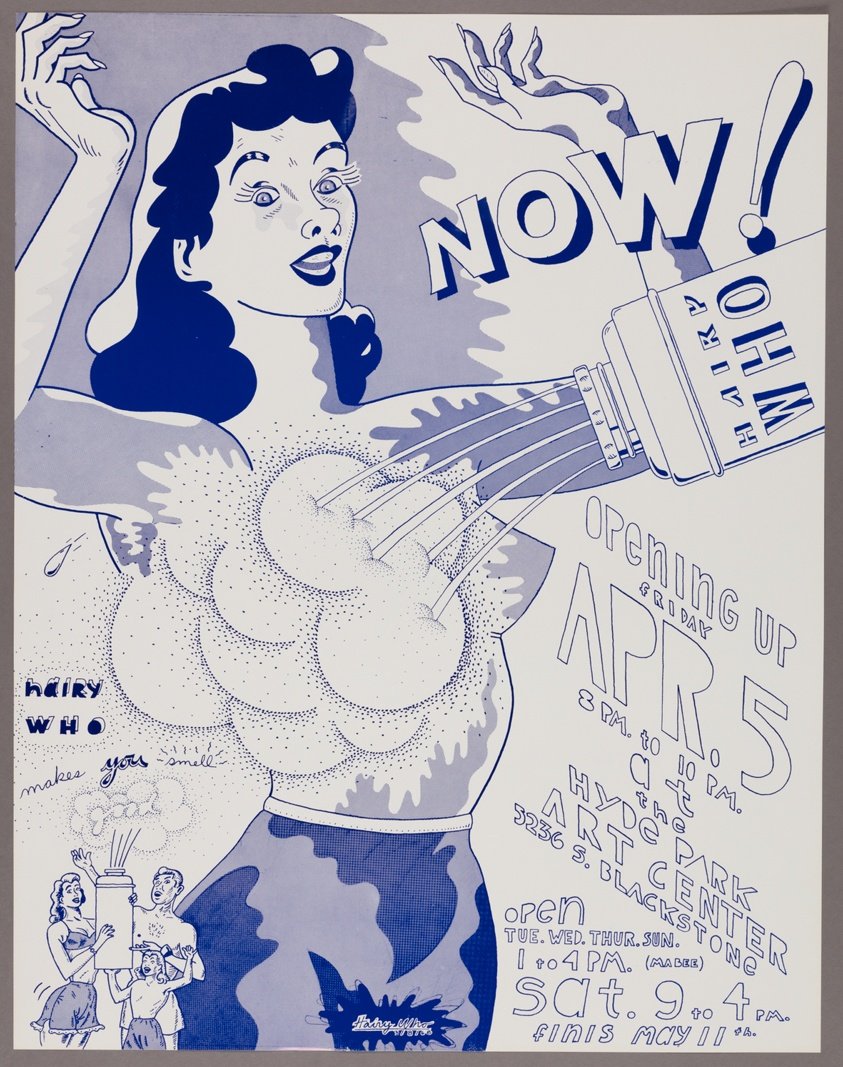
The Art Institute of Chicago, Gift of Gladys Nilsson and Jim Nutt · The Art Institute of Chicago
Six people who named themselves
Hairy Who was a group of six Chicago artists: Jim Falconer, Art Green, Gladys Nilsson, Jim Nutt, Suellen Rocca and Karl Wirsum. According to the Art Institute of Chicago, all six graduated from the School of the Art Institute of Chicago, and they named the group themselves.
From 1966 to 1969 they mounted shows at the Hyde Park Art Center on the city's South Side. Their work was loud in colour and bold in line, full of distorted figures, lettering and puns. It borrowed freely from comics, advertising, packaging and the cheap printed matter of everyday life.
At a time when New York sat at the centre of American art, Hairy Who made something distinctly Chicago. They did not try to resemble anyone. The group's name, half question and half joke, said as much.
Decades later, from September 2018 to January 2019, the Art Institute of Chicago staged Hairy Who? 1966 to 1969, the first major exhibition devoted to the group, presenting each artist and showing how their shared aesthetic changed the art of Chicago.
A poster in the voice of an advert
In 1968 Jim Nutt made the poster Now! Hairy Who Makes You Smell Good. According to a Phillips auction entry, it derives from an original drawing made for the third Hairy Who exhibition at the Hyde Park Art Center, held from 5 April to 11 May 1968.
The impression in the Art Institute of Chicago is catalogued as an offset lithograph in blue on coated white paper, about 54 by 42 cm. It was a gift from Gladys Nilsson and Jim Nutt, two members of the group and a married couple.
The title reads like a line on a soap box or a deodorant can. Now, with its exclamation mark, is the voice of advertising: available today, brand new, don't miss it. Then the promise: makes you smell good. Except that the product on offer is a group of artists.
An exhibition of pictures makes no one smell better. Everyone knows that. The poster knows its reader knows, and plays with exactly that. It borrows the language of consumer goods to talk about art, as if art too were a product on a shelf, promising to transform the buyer's body.
Smell as a printed promise
The American 1960s were the years of television, magazine and billboard advertising. Much of it sold the same thing: a body cleaner, sweeter, more acceptable. Body odour became a problem to be solved, and the product was the answer.
Nutt did not need to draw a bar of soap to point this out. One sentence was enough. Viewers recognised the tone because they had heard it a thousand times. The poster works like a mirror: it hands readers back a language so familiar they had stopped hearing it.
This is a way of talking about smell without any smell. The smell in the poster lives entirely in words, in imagination, in what the reader already carries. Later artists also worked with the language of products and shelves, such as Sylvie Fleury; see Aura Soma.
Nutt's poster is memorable because it is light. It does not condemn advertising or lecture about consumer society. It simply laughs. And in that laughter the reader sees more clearly how smell, the most private thing about a body, was turned into a mass printed promise, pasted on walls, sold to everyone.
Olfactory Art