
Essays · Photography
Jo Spence. The Picture of Health?
Whoever holds the camera gets to tell the story.
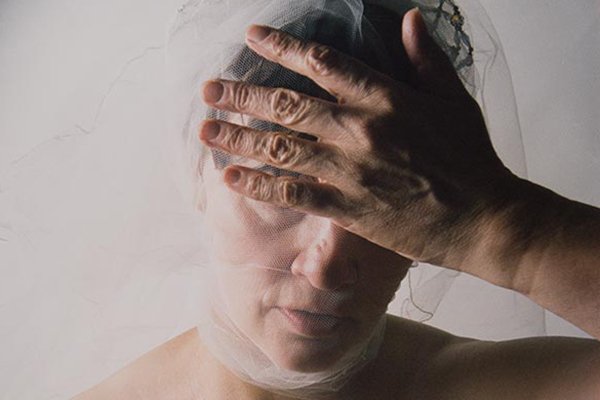
© Terry Dennett and courtesy of the Jo Spence Memorial Archive, Ryerson Image Centre, Toronto · Aperture
From high street studio to political image
Jo Spence began as a commercial photographer. From 1967 to 1974 she ran a high street studio in London: weddings, family portraits, passport pictures. She knew exactly how people wanted to look before a lens, and how to make them look that way.
Those years made her distrust photography. The wedding and family pictures she made every day followed a template: the woman must be pretty, smiling, in her proper place. From the mid 1970s she turned in a different direction.
In 1973 she cofounded the Children's Rights Workshop in London. In 1974, with her partner and longtime collaborator Terry Dennett, she set up Photography Workshop in their flat. She called herself an educational photographer, or a cultural worker. For her, a photograph was not decoration. It was a tool for asking questions about power, gender and class.
A camera in the clinic
In 1982 Spence was diagnosed with breast cancer. She entered the medical system like any patient: queuing, waiting, being examined, being told. She realised that inside that system the patient had almost no voice. Bodies were looked at, measured, recorded, but rarely asked.
From 1982 to 1986 she documented the process with a camera, in a project called The Picture of Health?. The question mark is deliberate. What does being well look like in a photograph? And who has the right to take it?
She worked with the photographer Maggie Murray. The images show her body in the ward, on the bed, in moments medical pictures usually leave out: a woman looking back at the lens, not a case lying still.
The project also records her turning to traditional Chinese medicine alongside Western medicine. Spence did not present it as an answer. She recorded it as part of searching for herself and deciding for herself.
Putting herself in the frame
In the same years Spence developed, with the photographer Rosy Martin, a way of making pictures drawn from co-counselling sessions. The two took turns playing roles, restaging images lodged deep in their lives: a mother as a wartime worker, a bride on her wedding day. Then they photographed them. The aim was to take apart the models society places on women.
In 1986 she published Putting Myself in the Picture, an autobiography in photographs, both personal and political. The title sums up her work: placing yourself in the frame rather than letting others place you there.
Jo Spence died in 1992. In her final years she kept photographing. Her pictures now sit in archives and museums, and come up whenever people discuss how photography looks at the sick body.
Set beside Peter Hujar's Portraits in Life and Death, Spence's pictures show one difference: here, the person in the bed is also the person holding the camera. There is no distance between the one seen and the one seeing.
Photography