
Essays · Olfactory Art
Josely Carvalho. Diary of Smells: Glass Ceiling (Teto de Vidro).
Broken glass can still hold a smell.
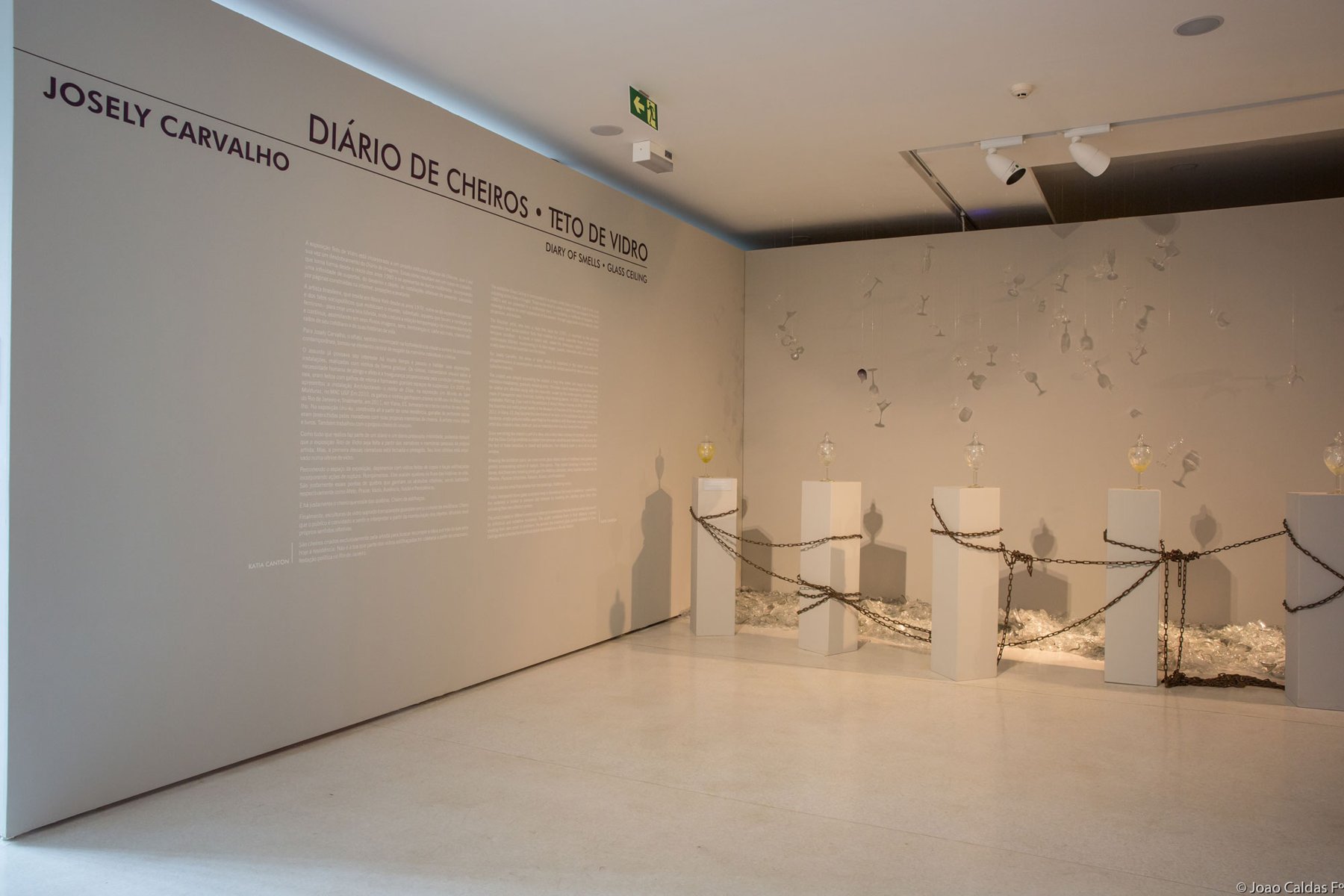
Photo: João Caldas · Josely Carvalho (official site)
A diary written in smell
Josely Carvalho is a Brazilian artist who has lived in New York since the 1970s. Her work draws on personal life and on the political and social upheavals of the world, especially those that touch the condition of women.
For years she has kept a project called Diary of Images. Diary of Smells grew out of it. Instead of recording a day in pictures, she records it in the smells that stay in memory.
Glass Ceiling, Teto de Vidro in Portuguese, is one chapter of that project. It was shown at the Museum of Contemporary Art of the University of São Paulo, MAC USP, from 3 March to 6 May 2018, curated by Laura Abreu.
The title works twice. The glass ceiling is the familiar phrase for the invisible limit that holds women back. Here glass is also a real material: something you can hold, break, and make again.
From broken glass to blown vessel
The exhibition had four parts. The first hall, Shards. The second room, Resilience. The third, Smell Flasks and Olfactory Crayons. And a video, Memory of Glass, following the making of the glass.
The starting point was a book object called Estilhaços, or Shards, made from the artist's memories and writings about broken wine glasses. From those pages came the first six smells: Affection, Illusion, Persistence, Emptiness, Pleasure, Absence.
The sculptures were made at UrbanGlass, a glass studio in Brooklyn, New York. Broken shards were gathered and blown into vessels of ambiguous form, using sand, fire and bellows. None looks like a familiar object. They sit somewhere between a glass and a fragment.
Carvalho left the mouths of the vessels open on purpose. The smells escape in their own way, and each visitor reads resilience through their own nose.
Twelve smells, one question about resilience
In all, the exhibition held twelve smells, made with Givaudan do Brasil. Six came from the book Shards. Six others lived in the glass vessels: Anoxia, Pepper Ball, Dust, Barricade, Lacrimae and Queen of the Night.
These six were made as memory traces of protests around the world. Anoxia is the suffocation of air without oxygen. Barricade is the burnt smell of destroyed forests. Lacrimae runs from the tear gas police use to break up protests to tears of sorrow. Pepper Ball recalls the pepper projectiles. Dust is dust. Together the six are called Resilience, the name of the second room.
Queen of the Night is the smell of Cestrum nocturnum, a plant whose flowers release their strongest scent after dark. Placing it beside tear gas and forest smoke is a clear choice. Among the smells of violence there is one of life still blooming, and it blooms when it is hardest to see.
In 2019 the work received the Sadakichi Award from the Art and Olfaction Awards, shared with Leandro Petit. Like Sissel Tolaas's wall of fear, Glass Ceiling shows that smell can carry a collective feeling. The difference is that Carvalho does not stop at the wound. She asks one more question: once something breaks, what do we do with the pieces?
Olfactory Art