
Essays · Olfactory Art
Luiza Gottschalk. Glade: To Touch Painting.
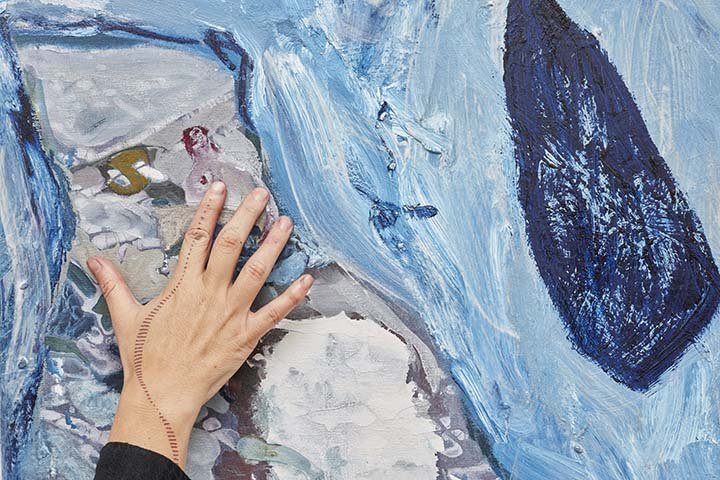
A forest that opens only when touched.
Olfactory Art Keller · Olfactory Art Keller
Six paintings you may touch
In the spring of 2022, from 10 March, Olfactory Art Keller in New York hung six paintings by the Brazilian painter Luiza Gottschalk. All six show forest scenes. All six have a smell.
The scent is not sprayed on the canvas, nor released by a diffuser in the room. It lives in the paint. To smell it, visitors must do what every museum forbids: touch the painting. A finger rubs the surface, and the scent is released.
The title says it plainly: Glade: To Touch Painting. A glade is a clearing in a forest. To Touch Painting is an invitation, and also another definition of looking at a picture.
Four smells of a forest
Gottschalk developed four scents with expert help. Their names are as simple as weather: wet night, dry forest, citrus and pasture.
Wet night is fresh and damp. Dry forest recalls dry grass that has been trodden on. Citrus is fruity. Pasture is warm and vivid. The four do not try to reproduce any real forest. They are more like four moments on a walk: just after dark, crossing a sunny patch of grass, breaking open a ripe fruit, stepping out into the open.
Visitors move from one canvas to the next, touching, smelling, slowly rebuilding the forest in their heads. The exhibition text describes the paintings, once touched, spilling past the canvas and taking in the viewer.
From studio to national museum
The six paintings were made during Gottschalk's residency at the International Studio & Curatorial Program in New York in 2021, a period in which she studied scent as a way to widen how viewers sense her paintings.
Glade was her first solo exhibition in New York. At the same time, in Brasília, Brazil's National Museum of the Republic was showing another exhibition of hers, called Clareira. In Portuguese, clareira also means a clearing in a forest.
Two exhibitions with the same name, in two cities thousands of kilometres apart. One in a large museum in a capital. One in a small gallery in Manhattan's Chinatown, where visitors were invited to reach out a hand.
When the finger becomes a third eye
Western painting has long been taught as an art of the eye. The viewer stands at a distance, looks, thinks. Every other sense waits outside. In many museums a rope or a painted line on the floor is there to remind us.
Gottschalk does not tear painting down. Her pictures are still pictures, with colour, composition, a forest to look at. She only adds another way in. The finger touches, the nose receives, and the eye looks again differently. A patch of green reads differently once you have just smelled dry grass rising from it.
One more small thing. Every touch is an exchange. The visitor takes a little scent away on a fingertip and leaves a little warmth, a faint fingerprint, on the surface. After weeks, these paintings are no longer exactly as they were on opening day. They carry the marks of everyone who came close. An ordinary painting tries to stay intact. Gottschalk's paintings accept being changed by each viewer.
Olfactory art has had paintings that hide scent before, such as Peter de Cupere's invisible paintings, where one had to scratch the surface to smell the meaning of the title. Gottschalk is gentler. No scratching. Only touch. And the forest opens.
Olfactory Art