
Essays · Olfactory Art
Leanne Wijnsma, Froukje Tan. Smell of Data.
The most dangerous things are the ones without a smell.
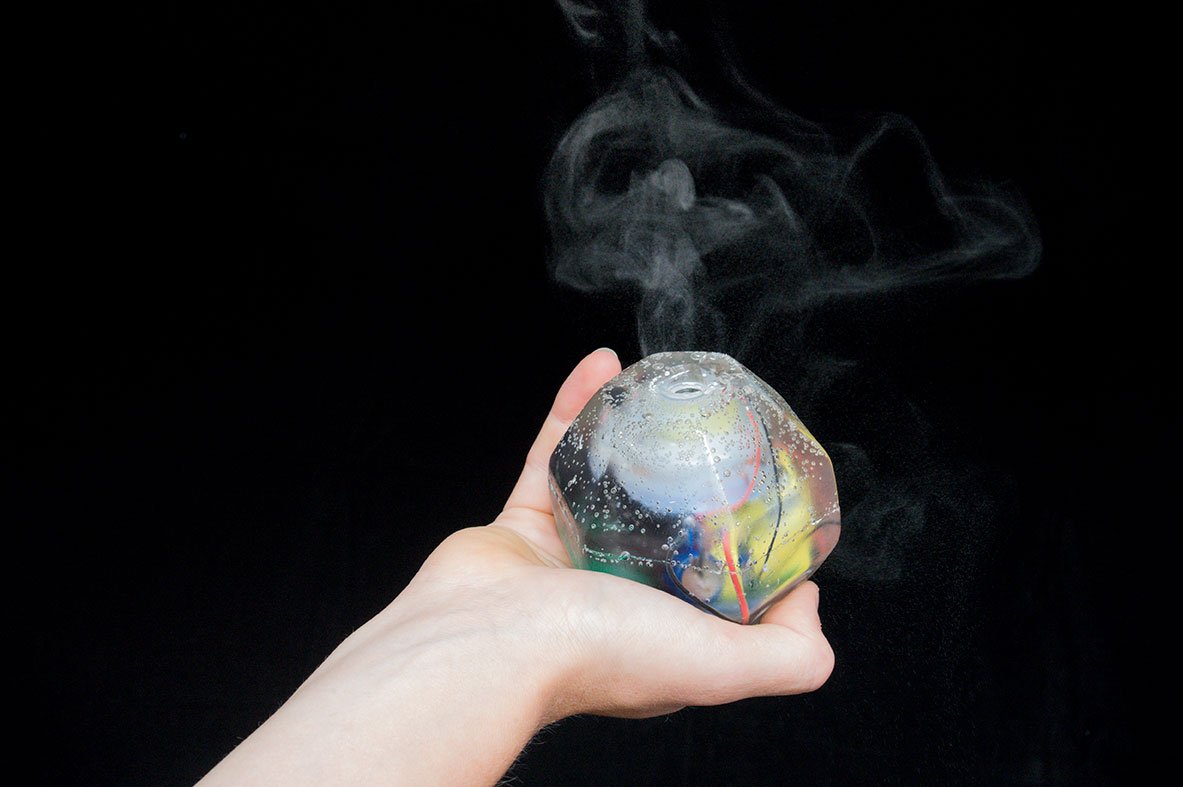
© Leanne Wijnsma · Smell of Data (official project site)
An explosion in 1937
In 1937, in the town of New London, Texas, a school exploded. The cause was natural gas leaking and building up in an enclosed space without anyone knowing. Gas at the time had no smell. According to the project's site, 295 students and teachers were killed.
After the disaster, authorities required that odour be added to otherwise odourless gas. The unpleasant smell everyone now recognises from a leaking stove does not come from the gas itself. It is added, on purpose, so that the human nose can keep watch. Explosions fell sharply.
The designer Leanne Wijnsma and the filmmaker Froukje Tan began from this story. They asked: what is leaking around us today without a smell? Their answer was personal data.
A smell for data
Smell of Data was made in Amsterdam in 2016. It has two parts. The first is a new smell, created to be tied to the feeling of data being exposed. Articles about the project describe it as metallic. It was developed by Wijnsma with the company ScentAir.
The second is a small dispenser that fits in the palm, connected by wifi to a phone, tablet or computer. When the user visits an unprotected website on an unsecured network, the device releases a puff of scent.
The code was written by Jip de Beer. The prototype was designed by Robert van Leeuwen. Photographs are by Simone C. Niquille. The code is published under a Creative Commons licence so that anyone can rebuild it.
Several organisations took part, among them ScentAir, Bits of Freedom, Mediafonds, Greenhost and Waag Society, later joined by SIDN fonds, STRP and Hackers and Designers.
A warning, not a lock
The makers are clear: Smell of Data is not a security solution. It blocks nothing. It only warns. Just as the smell in gas does not mend a pipe, it only tells you there is a leak.
Why smell, when phones already have every kind of notification? Because on screen alerts are too many and too alike. Users learn to dismiss them. Smell is different. It goes straight to reflex, faster than reading or thinking. We do not decide whether to smell. The smell is already there.
The project relies on exactly this feature of the sense: a direct line to instinctive reactions. A strange smell in a room makes us look up before we think. Smell of Data wants personal data to be treated that way, as something that can startle us.
In 2016 the project won Most Innovative Project at Science Hack Day. In 2017 it was a finalist for the Sadakichi Award of the Art and Olfaction Awards.
Giving the invisible a body
Data is among the hardest things in contemporary life to picture. It cannot be seen, held or heard. It passes through us every second without our noticing, and so every risk around it feels abstract.
Smell of Data does not explain data. It gives data a body. A smell, a sensation in the nose, a reaction in the gut. When something invisible has a smell, it begins to exist in a way the body understands.
Olfactory art often uses smell to speak of what the body knows but words cannot fully say, like fear in Clara Ursitti's The Smell of Fear. Smell of Data works the other way: it uses smell so the body can know something that until then only words could say.
What stays with you is its modesty. It promises no protection. Only a warning. And it trusts that the nose, the most underrated of the senses, is still quick enough to stand guard over a digital world.

Olfactory Art