
Essays · Olfactory Art
lindsey french, Alex Young. Scent Poems for Pipeline Plants.
Plants speak too, in smell.
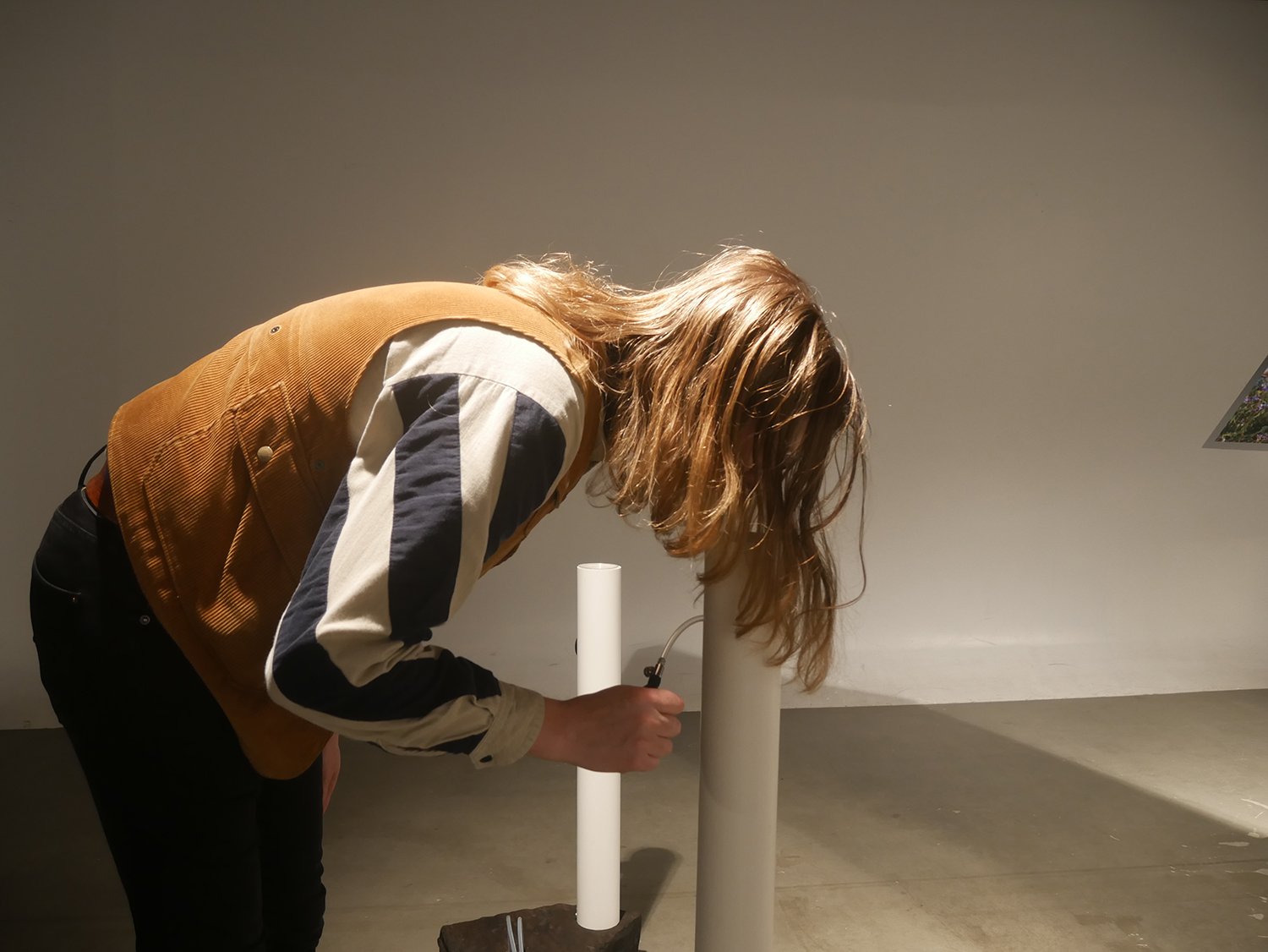
© lindsey french & Alex Young · Scent Poems for Pipeline Plants (project site)
36 stops along a pipeline
Line 3 is a crude oil pipeline running from Edmonton, Alberta, across the border into the United States, to Superior, Wisconsin. More than a thousand miles long. Its rebuilding was widely contested, especially by Indigenous communities whose land and water lie along the route.
Artists lindsey french and Alex Young travelled that route. They stopped at 36 sites. At each one they left a scent poem for the plants growing on the disturbed ground.
Each stop followed the same sequence. Place the poem. Photograph the site with two ceramic vessels, one of red earthenware, one of buff stoneware. Collect roadside debris. Take notes: which plants grew nearby, what smells, what sounds, which insects, and fragments of conversations with people met along the way.
The trip became a long field notebook. Not about the pipeline, but about what lives beside it.
Poems in the language of plants
A scent poem, in this project, is oil infused with compounds plants use to signal. Plants have no voice, but they communicate with each other and with insects through volatile organic compounds. A bitten leaf can release a smell that tells its neighbour to prepare its defences.
The oil sits in ceramic vessels the artists made themselves. Each carries a lens that gathers sunlight to warm the oil inside. As it warms, the scent rises. The sun reads the poem aloud.
The project sets two kinds of airborne chemistry side by side. On one side, the signals plants have used for a very long time. On the other, the volatile compounds the oil industry releases into the air. Both invisible. Both carry information. One is speech, the other is noise.
No one knows for certain whether the plants register these poems. The artists do not claim it. The project is not an experiment measuring a response. It is a gesture: an attempt to address another species in its own language, at the very place where people have just wounded the ground.
The poems have no words. A passer by reads nothing. But for a plant regrowing on turned earth, they may be the first greeting.
Three sites brought indoors
From 6 to 9 May 2023, part of the project was shown in the Multisensory Art Gallery of the Uncommon Senses IV conference at Concordia University, Montreal. Of the 36 sites, the artists chose three.
Site 1 is Edmonton, where the pipeline begins. Site 31 is Cass Lake, on the edge between settler land and treaty land. Site 35 is Superior, where the pipe rises visibly above ground.
A scent was made for each site and housed in ceramic, the vessel designed like the chamber of a dismantled perfume atomiser. Visitors squeezed a rubber bulb to push the scent out. Beside the photographs, they stood before a place thousands of kilometres away, and smelled it.
The project was a finalist for the 2024 Sadakichi Award for experimental work with scent. It belongs to a line of olfactory art that questions shared air, such as Peter de Cupere's Air Polluter. But here the ones being addressed are not people. They are plants.
Olfactory Art