
Essays · Olfactory Art
Linnaeus. Seven classes of a classifier.
Seven drawers for something that will not stay still.
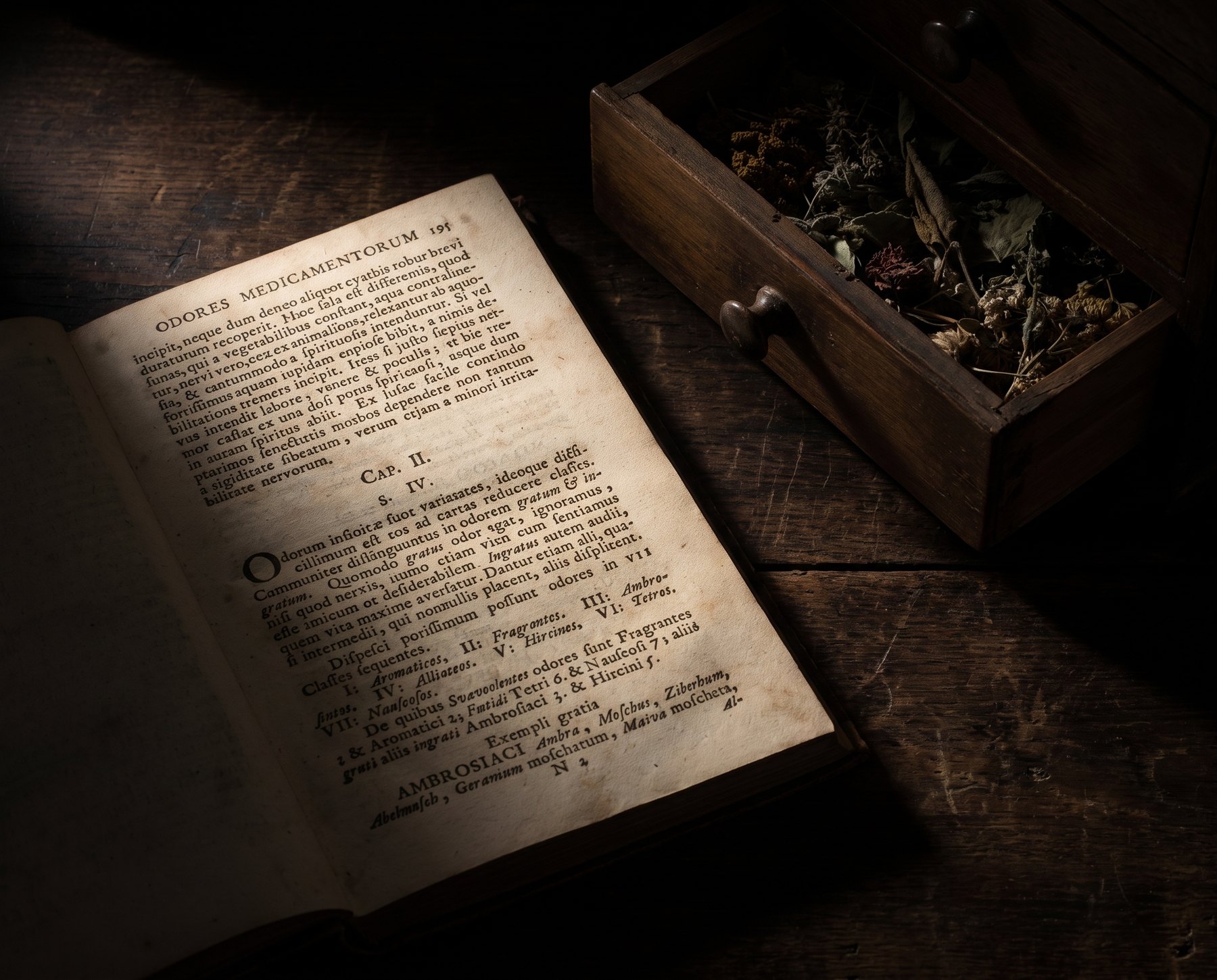
Uppsala, 1752: Odores medicamentorum
Carl Linnaeus was a professor at Uppsala. He had published Systema Naturae in 1735 and was about to publish Species Plantarum in 1753, the book behind the two word Latin plant names still in use. He lived among specimen cabinets, pressed sheets and lists.
As was customary, students defended dissertations under a presiding professor. In 1752 Linnaeus presided over Odores medicamentorum, the odours of remedies; the respondent was Anders Wåhlin. The Stockholm printing runs to sixteen pages. In 1756 it was reprinted in the third volume of Amoenitates Academicae, the collection of dissertations produced under Linnaeus.
Its purpose belonged to eighteenth century medicine: the smell of a remedy was believed to show how it acted on the body. That idea no longer stands. What remains, and is still cited, is the classification at the centre of the text.
Before sorting, the dissertation spends a few pages on the nose. It describes the lining of the nasal cavity and makes an observation: the organ of smell sits right above the mouth, so that nothing with an odour enters a meal without passing the nose's inspection.
Seven classes, from fragrant to nauseous
The text admits that smells are usually divided only into pleasant and unpleasant. It adds that we do not know how a pleasant smell works, and that some smells sit in between, liked by some and disliked by others. Then it proposes seven classes.
Fragrant, odores fragrantes: lily, tuberose, wallflower, saffron crocus. Aromatic, aromatici: the leaves of laurels, carnation flowers. Ambrosial, ambrosiaci: musk. Alliaceous, alliacei: garlic, garlic mustard, asafoetida. Hircine, hircini: a goat scented St John's wort, herb Robert. Foul, tetri: walnut, box, dill, even coriander. Nauseous, nauseosi: false hellebore, hellebore, the flowers of a carrion plant.
The first three are pleasant; the other four are not. Coriander among the foul is worth pausing on: a European of the eighteenth century and a Vietnamese cook today can smell the same leaf and file it in different drawers.
Sorting plants and sorting smells
For plants Linnaeus had something to hold on to: stamens and pistils, which could be counted, seen and drawn. For smell he had nothing similar. No number to count, no shape to draw. So the seven classes rest on examples, things a reader of the time could pick up and smell.
This is both weakness and strength. Weakness, because each class is defined only by a few samples, and the borders depend on the reader's nose. Strength, because the table holds on to real materials rather than a theory of sensation.
The table outlived its maker. In 1895 the physiologist Hendrik Zwaardemaker kept the seven class frame, added an ethereal class and an empyreumatic, or burnt, class, and arrived at nine. Linnaeus's Latin names travelled on for nearly a century and a half.
Drawers for what evaporates
There is a gentle irony here. The century's great placer of things opens by saying that smell will not stay in any place. He makes the table anyway, because an imperfect table still gives people a shared way of speaking.
Biology now tells us the human nose has around four hundred kinds of odorant receptor, and each smell is recognised through a combination of them. There are no seven natural drawers. Yet the table is not useless. It shows someone facing a sense without a vocabulary and trying to give it a cabinet.
Read today, the seven classes are more a portrait of Uppsala in 1752 than a map of smell: a physic garden, a Latin library, and a classifier who knew he was doing something that could not be finished.
Olfactory Art