
Essays · Olfactory Art
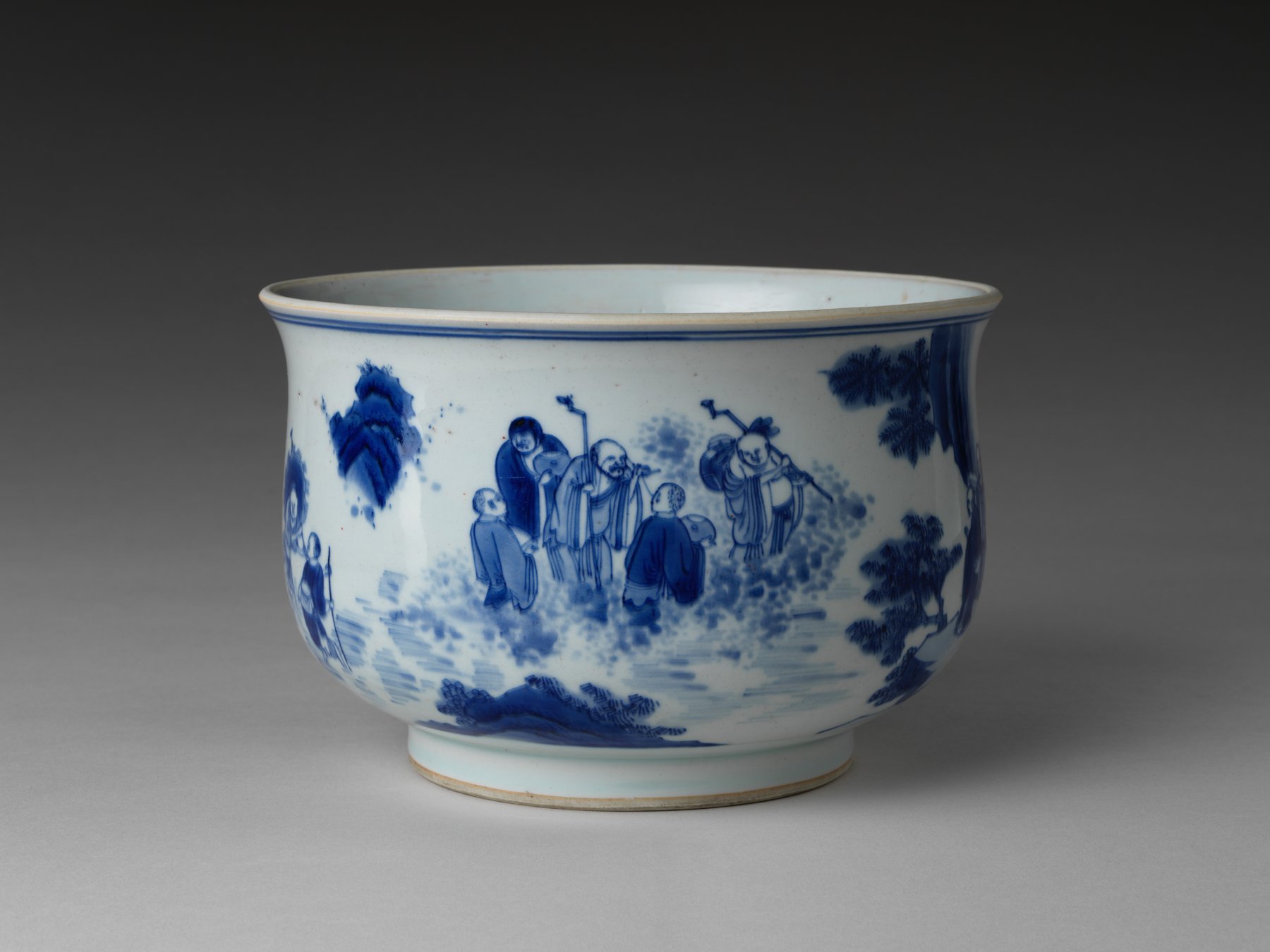
Unknown maker, Jingdezhen. Incense Burner with the Eighteen Luohans.
The dynasty changed hands. The burner still had to be lit.
The Metropolitan Museum of Art, Gift of Julia and John Curtis, in celebration of the Museum’s 150th Anniversary, 2020 (Open Access, public domain) · The Metropolitan Museum of Art
A burner that carries a year
The Metropolitan Museum in New York holds an incense burner in porcelain, painted in cobalt blue under the glaze, made at the Jingdezhen kilns. It is not large. About 14.9 cm high, 21.3 cm across the body, 22.9 cm at the rim, 13.7 cm at the foot. The rim is wider than the body: a shape that opens upward, exactly where the smoke will go.
What sets this burner apart from other blue and white burners is its year. The Met gives a single date: 1645. Not a range, not a century. For Chinese porcelain, knowing the exact year of making is unusual. According to the Met, dated ceramics from the Southern Ming are extremely rare.
The burner came to the museum in 2020, a gift of Julia and John Curtis in celebration of the Met's 150th anniversary. From 1999 it had been in the Curtis collection in Williamsburg, Virginia. It was shown in the Met's exhibition Another World Lies Beyond: Chinese Art and the Divine, 2019 to 2020.
Eighteen luohans around the body
Luohans, arhats in Sanskrit, are followers of the Buddha who have reached liberation. In Chinese art they usually appear as a group: sixteen, later eighteen. They are not solemn like images of the Buddha. Each has his own face and temperament, often drawn as odd, playful, and at ease with wild animals.
On the Met's burner, the painter caught that spirit. One luohan fords a river on the back of a tiger. His companion hails a flying dragon. Others wait to greet friends arriving on drifting clouds. The Met describes the scene as both playful and powerful.
All of it is painted in one colour: cobalt blue on white porcelain, then glazed and fired. There is no second colour to separate tiger from water, dragon from cloud. Only the light and dark of a single blue. The painter had to build a sacred world out of brushwork and the bleed of a mineral pigment.
When the burner was in use, smoke rose from its mouth, just above the luohans' heads. Picture and smoke move the same way: from earth toward cloud. Since the Han dynasty, Chinese burners had often been shaped as immortal mountains so that smoke could drift around the peaks. Here the mountain is replaced by people: those who have walked the whole path.
Jingdezhen in 1645
In 1644 Beijing fell, the Chongzhen emperor took his own life, and the Qing entered the capital. But the Ming was not wholly gone. A remnant court fled south and set up the throne again. Historians call this the Southern Ming, lasting from 1644 to about 1662. The Met places the burner in that period.
Jingdezhen in Jiangxi province had been the porcelain capital of China for centuries. In the last Ming years imperial orders thinned, and private kilns had to find their own buyers: customers at home, foreign merchants, temples. Porcelain from these transition years often shows freer subjects and looser brushwork than court wares.
A burner painted with luohans is an object for worship, whether in a temple or on a household altar. Whoever ordered it in 1645 lived among war, rumour and passing armies. They still ordered a burner. They still needed a place to light incense.
Penta does not know who that person was, and the museum does not say. But an object for burning incense made in that year, and marked with that year, is a trace. It shows that some things people do not give up, even when everything else is changing hands.
Nearly four centuries later, the burner stands in gallery 210 at the Met. No smoke now. The eighteen luohans are still crossing the river, still calling the dragon, still arriving on clouds.
Olfactory Art