
Essays · Olfactory Art
Lucy Dodd. Cake 4 Catfish.
A painting that is not quite dry is still alive.
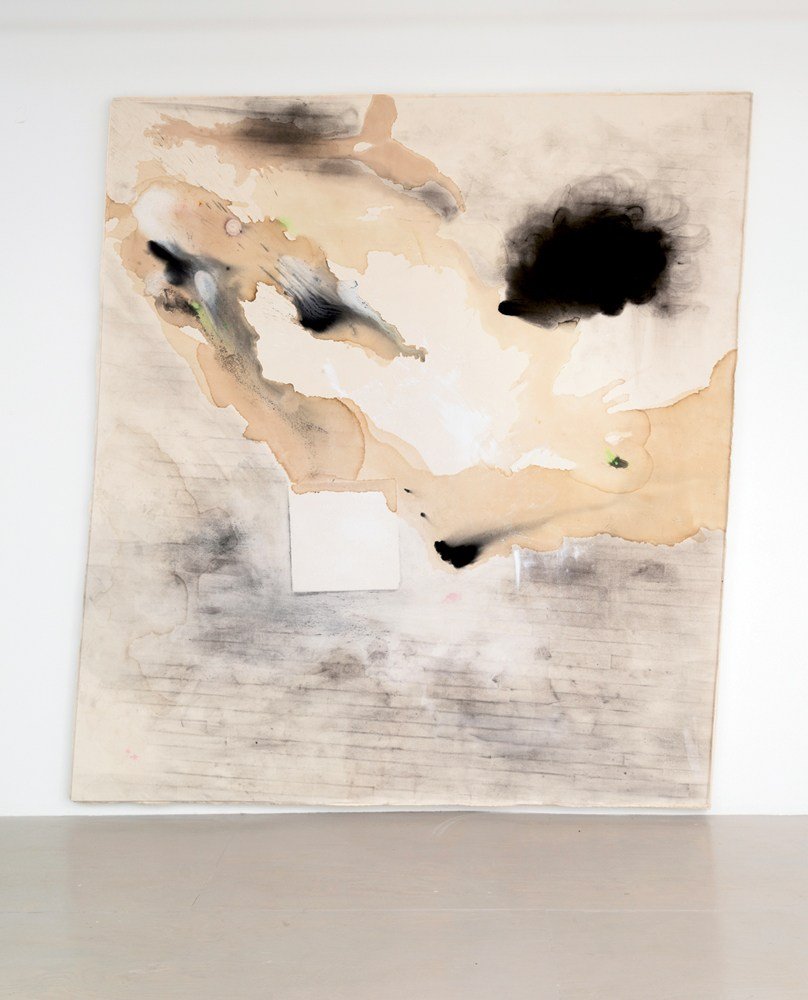
Lucy Dodd, Beyond Blind (1981 ½), 2013 · Art in America
A catfish party
Cake 4 Catfish was Lucy Dodd's first solo show at David Lewis Gallery, then newly opened on the fifth floor of 88 Eldridge Street on New York's Lower East Side. It ran from 24 November 2013 to 12 January 2014.
The opening was billed as a pescatarian potluck. Dodd served fried catfish and a pungent soup. By accounts of the evening, it ended with guests throwing birthday cake in each other's faces. The title was not a metaphor. There was real cake and real fish.
But the smell of the show did not come only from the kitchen. It came from the paintings on the walls.
Painting with things that are not paint
Dodd's canvases are huge, smeared with nettles, iron oxide and other matter more often found in a kitchen or a forest than in a paint box. With their strong smells, the paintings seemed to be fermenting in the room.
The materials of one 2013 work, 2 Doors, 1 Tomb, Coming Through the Back Side of Death-Right, show her method: leaf extract, yerba maté, berries, wakame, liquid smoke, wild walnut rind, iron glimmer, spirulina, yew berries, hematite, black lichen, urine, charcoal, kombucha SCOBY, nettles and pigments. More than a dozen things, each with its own colour and smell.
Dodd does not paint on an easel. She lays canvas directly on the studio floor, then pours, rubs and scatters material onto it. Her first large paintings, about twelve feet square, were made on the floor of her Brooklyn apartment.
The urine has its own story. In a later interview Dodd recalled that her dog, her studio assistant for thirteen years, urinated on canvases lying on the floor. She was upset at first. Then she gave in and tried adding pigment. It became a material.
Hallway and furniture
At the entrance, the hallway was taken over by a disorderly installation: Breuer chairs with woven rope seats in no order, rhombus-shaped paintings leaning on the walls, oddly proportioned glass tables placed at random.
The disorder made the gallery feel less like a white cube and more like a lived-in home. Food, furniture, smell. The paintings did not stand apart from life. They were part of it.
Dodd has said she uses these materials because they are meaningful, because she has a relationship with them, and that she does not try hard to come up with ideas but takes what is in front of her. That explains why her paintings smell: she paints with her surroundings.
Painting as a living process
Most painting aims at stability. Paint dries, varnish seals, the work is kept at fixed temperature and humidity so it will not change. Dodd's paintings go the other way. Kombucha is a living culture. Tea, leaves and fruit are organic. They keep changing after the painter stops.
Smell is the clearest sign of that change. Viewers cannot see microbes at work, but they can smell them. Such a painting never fully stands still on the wall.
Placed beside Candice Lin's Swamp Fat, where a scented block of lard is offered for rubbing on the skin, Cake 4 Catfish shows artists treating the smell of organic matter as material rather than side effect.
Cake 4 Catfish lasts because it gives painting a smell without adding one. The smell was already in the materials. Dodd simply did not hide it.

Olfactory Art