
Essays · Photography
Luigi Ghirri. Kodachrome.
The world is already a picture before we photograph it.
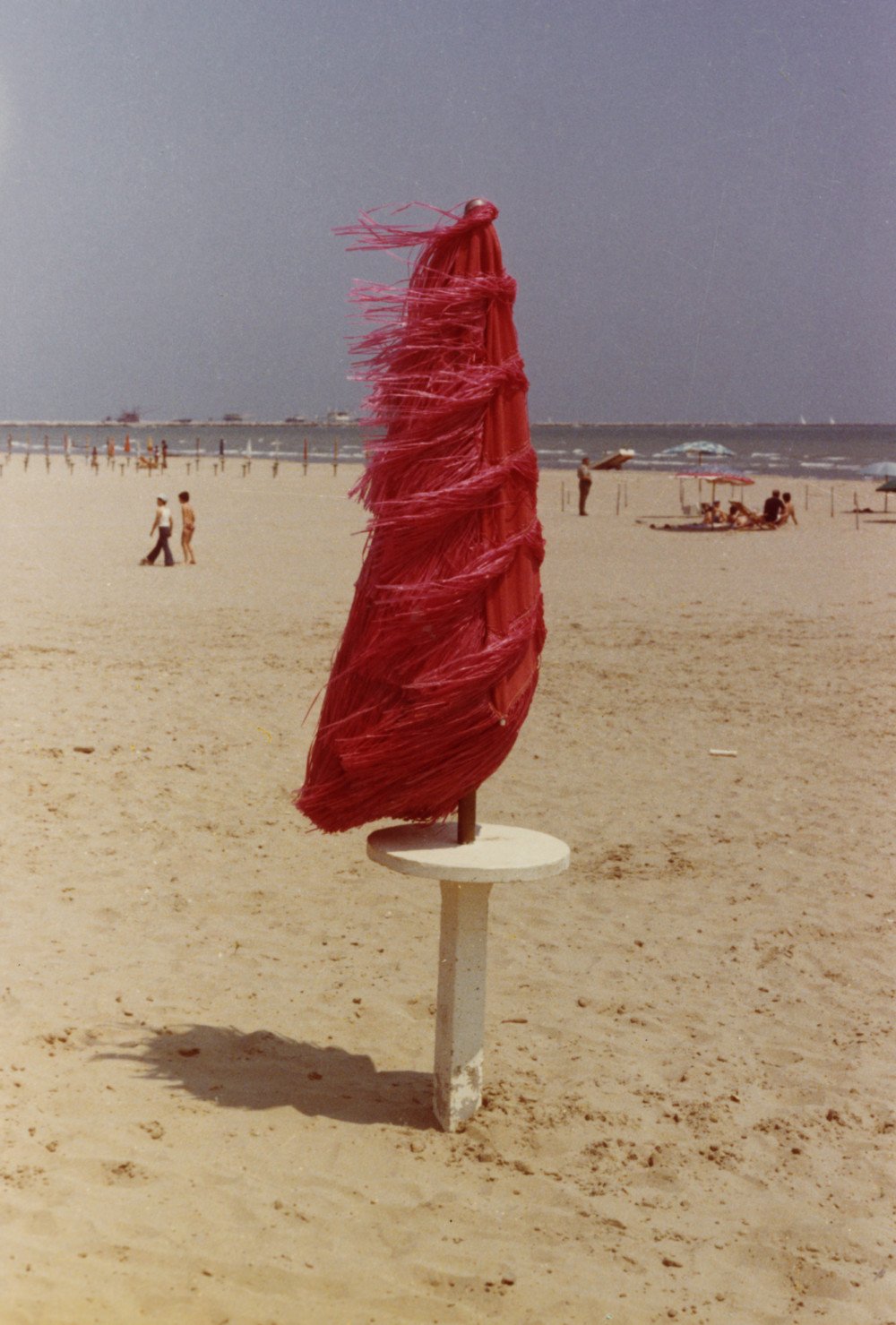
Matthew Marks Gallery · Matthew Marks Gallery
A small colour book
In 1978, in Italy, a colour photobook appeared on a scrap budget. Rough, cheap paper, about a hundred pages. Inside were 92 photographs. The title was Kodachrome, the name of a Kodak colour slide film.
The photographer was Luigi Ghirri. The publisher was Punto e Virgola, founded in 1977 by Ghirri and his wife, Paola Borgonzoni Ghirri. Kodachrome was its first publication and Ghirri's first book. He published it himself.
The pictures were taken in the 1970s, mostly in Italy, some in France and Switzerland. Modena, Bologna, Paris, Versailles, Lucerne. No famous sights. Only street corners, walls, shopfronts, empty beaches.
A world covered in images
At first glance Ghirri's pictures are quiet. Pale colour, direct composition, a lot of empty space. Look closer, and almost every one holds another image inside it.
A billboard printed with a landscape stands in front of a real landscape. A map hangs on a wall in place of the land it depicts. A window reflects the sky. A poster half torn away reveals an older one beneath. The world of Kodachrome is not untouched nature. It has been printed, pasted, painted and drawn over many times.
Ghirri does not photograph these things to mock them. He observes them as a real part of the modern landscape. In 1970s Europe, advertising, signs and postcards already covered daily life. People lived among them as among trees. Ghirri simply put a frame around them, and the viewer suddenly saw what had become too familiar to notice.
The results are funny and a little sad. They show the gap between a place and its image, and show that gap narrowing.
Colour as a choice
In the 1970s colour photography was still often seen as the stuff of advertising and family snapshots. Serious art photography, for many, meant black and white. Choosing colour, and naming the book after a mass market film, was a statement.
Ghirri did not use colour to make pictures prettier. Colour was the material of the world he observed: the colour of posters, of painted walls, of shop signs. Black and white would have erased the very layer he wanted to show.
That is why Kodachrome is often described as a manifesto for colour photography. It shows colour can be a language, not only decoration.
Why the book returned
Kodachrome was out of print for many years. In 2012, twenty years after Ghirri's death, MACK republished it as a facsimile: the same design, text layout and sequence, but scanned anew from Ghirri's original film. The new edition added a booklet with an essay by Francesco Zanot, and French and German translations of the original texts.
In 2013 Matthew Marks Gallery in New York showed vintage colour prints from the series, from 6 March to 20 April. American viewers, used to their own generation of colour photographers, could see a parallel path in Europe.
In the same years, across the Atlantic, Stephen Shore was photographing ordinary American streets in colour. The two did not do the same thing, but they shared a belief: the ordinary, looked at closely enough, is enough to make a picture.
Kodachrome reminds us that the world we live in is already a picture before we raise the camera. The photographer's task is to notice it.
Photography