
Essays · Olfactory Art
Lygia Pape. Luar do Sertão.
A moonlight made of popcorn is still moonlight.
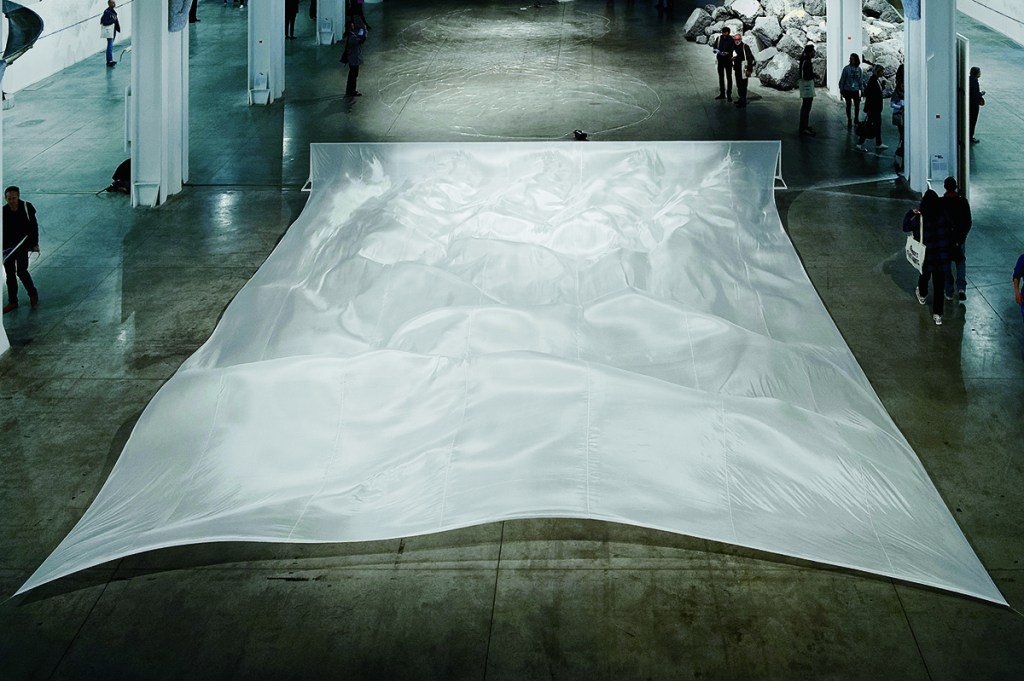
Biennale de Lyon 2017 (exhibition view) · Art in America
A field under violet light
Luar do Sertão is an installation Lygia Pape made in 1995. Its materials come down to two: popcorn and ultraviolet light, the kind that makes white things glow blue violet in the dark.
The popcorn is spread over a wide area of floor. Under the lamps, the white kernels stop looking like food. They glow like sand under the moon, like frost on a field, like a distant land seen at night. Visitors step into a dark room and meet a landscape.
But the landscape has a smell. Toasted corn, cinemas, fairgrounds, street stalls. The eye says one thing, the nose another. And usually the nose knows first.
The title comes from a very popular Brazilian song, Luar do Sertão, associated with the poet Catulo da Paixão Cearense. The sertão is the dry interior of northeastern Brazil, far from the coast and the cities. The song praises the simple life there, its small pleasures, and a moonlight the singer calls the most beautiful of all.
The Biennale de Lyon describes Pape's work as an image both lyrical and ironic: a wander through a moonlit landscape that also evokes Brazilian hopelessness. The sertão of the song is idealised. The real sertão is a place of drought, poverty and waves of migration to the cities.
Popcorn is a sharp choice. Corn is the staple of the poor. Popping it is the cheapest way to turn a handful of kernels into a full hand. Pape builds the song's moonlight from exactly that material. The beauty is real, but it is made from hunger.
An artist of the senses
Lygia Pape was born in 1927 in Nova Friburgo, Brazil, and died in 2004. She was a key figure of the Brazilian avant garde, part of the Neo Concrete movement of the late 1950s alongside artists such as Lygia Clark and Hélio Oiticica. The group wanted art to leave the frame and move into space, into the viewer's body.
From there Pape made many works that needed participants. Divisor is a famous example: a huge white cloth cut with holes, through which people put their heads and move together as one body. She cared about the senses closest to the body, such as touch and taste, which Western art once ranked below sight.
Luar do Sertão came late in her career but carries the same spirit. It asks for no theory. Only that visitors enter, look, and breathe.
Lyon, 2017
In 2017 Luar do Sertão was shown again at the Biennale de Lyon with two other works by Pape. New House, 2000, is a structure evoking a favela house slowly falling apart. Divisor was performed again on the weekend of 14 and 15 October, in Lyon and at MAGASIN in Grenoble, with local residents standing together under the white cloth.
Together the three works share a thread. A house collapsing. A crowd divided by cloth yet moving as one. A moonlight made of popcorn. In each, beauty comes with fragility, and what is destroyed is part of what is born.
In Lyon, half a world from Brazil, few visitors would know the song about the sertão. But everyone knows the smell of popcorn. Like the spice filled rooms of Ernesto Neto, another Brazilian artist, smell crosses language. Visitors may not understand the lyrics. They still stand under that moon.
Olfactory Art