
Essays · Modern Art
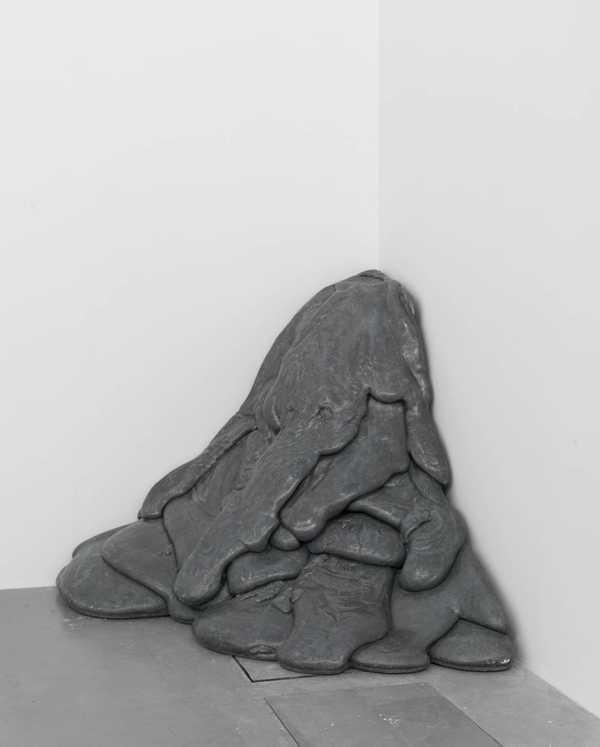
Lynda Benglis. Quartered Meteor.
One act of flowing, held in lead.
Tate · Tate
A block of lead shaped like a liquid
From a distance, Quartered Meteor looks like something that has just spilled over and set. Folds pile on one another, thick here, thin there, like a flow of material still looking for a place to rest. Only up close does it read as metal. Tate lists it as lead and steel on a steel base.
The title carries two dates: 1969, and cast in 1975. The form existed in 1969. Only six years later was it carried over into lead. Between those dates sits an interesting question: is a shape born from flowing still itself once it is moved into a material that never flows at room temperature?
Lead is heavy, soft, grey and dull. It does not reflect light the way polished bronze does. It takes light in. A flow made of lead therefore feels very slow, like cooled lava, like a meteor that fell and broke apart, as the title suggests.
Letting the material do its part
In the late 1960s Lynda Benglis became known for poured works. She poured coloured latex straight onto the floor and let it spread into bright pools. She poured polyurethane foam and let it swell, overflow and harden. The artist did not hold a brush. The artist tipped the container.
This way of working hands part of the decision to the material. Viscosity, temperature, the slope of the floor and the pull of the earth make the shape together. Benglis chose the substance, the place and the moment to stop. The rest was gravity's work.
In a conversation published by Tate, Benglis said she did not want to take art to a minimal conclusion. She wanted it to be excessive, about more rather than less. She also described making her linear forms first in plaster and later in metal. Quartered Meteor sits on that path: from an instant gesture to a lasting object.
She said one more thing worth keeping: she was not depicting something, she was making a feeling, a form. The edges suggest their own reading, the way we find things in clouds, in trees, in the shapes of land.
Gravity as a collaborator
At the same time, many American artists were making minimal sculpture: cubes, metal plates, bricks laid in straight lines on the floor. Their forms were calculated, tidy and cool. Benglis went the other way. Her forms were not calculated. They were allowed to happen. In the same generation, Eva Hesse also left the hard block behind for soft materials and irregular forms.
So Quartered Meteor keeps something classical sculpture usually hides: the time of making. Looking at the folds, one can almost guess the order in which the material piled up. Which layer came first. Which slid over which. Where the spreading stopped.
Cast in lead, that process is locked. Nothing flows any more. Yet the shape is still the shape of a flow. The work holds two times at once: a brief moment in 1969 and the open ended stillness of metal.
That is why it still rewards a long look. It tells no story. It shows something plain: some forms do not come from the hand but from a material being allowed to do what it tends to do. The artist stands beside it, close enough to begin, far enough not to interfere.
Modern Art