
Essays · Modern Art
Eva Hesse. Addendum.
Above, the numbers. Below, gravity.
Tate · Tate
Seventeen hemispheres and their cords
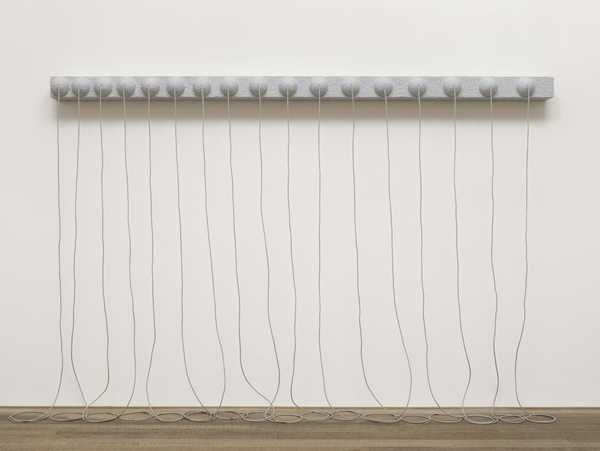
Addendum is a wall sculpture. A wooden bar just over three metres long, coated in the same papier mâché, hangs horizontally. Along it sit seventeen pale grey papier mâché hemispheres. From the centre of each, a length of grey painted rope falls to the floor and coils into unpredictable loops.
The horizontal rhythm of bar and hemispheres works against the vertical fall of the cords. The hemispheres look organic; the rope is manufactured. The piece seems to set a natural form beside a man made one.
The surfaces of bar and hemispheres are uneven, showing pulp added layer upon layer. Hesse did not smooth them or hide the process. That record became part of the composition. Over time the paint has cracked and discoloured.
Eva Hesse, born in Germany in 1936, worked in the United States and died in 1970. She made Addendum in 1967, while living and working in a loft studio at 134 Bowery, New York.
A number series and a joke
The hemispheres are not evenly spaced. They sit at increasing intervals, following a fixed series Hesse herself described: one eighth, three eighths, five eighths, seven eighths, and on. At the time many artists used serial systems as a way to compose without relying on personal expression.
Hesse chose three units as different in shape as possible: rope, rectangle, hemisphere. She unified them by sequence, by repetition, and by the same rough grey over everything.
Then she deliberately tipped the balance. She specified that the work hang seven feet from the floor. The cords start down in parallel lines, but because of their length they collapse into a random mass on the ground.
Hesse closed her statement on the work with one sentence: "Serial art is another way of repeating absurdity." It was repeated several times, and at first she had meant it to be her only comment.
Art in Series, 1967
Addendum was first shown in Art in Series at the Finch College Museum of Art in New York, November 1967 to January 1968. The show was organised by Elayne Varian and the artist Mel Bochner. Every work was based on arithmetical or serial progressions. Other participants included Donald Judd, Dan Flavin, Robert Smithson and Sol LeWitt.
There was no catalogue. The artists recorded statements for an audio guide. In hers, Hesse said the title meant a thing added or to be added. A title, she said, comes after the fact, and so do explanations. The work exists only for itself.
Reviewing the show in the Village Voice, the critic John Perreault wrote that only Hesse saw, questioned and in a way relished the absurd implications of the new formula. He described the grey cords falling to the floor and tangling together.
Minimal, but soft
Addendum is among Hesse's most minimal works. It has rows, numbers, a single colour. Yet it keeps an organic informality that sets it apart from the austere pieces of many fellow exhibitors. Tate notes that despite her interest in serial ideas, her work always leaned towards the expressive.
The size and height of the piece, and the coils spilling into the viewer's space, give it an imposing presence. You do not just look at a row of domes on a wall. You watch your step around the rope on the floor.
Tate bought the work in 1979. More than half a century on, what makes Addendum stay is that simple moment: a carefully counted system, and gravity quietly softening it.

Modern Art