
Essays · Modern Art
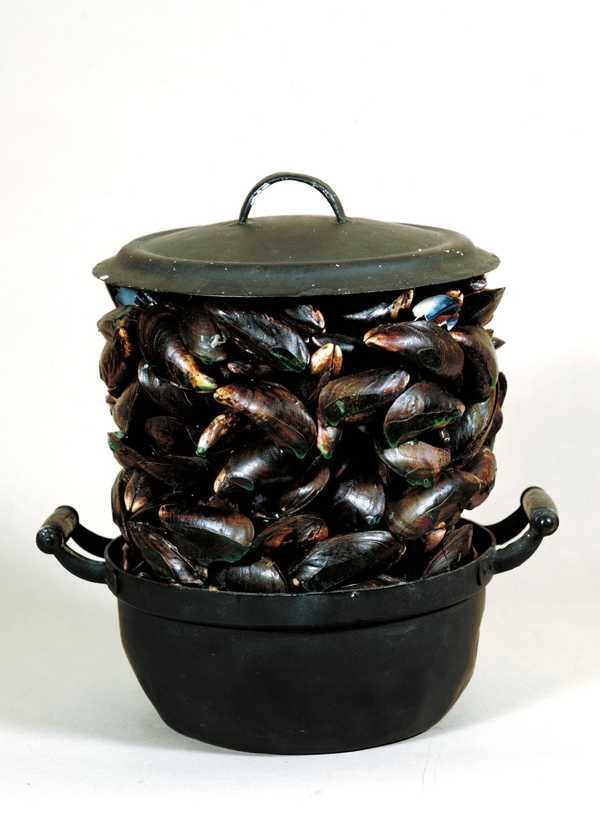
Marcel Broodthaers. Casserole and Closed Mussels.
An empty shell still holds the shape of what lived inside.
Tate · Tate
A pot full of shells
Casserole and Closed Mussels was made in 1964. Tate, which holds the work, lists its materials: mussel shells, pigment, polyester resin, and an iron casserole with wooden handles.
Seen in person, it looks like a meal stopped halfway. The pot is the ordinary kitchen kind. Inside, the shells are stacked and fixed with resin into a mass that rises above the rim. The lid cannot close. It sits unsteadily on top, pushed up by the shells.
The shells are all closed. No flesh, no broth, no steam. Only the shape of a meal, set hard.
The title is odd too. In the kitchen, people often say that mussels still closed after cooking should be thrown away. Broodthaers built an entire work from closed shells. No one can say for sure whether he had that rule in mind. But the work leaves the possibility open: what is on display is what should have been discarded.
A poet decides to make objects
Marcel Broodthaers was born in Brussels in 1924 and died in 1976. For about twenty years he was a poet, wrote for newspapers, and did odd jobs around the art world. His poetry sold very little.
In 1964, in his forties, he announced that he would become a visual artist. One of the first things he did was take the unsold copies of his book of poems, Pense-Bête, and set them in plaster. The books could no longer be read, but they became something to look at. That same year he had his first exhibition in Brussels.
The mussel pot comes from that moment. It carries the spirit of someone who has just entered art from outside, looking at the art world with curiosity and suspicion at once. The pot tells no story about the cook. It only presents what is left over.
Mussels, moulds and identity
Steamed mussels are a common dish in Belgium, usually cooked in a large pot and served in it. Putting a pot of mussels in a gallery puts a national emblem where visitors expect a serious work of art.
In French, the word moule means both mussel and mould. Broodthaers loved puns like this. The mussel secretes its own shell to hold its shape. A mould casts identical copies. A culture has its moulds too: the dishes and habits into which everyone born there is poured.
Looking at the fused, inseparable shells, viewers might think of a crowd, a collective, or simply a meal too large. Broodthaers does not choose for anyone. He puts the object there and lets the joke do its work.
Satire from the inside
A few years later, from 1968, Broodthaers set up the Musée d'Art Moderne, Département des Aigles, a fictional museum in his own home, with packing crates, postcards and labels. It was a fake museum mocking real ones: how they classify, label, and decide what counts as art.
The mussel pot already holds that attitude. It takes the most ordinary object, places it in the most solemn position, and lets viewers wonder why they are standing respectfully before a pot of shells.
Broodthaers was not the only one bringing food into art in the 1960s. Daniel Spoerri glued whole tables after dinner to the wall. But Broodthaers' pot is quieter. Almost silent. A meal that is over, and a shell that refuses to disappear.
Modern Art