
Essays · Olfactory Art
Massimo Bartolini. Toscano.
A cigar smoked with no one smoking it.
Art in America · Art in America
A breathing machine
Toscano is a small object. About eighty centimetres long, under twenty high. A cigar, a vacuum pump, a mouthpiece. The pump draws air through the cigar the way a person draws on it. The tip glows. Smoke rises.
The cigar is an Italian Toscano, small, dark and known for its heavy smell. Massimo Bartolini, an Italian artist, gave its name to the 2016 work. No other title. The thing is the thing.
No smoker. No performance. The machine works quietly, and what visitors notice is the smell. It spreads through the gallery, into corners where the machine cannot be seen, onto anyone who walks through the door.
A work like this does not need to be looked at for long. It needs to be smelled, and it reaches the visitor before the visitor reaches it.
The region of song and smoke
Toscano was part of Bartolini's exhibition Golden Square at Frith Street Gallery in London, from 25 May to 30 July 2016. The gallery has two spaces, one on Soho Square and one on Golden Square itself, a small square in Soho.
The title comes from Charles Dickens. In Nicholas Nickleby, Dickens describes Golden Square as a region of song and smoke, where gruff voices practising music break the evening quiet and the fumes of choice tobacco scent the air. He also mentions a mournful statue among its few shrubs.
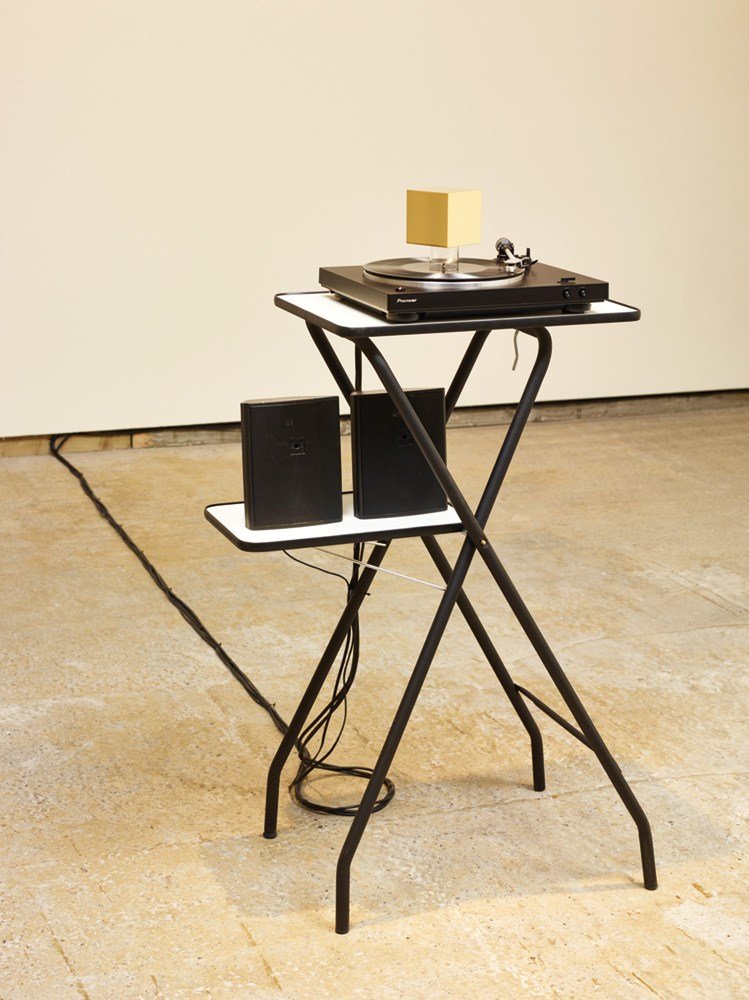
Bartolini rebuilt that passage with real things. The smoke came from Toscano. The song came from a vinyl record also titled Golden Square, a brass cube set at its centre, playing a piece by Edoardo Marraffa inspired by the nursery rhyme Ring a Ring of Roses. The statue was Georgius, a block of grey marble in which a figure seems to sink back into stone.
Visitors moved between the three as if into a page. Not reading it, but smelling and hearing it.
Dust, pins and what cannot be seen
The rest of the exhibition circled things hard to hold. The Dust Chaser series drew particles of dust in ink. Diagram (graveyard) laid out a cemetery plan in four thousand map pins. Two marble plinths carried paper airplanes in low relief, set like memorials. A red neon enlarged a line of graffiti from an Inquisition prison wall.
Beside them, Toscano was the one work that did not stay in its place. Dust was drawn. The graveyard was pinned. The smoke actually drifted.
That is the difference. Toscano does not depict something invisible. It produces it, continuously, for as long as the gallery is open.
The smell of a place
Tobacco is rarely a neutral smell. For some it is warm, a grandfather's study. For others it is stale, an old pub. Bartolini takes no side. He simply lets the smell return to a district that, by Dickens's account, was once full of smoke.
The reverse can be seen in Heman Chong's smoking corner in Seoul, where the smell came from real visitors lighting up. Bartolini removes the people and keeps only the result.
Since 2007, England has banned smoking in enclosed public places. The smell of tobacco has nearly vanished from closed rooms. A cigar machine in a gallery does more than recall a passage. It brings a smell that was pushed out of rooms back inside one.
Toscano lasts because it shows that a smell can be an address. Dickens's Golden Square had a smell. Bartolini found it again, not by describing it, but by burning a real cigar, one draw at a time, with no one there to smoke it.
Olfactory Art