
Essays · Contemporary Art
Michael Landy. Break Down.
A life, counted item by item, then erased.
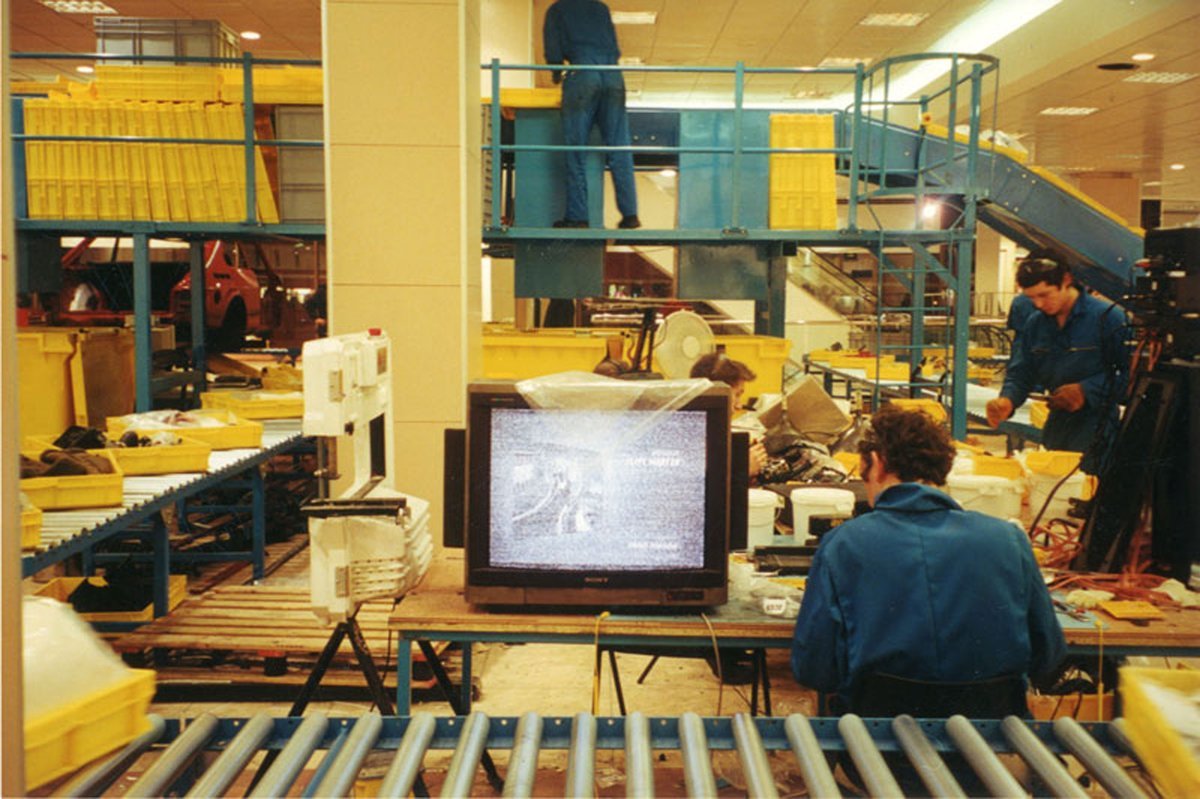
courtesy Artangel · Artangel
An empty store, a temporary factory
In February 2001, the former C&A department store on Oxford Street in London opened again. Not to sell anything. From 10 to 24 February, it housed a material reclamation factory built for a single work.
At its centre ran a conveyor system 100 metres long, carrying yellow trays. In the trays were the belongings of the artist Michael Landy. All of them.
Landy and 12 operatives, whom he called his disciples, worked for two weeks. Each item was taken apart, broken, pulped or granulated. Passers by could walk in and watch.
The title, Break Down, means to destroy, to collapse, and to analyse into parts. All three meanings were present in that room.
A year of counting
The least visible part of the work took the longest. Before destroying anything, Landy spent a year making an inventory of everything he owned. It came to 7,227 items.
He sorted them into categories: artworks, clothing, equipment, furniture, kitchen, leisure, motor vehicle, perishables, reading material, studio material. Each item had its own code, logged like stock in a warehouse.
The motor vehicle category held a single entry: his cherry red Saab 900. It was taken apart like everything else.
The artworks were not spared either. No exceptions. With an exception, the work would no longer be the whole. An inventory only means something when it counts everything, down to the smallest thing in a drawer.
The cost of owning
Oxford Street is one of the busiest shopping streets in Europe. Placing the work there, in a former clothing store, was a clear choice. Outside, people were buying. Inside, one man was letting go of everything he had ever bought.
Yet Break Down is not a lecture on consumption. No slogans on the walls. Only the steady belt, the yellow trays, the sound of the shredders.
Visitors made the comparison themselves. They watched things pass, a coat, something from a kitchen, a book, and wondered how many such things they had at home. How long it would take them to count.
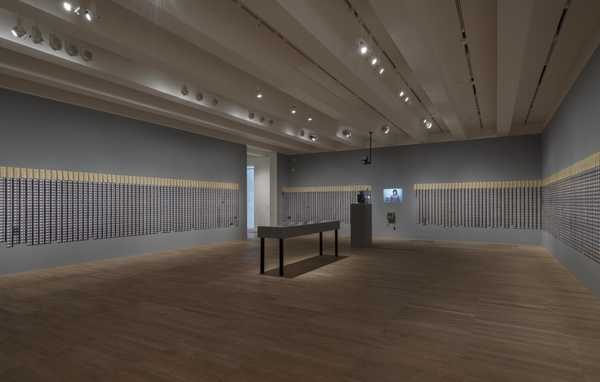
A year later, in 2002, the full inventory was published as a book. The objects are gone. Their list remains.
When nothing is left
At the end of the fourteenth day, Landy owned nothing. That was the end of the work, and the question it leaves: what is a person without possessions?
One could answer that people are not things. The work shows it is not so simple. Objects hold memories, relationships, work, habits. A letter keeps a friend. A coat keeps a season. Losing them is not losing memory, but losing a place for memory to cling to.
Break Down stays with us because it does what most of us only consider for a moment while moving house. It carries it through to the end, in public, systematically.
Like other works that exist briefly and vanish, such as Kara Walker's sugar sculpture, what remains after Break Down is not an object. It is the memory of those who stood and watched.
Contemporary Art