
Essays · Contemporary Art
Mike Nelson. The Coral Reef.
An empty room is still full of people.
Tate · Tate
Fifteen rooms
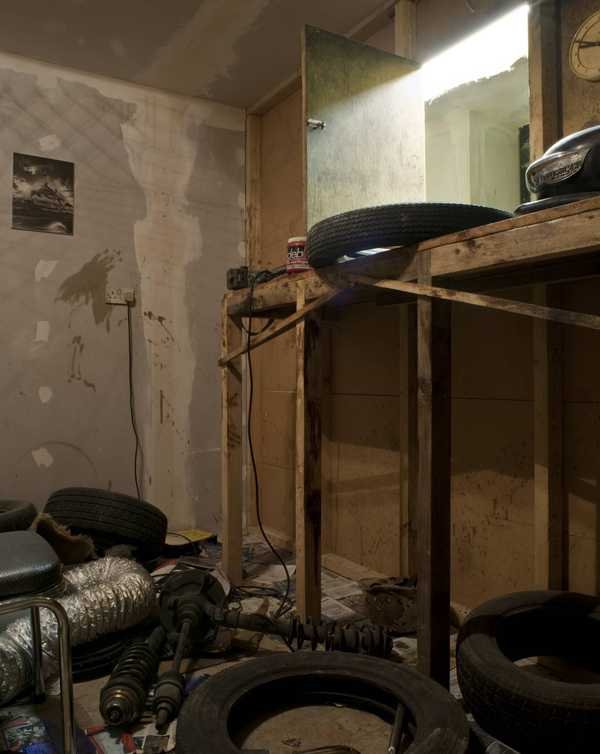
The Coral Reef was made in 2000. Tate, which holds the work, lists its materials like an inventory: fifteen rooms, lights, columns, chairs, mirrors, printed papers and other materials. The first figure says almost everything. This is not an object placed in a room. It is the rooms.
Visitors step through a door and find themselves in a waiting room, the kind that belongs to a cheap minicab office. Chairs, a desk, papers, a light. Then another door leads to another room. Then another. There is a prayer room. There is a room whose print Tate later acquired under the title Heroin Room.
The rooms are joined by doors, one opening onto the next. There is no map. No arrows to the exit. After a few rooms, visitors are no longer sure where they have been, or whether they are near the first door or far from it.
People who have just left
The strangest thing about The Coral Reef is that every room seems recently occupied. A chair pushed back from a desk. A paper left half read. A mirror reflecting an empty room. Visitors always arrive a few minutes too late.
The rooms belong to lives on the margins: cab drivers, people praying far from home, addicts. Nelson does not reconstruct any particular story. He builds the setting in which such stories could happen.
Because no one is there, visitors become the only ones present. They look into drawers, read the paper on the desk, try a chair. Slowly they realise they are doing something slightly wrong: entering someone's life while they are out.
That feeling of trespass is part of the work. Nelson does not let viewers stand outside and admire. He puts them inside and lets them feel awkward.
A name from the sea
Mike Nelson was born in Britain in 1967. He is known for large architectural installations built from used, found and salvaged things, assembled into spaces that feel almost real. He was twice shortlisted for the Turner Prize and represented Britain at the Venice Biennale in 2011.
The title The Coral Reef suggests something offshore, far from shabby rooms on land. Perhaps that distance is the point. A reef is a structure grown from countless small bodies, layer upon dead layer. It lives on what has passed.
Nelson's fifteen rooms grow the same way. Each is a layer of abandoned life. Alone, none is remarkable. Joined, they become a terrain one can get lost in.
Lost in a real maze
Many installations build spaces to be looked at. The Coral Reef builds a space to get lost in. Those are different things. Looking means standing still. Getting lost uses the whole body: legs moving from door to door, eyes adjusting to each kind of light.
Like Ilya Kabakov's corridor, Nelson's maze has no centre to reach. Walking through every room leads to no answer. It only returns visitors to where they started, with the sense of having seen too much and understood nothing.
On the way out, people usually carry one tiny detail: a chair, a sheet of paper, a wall colour. The work is vast, yet what lasts longest are the fragments.
Contemporary Art