
Essays · Olfactory Art
Milica Zec, Winslow Porter. Tree VR.
A tree goes nowhere. It stays, and bears everything.
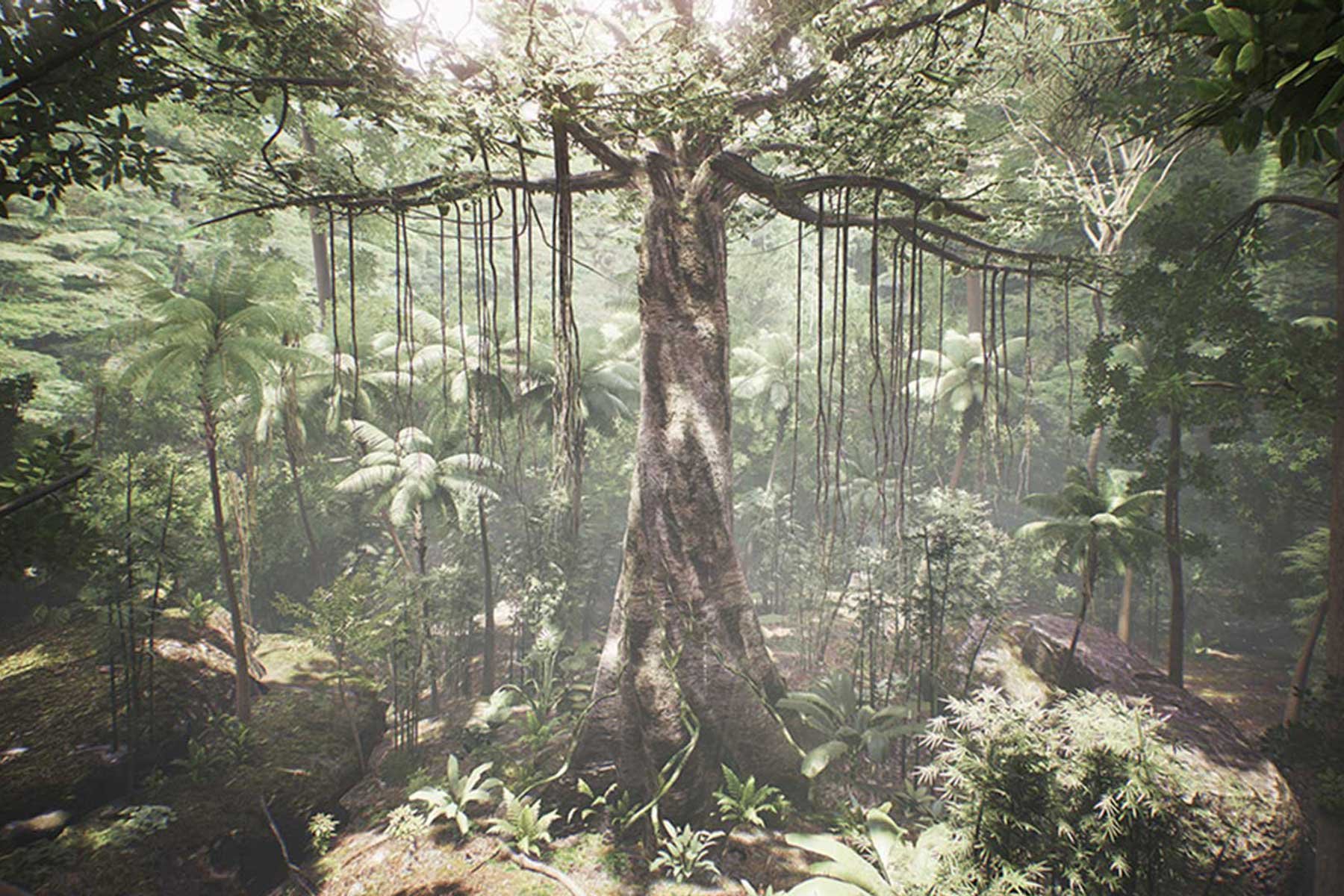
Courtesy the artists / Institute for Art and Olfaction · Tree (official project site)
Plant a seed, become a tree
Before putting on the headset, viewers are asked to plant a real seed. A small gesture, a few seconds. Then the screen comes on, and they are no longer human.
They begin as a sprout breaking through the floor of a tropical rainforest. Their arms become branches. Their body becomes a trunk. They grow, pass through the understory, reach the canopy. Birds cross, rain falls, the light shifts through the day. The viewer cannot walk anywhere. A tree has no legs.
A whole life is compressed into a few minutes. Then comes its fate. The work does not end in a peaceful old age. The tree falls, and the viewer, standing in its place, feels it with the whole body. A review quoted on the project's site recalls one woman leaving the headset in tears, having become the tree that fell.
Tree is by directors Milica Zec and Winslow Porter and produced by New Reality Company. It premiered in 2017 at the Sundance Film Festival, then travelled to Tribeca, Cannes and TED in Vancouver the same year.
Smell, wind, heat
The images are only half of it. The other half belongs to senses virtual reality usually ignores. According to the project's official site, Tree uses vibration, temperature, wind from fans, surround sound, and an automated scent delivery system.
Scent is released scene by scene: earth when the tree is a sprout, forest when it has grown tall. The scent technology is credited to Emanuela Maggioni of OWidgets. According to the Art and Olfaction Awards nomination, the scent itself was created by Laurent Le Guernec, a perfumer at IFF.
Why smell? However beautiful the image in the headset, a distance remains: the eye knows it is looking at a screen. Smell does not cross that distance. It goes straight in. When the nose picks up damp earth, the body simply believes the ground is there.
In 2020 Tree was a finalist for the Sadakichi Award of the Art and Olfaction Awards, which recognises experimental work with scent. A virtual reality piece judged alongside scent installations shows that smell here is not a side effect. It is part of the structure.
From film festivals to Davos
After the festivals, Tree went where few would expect an artwork to go. The World Economic Forum brought it to meetings in Tianjin in 2018, Davos in 2019 and 2020, and Cape Town in 2019. It was also shown at the United Nations General Assembly in 2019 and at Burning Man.
The project works with the Rainforest Alliance, with the message that forests are among humanity's most important defences against climate change.
Tree can be read as an advocacy piece. But its weight does not lie in the message. Messages about forests are everywhere, in reports, documentaries, statistics. What Tree does differently is place the viewer exactly where the tree is, long enough to learn that a tree cannot step aside.
Trading places with another species
Art usually lets the viewer stand outside and look in. Tree does the reverse. It makes the viewer the subject. We do not look at the tree. We are the tree, and what we look at is the forest, the rain, whatever is coming.
That exchange only works if the body is convinced. This is why the other senses are brought in. Vibration underfoot, wind on the face, heat, and smell. Each removes a layer of doubt.
Another work centred on a tree is Ernesto Neto's GaiaMotherTree, where visitors step inside a tree form made of fabric. The two works take different routes, one through knotted cord, one through technology, but ask the same thing: to come close enough to a tree to forget you are standing outside it.
Olfactory Art