
Essays · Olfactory Art
Nose to Nose. Contemporary Perfumers.
A scent has no shape. The room must.
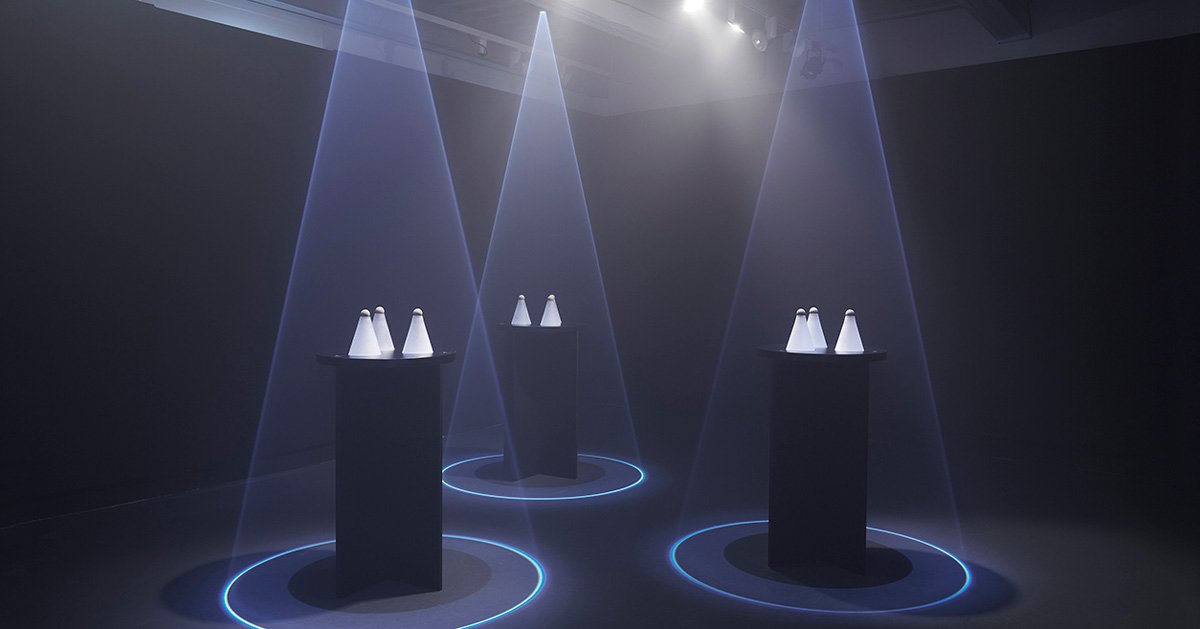
Photo: Daniela Droz and Tonatiuh Ambrosetti · designboom
Thirteen noses
From 15 February to 16 June 2019, mudac, the museum of contemporary design and applied arts in Lausanne, Switzerland, held Nez à nez. Parfumeurs contemporains, in English Nose to Nose. Contemporary Perfumers.
It was made with Nez, a French magazine devoted to scent and smell, which helped choose the people and the scents. The result was thirteen contemporary perfumers of different styles and career stages, men and women.
Among them were Jean-Claude Ellena and Céline Ellena, Dominique Ropion, Isabelle Doyen, Olivia Giacobetti, Vero Kern, Rodrigo Flores-Roux, Patricia de Nicolaï, Marc-Antoine Corticchiato, Pierre Guillaume, Fabrice Pellegrin and Maurice Roucel. Some work for large fashion houses, some for their own small labels.
The title is a play on words. Nez is French for nose, and also what the trade calls a perfumer. Nez à nez means face to face, but here it is nose to nose: the visitor stands before each maker with only a little air between them.
Glithero's six rooms
The design went to Glithero, the London studio of Sarah van Gameren and Tim Simpson. They made six olfactory installations across the museum's rooms. The aim, as the show put it, was to make the immateriality of perfume tangible.
Each room grouped perfumers by a way of working. In the room for the more outgoing perfumers, scented fans rose out of the tables. Visitors lifted a fan, waved it, and the scent came on a small breeze.
In the room for new approaches, scents sat in conical glass vessels stoppered with ping pong balls, each tied by a string to a helium balloon floating above. Pull the string, the stopper lifts, the scent escapes. Each sniff became a small, deliberate gesture.
In the room for historic formulas, the centre was a stained glass window depicting perfume bottles through the centuries. Light passed through the glass and fell in colours on the scent vessels below. At the heart of the show was a reading room, with interviews and material on the craft.
A design museum smells perfume
Perfume is usually shown in shops, not museums. When it does enter a museum, it tends to appear as bottles and advertising, the visible part. Nez à nez did otherwise. Bottles were almost absent. What was on show was the scent, and the people who made it.
Placing it in a design museum mattered too. It treated perfume as a product of design: materials, process, a designer. The perfumer appears as a creative professional, like an architect or an industrial designer.
In 2012 in New York, Chandler Burr's The Art of Scent took a similar line, showing scent in almost bare white wall niches. Nez à nez went the other way in form. Instead of removing objects, it designed an object for each way of smelling.
Both answer the same question: how do you exhibit something invisible? One says: leave it empty and let the nose work. The other says: give the nose something to reach for. In Lausanne, the fan, the string and the coloured glass were all invitations to lean in and breathe.
Olfactory Art