
Essays · Olfactory Art
Olivia Giacobetti. A tree and its shade.
Not the tree. The air around it.
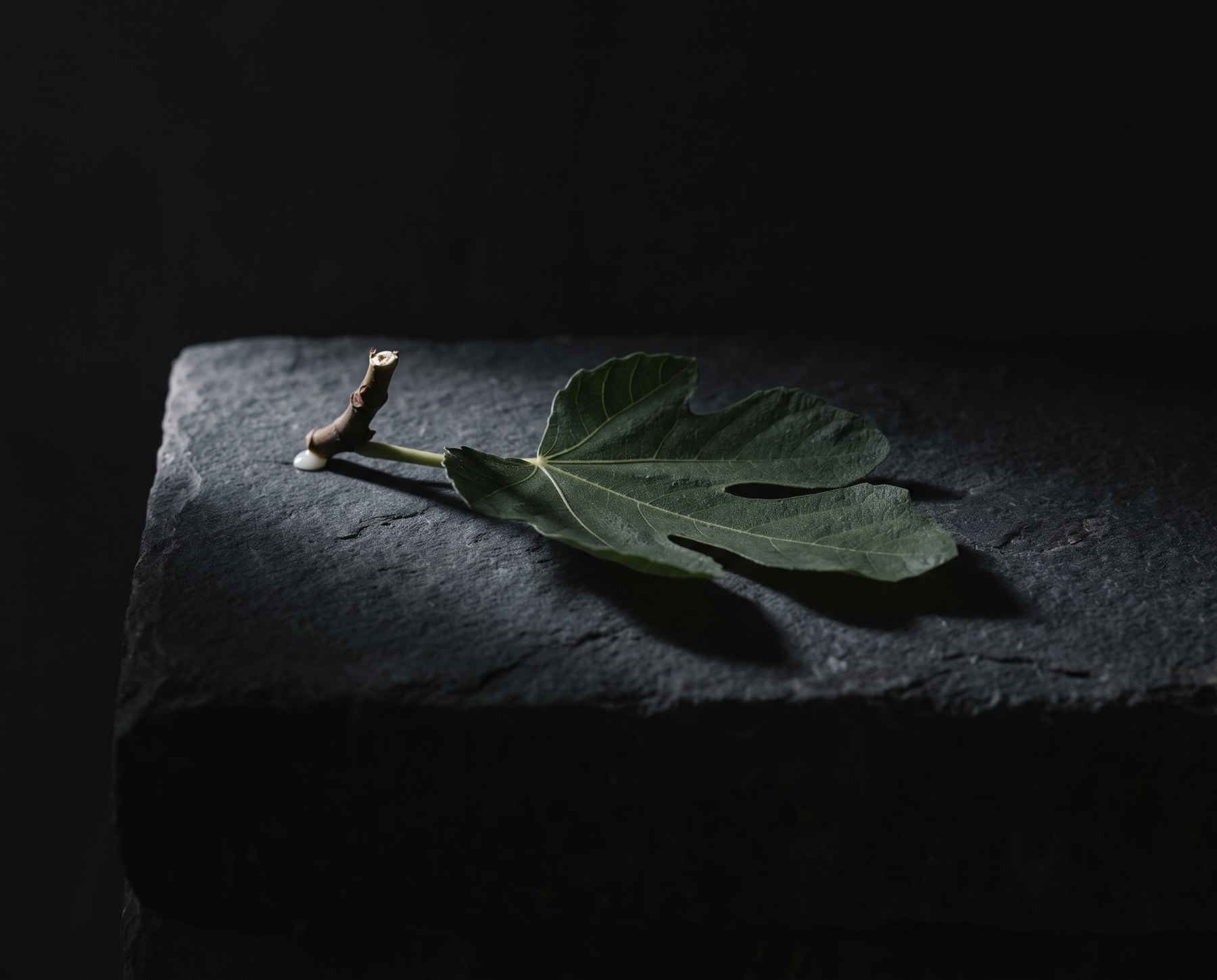
Premier Figuier: the fig tree as a place
In 1994 L'Artisan Parfumeur released Premier Figuier, made by Olivia Giacobetti. The name states the subject plainly: the fig tree. Not a flower, not a precious wood. A tree familiar from gardens around the Mediterranean, growing against walls, broad in its crown, with leaves the size of a hand.
Until then, perfume had rarely taken a fruit tree as its subject. Rose, jasmine, sandalwood and oakmoss were the familiar names. The fig was not. It has no flowers to look at, because its flowers are hidden inside the fruit. It has only leaves, sap, wood and ripe fruit.
So Premier Figuier could not be a copy of a flower. It had to be a record of a place. The person smelling it does not stand before an object on a table. They stand under a canopy, at midday, with the sun somewhere overhead.
Fig later appeared at many other houses. Diptyque has Philosykos, also by Giacobetti, released a few years later. Fig became a theme of its own. But the first bottle keeps one thing: it began with looking closely at a tree, not with a ready formula.
Leaf, sap, wood: an object with many sides
A fig tree has several smells at once. Crushed leaves smell green, a little bitter, a little sweet like hay. A snapped stem weeps a milky white sap, sticky, with a smell of its own. Bark and branches smell faintly of wood. Ripe fruit smells soft and sweet, close to honey.
Premier Figuier does not pick one of these sides. It holds several at once and lets them sit next to each other. You might notice the leaf first, then the sap, then the wood. Or the other way round. The order is not fixed, like walking around a tree and seeing a different side with each step.
It is a way of looking close to photography: no angle is the only angle. A tree is not one image. It is the sum of every look.
It also departs from the habits of its day. There is no large floral mass in the middle for everything to circle. Only pieces of a tree, spaced out, enough for the person smelling to put them together.
Sparse scents: the gap as material
Giacobetti is known for clear, light scents, often described as airy, as if they had air inside them. In 2000 she made En Passant for Éditions de Parfums Frédéric Malle, a lilac that travels with the smell of wheat and water. In 2017 En Passant was one of ten contemporary scents chosen for the Perfume exhibition at Somerset House in London.
In these scents the gap is a material. It is not filled. It is kept, like a rest in music, like the white paper left around an ink drawing.
A dense scent says a lot. A sparse one lets others speak. Giacobetti chose the second way, and so her work tends to attach to a place, a season, a passing moment, more than to one particular flower.
En Passant means in passing. The name describes how these scents appear: they do not stand still in front of you. They pass by and leave a trail.
The air around the object
Looking back, Premier Figuier and Giacobetti's later work share one idea: an object never stands alone. A tree stands in air, in sunlight, beside a wall. Its smell is all of those things together.
That is why a fig scent can bring back a whole summer. It records not only leaf and sap, but the heat of midday, the damp of the soil, the shade under the branches.
In the history of perfume, some bottles changed how molecules were used, some changed how scents were named. Premier Figuier changed how to look. It showed that a scent can be the portrait of a place, not only of an object.
Giacobetti paints the air around things. More than thirty years on, that air can still be smelled.

Olfactory Art