
Essays · Contemporary Art
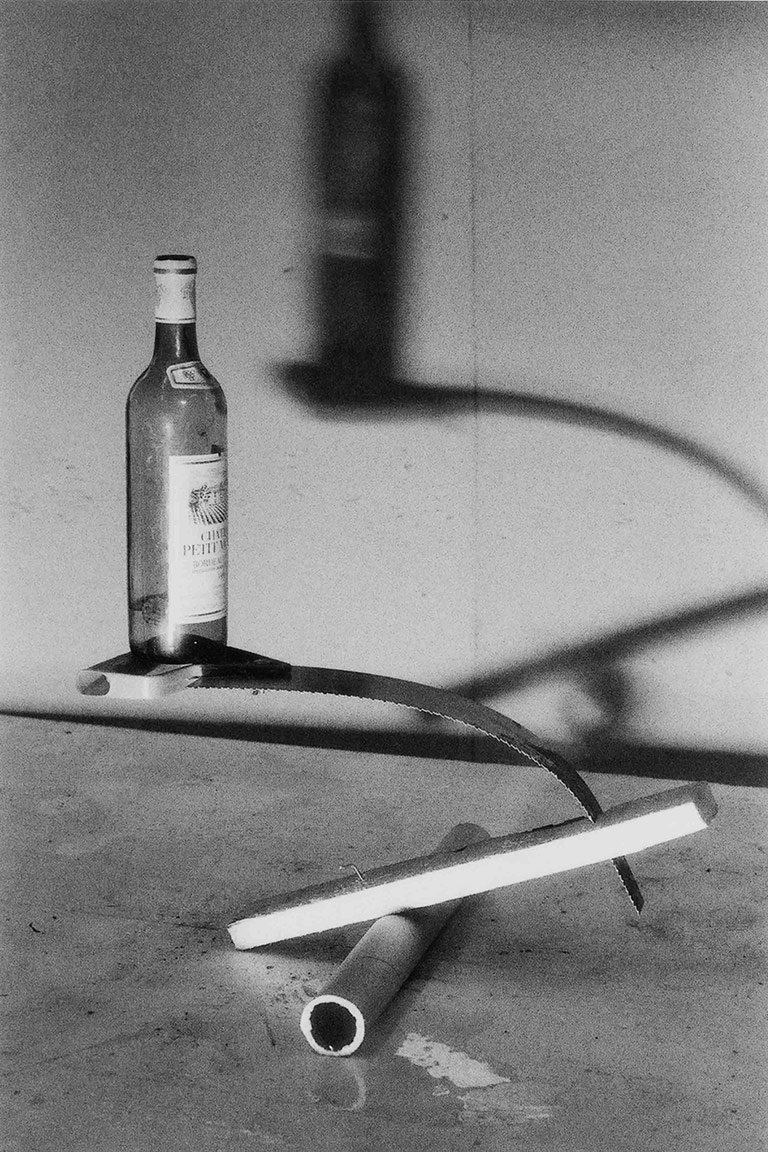
Peter Fischli and David Weiss. Equilibres (Quiet Afternoon).
Balance is real for only a moment.
Guggenheim · Guggenheim
A quiet afternoon in the studio
Between 1984 and 1986, the Swiss artists Peter Fischli and David Weiss spent many afternoons in the studio doing something that looked like a game. They took whatever was around them: soup ladles, brooms, chairs, wine bottles, cutlery, leftovers from other projects. Then they stacked them, leaned them against each other, hung them from each other.
Each structure stood for a very short time. A bottle on the rim of a plate. A chair tilted on one leg, held by a broom. A fork as a counterweight to a ladle. Before it all fell, they took a photograph.
Then they took it apart. Or let it fall.
The series is called Equilibres, French for balances. There are 82 photographs, in black and white and in colour. A selection was first shown in 1985 in Cologne, then at the Kunsthalle Basel and the Groninger Museum, under the title Stiller Nachmittag, A Quiet Afternoon, with an artists' book of the same name.
The photograph is all that remains
The assemblages in Equilibres no longer exist. They were never glued, welded or fixed. They stood by gravity, friction and patience. When the picture was taken, their work was done.
So the photograph is not a record of a sculpture. It is the work. It is the only proof that the ladle once stood upright on its handle, that the chair once did not fall.
The viewer knows at once that what they are seeing is gone. Each frame carries a tension. The eye looks for the point of support, the spot about to slip. We can almost hear the crash coming, but it never comes, because the picture stops just before.
The artists gave the series a subtitle to the effect that balance is most beautiful just before it collapses. It is a joke, and also a serious remark about time.
Funny and serious
Fischli and Weiss worked together from the late 1970s until Weiss died in 2012. Their work often passes through the most ordinary objects: kitchen tools, workshop tools, things no one looks at closely. They did not raise these things into symbols. They let them do slightly absurd things.
Equilibres looks playful, and the titles of the photographs often carry a comic tone. Behind the joke is a real question: what holds a thing up? Itself, or the things around it? Each assemblage is a small system in which removing one element brings down the rest.
The method matters too. No drawings in advance. Two people trying, failing, trying again. Many structures fell before they could be photographed. The pictures that remain are the lucky ones, when hands and gravity agreed for a second.
The series came before their best known work, the 1987 film Der Lauf der Dinge, in which objects knock into each other in a long chain reaction. Equilibres is the still version of the same thought: just before movement, everything holds.
Why it stays
Equilibres shows that a work can live for a few seconds and still leave something lasting. It shows that household objects need not be changed to become worth looking at. They only need another place, another position, another moment.
Set beside the still objects of Morandi's studio, these pictures show two very different ways of looking. On one side, bottles that stood still for decades. On the other, bottles that stood for a second. Both make us look longer at familiar things.
And both remind us that standing still is not the natural state of things. It is an event.
Contemporary Art