
Essays · Olfactory Art
Regina Mamou. Hang Our Gods.
One material, two histories.
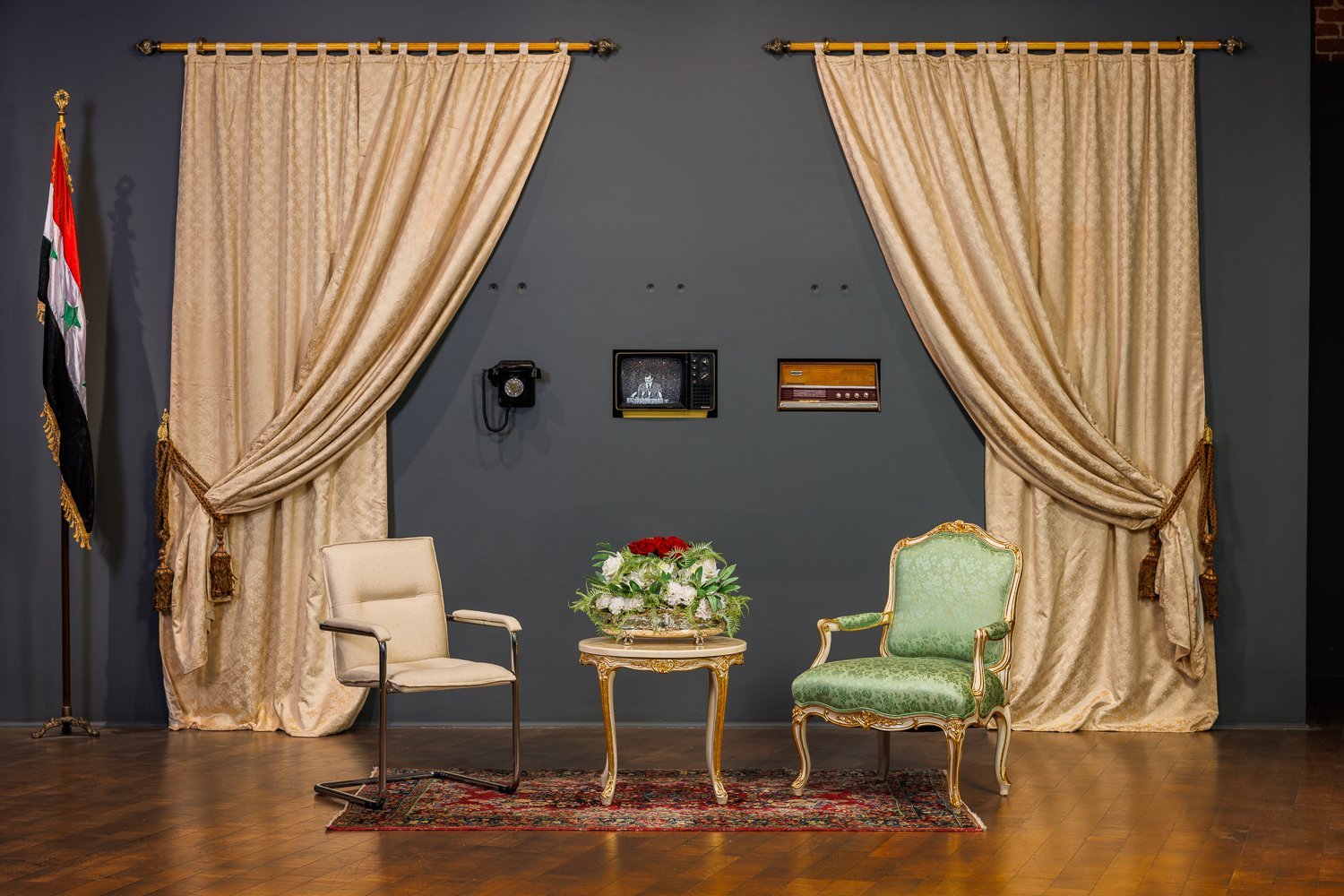
Photo courtesy of Craft Contemporary, Los Angeles · Regina Mamou (official site)
A room around 1980
From 31 May to 26 October 2025, Craft Contemporary in Los Angeles held the exhibition Ether: Aromatic Mythologies, about myths bound up with smell. One of its works was a site specific installation by Regina Mamou called Hang Our Gods.
Mamou recreates a diplomatic setting from Ba'athist Iraq, around 1980. A reception room, with objects of the period: a telephone, a television, a radio. At first glance it is a formal, quiet room.
But every object in it is speaking. And behind the walls, smells wait to be released. The room is a stage set for politeness; what it holds is not polite at all.
Three objects, three voices
The telephone is a Bakelite rotary model from the 1930s or 1940s. Lift the receiver and you hear the royal inscriptions of Nebuchadnezzar II, ruler of ancient Babylon. The choice has a reason: Saddam Hussein rebuilt Babylon, and many accounts say the bricks were stamped with his name, as if to place himself in the line of the old kings.
The television is a 1975 cathode ray set. It shows footage of the 1979 purge of the Ba'ath Party, the year Saddam Hussein took power.
The 1960s tube radio plays something far more private: a family cassette recorded in Iraq in 1976, with the voices of the artist's grandfather, cousins and relatives.
Three objects, three layers of time. One of ancient kings. One of politics. One of family. All pass through the same old appliances, in the same room.
Six tinctures, three materials
The scent in the work comes from six tinctures made by the artist in high proof alcohol. As visitors use the objects in the room, smells escape from hidden points behind the walls.
The six tinctures form three pairs, each pair sharing one material. Bitumen gives Divine Seal and Oil Fields. Gypsum gives Archeological Tomb and Mass Grave. Wood ash gives Sacred Offering and Chemical Warfare.
Each pair is a comparison. The same substance from Iraqi ground, half belonging to ancient Mesopotamia, half to the years under Saddam Hussein. Bitumen was used to bind, to coat, to seal. Then the same ground gave up oil, which decided the fate of a whole country. Gypsum covered an ancient tomb, then covered graves with no names.
Smell will not keep quiet
The title, Hang Our Gods, suggests violence against what is sacred. The room suggests the opposite: polite, orderly, correct in diplomatic protocol. The work lives in the gap between the two.
Smell is what breaks that gap. Images can be staged, words can be edited. A smell escaping from behind a wall follows no protocol. It comes close, enters the body, and stays after the visitor has left.
Using smell to speak of political danger is not new. Cildo Meireles's Volátil led visitors into a room smelling of gas. But Hang Our Gods does something else: it does not make a threatening smell. It shows how a familiar, even sacred smell can change meaning when history turns.
Olfactory Art