
Essays · Olfactory Art
Richard Wilson. 20:50.
The eye sees a mirror. The nose knows it is oil.
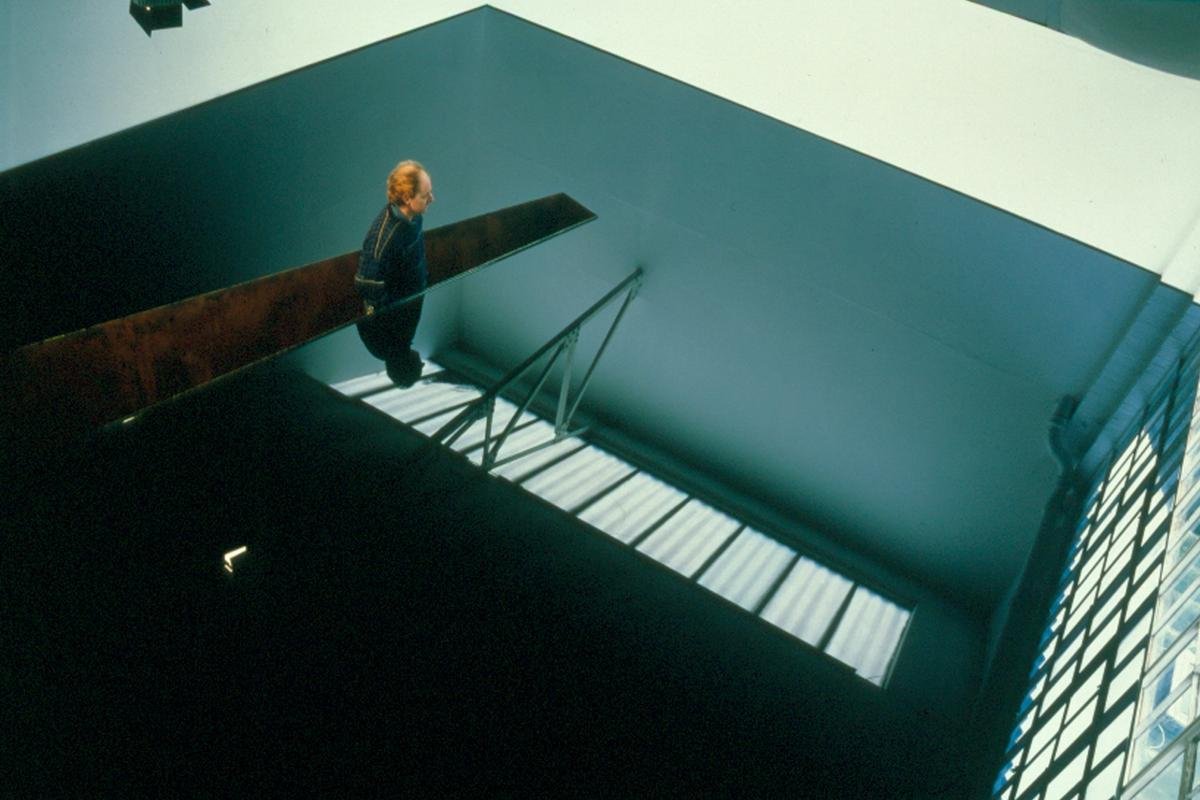
Courtesy Matt's Gallery; © Richard Wilson · Matt's Gallery, London
The room as mould
From 7 to 22 February 1987, Richard Wilson held his second exhibition at Matt's Gallery, then on Martello Street in London. He filled the gallery with about 200 gallons of used sump oil, the kind drained from an engine at an oil change.
According to Matt's Gallery, the room itself became the mould for the oil. Wilson did not build a tank in the middle of the space. He sealed the room and let the oil fill it to a set height, following every corner. The result was a horizontal plane, black, perfectly reflective.
A steel walkway led in from the door. It narrowed as it went, and the deeper one walked, the more the oil closed in on both sides. At the end one seemed to hover between two rooms: a real one above, a reflected one below, identical.
In the same exhibition, on the neighbouring wall, Wilson placed a block of ice. Oil and ice, a liquid and a solid, set side by side as two different ways of stopping time.
A number on an oil can
The title 20:50 is not a time of day. It comes from the grade of recycled engine oil Wilson used, a viscosity number printed on the can. So the title tells no story. It simply names the material.
Used sump oil is something people keep away from. It is black, sticky, impossible to wash out. A drop on a shirt is a permanent mark. In a repair shop it is waste. In Wilson's room it became the closest thing to a mirror anyone had seen.
And it smells. No one walks into 20:50 without noticing. The smell of engine oil hangs thick in the air, heavy, faintly sweet, carrying memories of garages, motorways, hot engines. The image is pure. The smell pulls the visitor back to the industrial world where the material was born.
Two senses say two different things at once. The eye says: this is space, light, geometry. The nose says: this is the residue of thousands of miles of road. The work lives where those two statements meet.
From London to Tasmania
Also in 1987, 20:50 entered the collection of Charles Saatchi. Over the following decades it was installed in several Saatchi Gallery spaces in London, each time to the size of a new room. Because the room is the mould, the shape of the oil changed with every installation.
Later the work was acquired by MONA, the Museum of Old and New Art in Tasmania, where it is installed long term as a fixed part of the museum, no longer drained and refilled with every move. A body of oil that once flooded a small gallery in east London now rests on the other side of the world.
What stays with you about 20:50 is that it needs to tell nothing. No figures, no symbols, no text. Only a material, a room, and the way the visitor walks between them. Wilson let the material do the work: the oil levels itself, reflects itself, gives off its own smell.
Other installations also use smell to draw visitors into a room and then unsettle them, like the talc and the scent of gas in Volátil by Cildo Meireles. 20:50 threatens no one. It only reminds us that the most beautiful thing in the room is also the dirtiest, and that the nose is the one sense not fooled.
Olfactory Art