
Essays · Contemporary Art
Robert Gober. Untitled.
A small patch of skin is enough to know someone is there.
Tate · Tate
A leg in the corner
Robert Gober made this work between 1989 and 1992. It has no title. Tate, which holds it, lists it simply as Untitled.
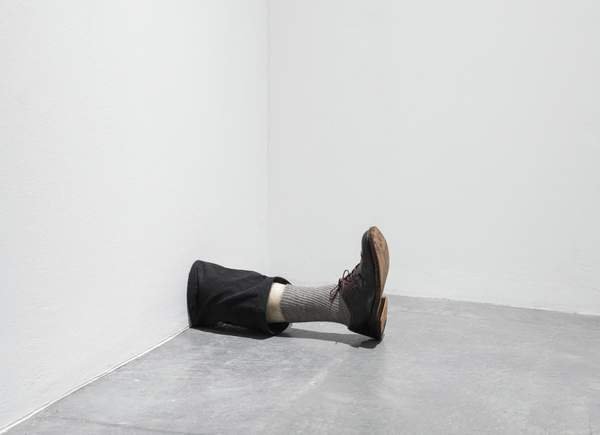
What the viewer sees is a human leg, from the knee down, emerging from the base of a wall, close to the floor. It wears dark trousers, a grey wool sock and a laced leather shoe. Between trouser and sock there is a strip of hairy skin.
The work measures about 30 by 16 by 51.5 centimetres. The size of a real leg. Not enlarged, not reduced.
Tate lists the materials as wax, wood, leather, fabric and human hair. Each is there for a reason. The shoe is leather, the trousers and sock are fabric, the leg is wax.
Beeswax, one hair at a time
Gober has described the process plainly. The leg is a bleached beeswax cast of his own lower leg. The hair is real human hair, bought from a wig supplier.
Each hair was pushed into the warmed wax one by one, with a tool he and his assistants devised in the studio after much trial and error.
That process explains why the work is so unsettling. Wax has a translucency close to skin. The hairs grow in the right direction and density. The viewer does not see a sculpture; they see a leg. Only then do they realise it belongs to no one.
According to Tate, it is one of about ten leg works Gober made over two years. They share an idea and differ in placement: some lie down, some project from walls, some carry strange objects attached to them.
Two memories
Gober has said the series came from two memories.
The first was a story his mother told him when he was small. She had been a nurse. Once, in an operating theatre, she was handed a leg that had just been amputated. The child heard this and kept it.
The second came as an adult. On a flight, a fellow passenger crossed their legs, and the trouser rode up to show a sliver of bare skin between hem and sock. A tiny, ordinary sight, but one that stayed.
The work lays these two memories over each other. One is a body cut apart; the other is a private patch of skin exposed by accident in public. The leg in the corner is both: severed from someone, and also like a person sitting behind the wall of whom we see only a part.
The everyday made strange
Gober often works with very familiar things: sinks, doors, a bed, a bundle of newspapers. He remakes them slowly and carefully until they look real but cannot be used. The leg belongs to the same line. It is something we see every day, placed where we do not expect it.
The late 1980s and early 1990s, when Gober made these legs, were also the years when AIDS was taking many lives in the New York art world. Many writers have read the severed bodies in his work in relation to that loss. The work states nothing directly. It leaves a space for the viewer.
Tate has shown the work in exhibitions on the uncanny and the surreal, such as Mike Kelley: The Uncanny at Tate Liverpool in 2004. Since 2024 it has had its own room in the Materials and Objects display at Tate Modern.
The wax links the work to another thread in contemporary art, where beeswax is used for its own living quality, as in Wolfgang Laib's wax lined room. In Gober, the wax does not fill a room. It shrinks into a small patch of skin near the floor, in the place people usually do not look.



Contemporary Art