
Essays · Olfactory Art
Sensorium 360°.
When the eye steps back, the other senses speak.
Singapore Art Museum · Singapore Art Museum
Beyond vision
From 31 July to 22 October 2014, the Singapore Art Museum presented Sensorium 360°, a group exhibition of contemporary art from Southeast Asia and Asia. The museum's premise was broad: move beyond vision and look at the world through the other senses.
The list of senses went further than the familiar five. Sight, hearing, taste, touch, smell. But also the detection of movement, pain, balance, and the perception of time. The museum set art beside phenomenology, philosophy and cognitive psychology, as if to say that questions about the senses belong to no single field.
Eleven artists took part. Bùi Công Khánh. Lavender Chang. Tad Ermitaño. Li Hui. Alecia Neo. Goldie Poblador. Pinaree Sanpitak. Eugene Soh. Linda Solay. Melati Suryodarmo. Mark Wong. They came from across the region, and each chose a sense as a way in.
There was no central work. Visitors moved through the rooms as through different ways of being present in the world.
A cage of light, a pole, a breast of cloth
Li Hui's Cage, made over the years 2006 to 2014, used green lasers and fog to build cages with no material. There were no bars to touch. Yet standing among the lines of light, visitors still felt enclosed, disoriented, anxious. A cage made of light is still a cage to the body.
Melati Suryodarmo brought Alé Lino, a durational performance she had been doing since 2003. She pressed a four metre pole against her solar plexus, just below the chest, and held it there for a long time. The method draws on Javanese ritual meditation and her butoh training. Pain is the material. Moving through pain is the work.
Pinaree Sanpitak showed noon-nom, from 2001 to 2002. It consists of fifty five sculptures in organza and synthetic fibre, shaped like a woman's breast. They are soft, touchable, something to lean on. The breast here is not an image to look at but a form tied to nourishment, sensation and the sacred.
Three works, three different senses: movement and space, pain, touch. None of them needs the eye to do the main work.
A keyboard made of scent
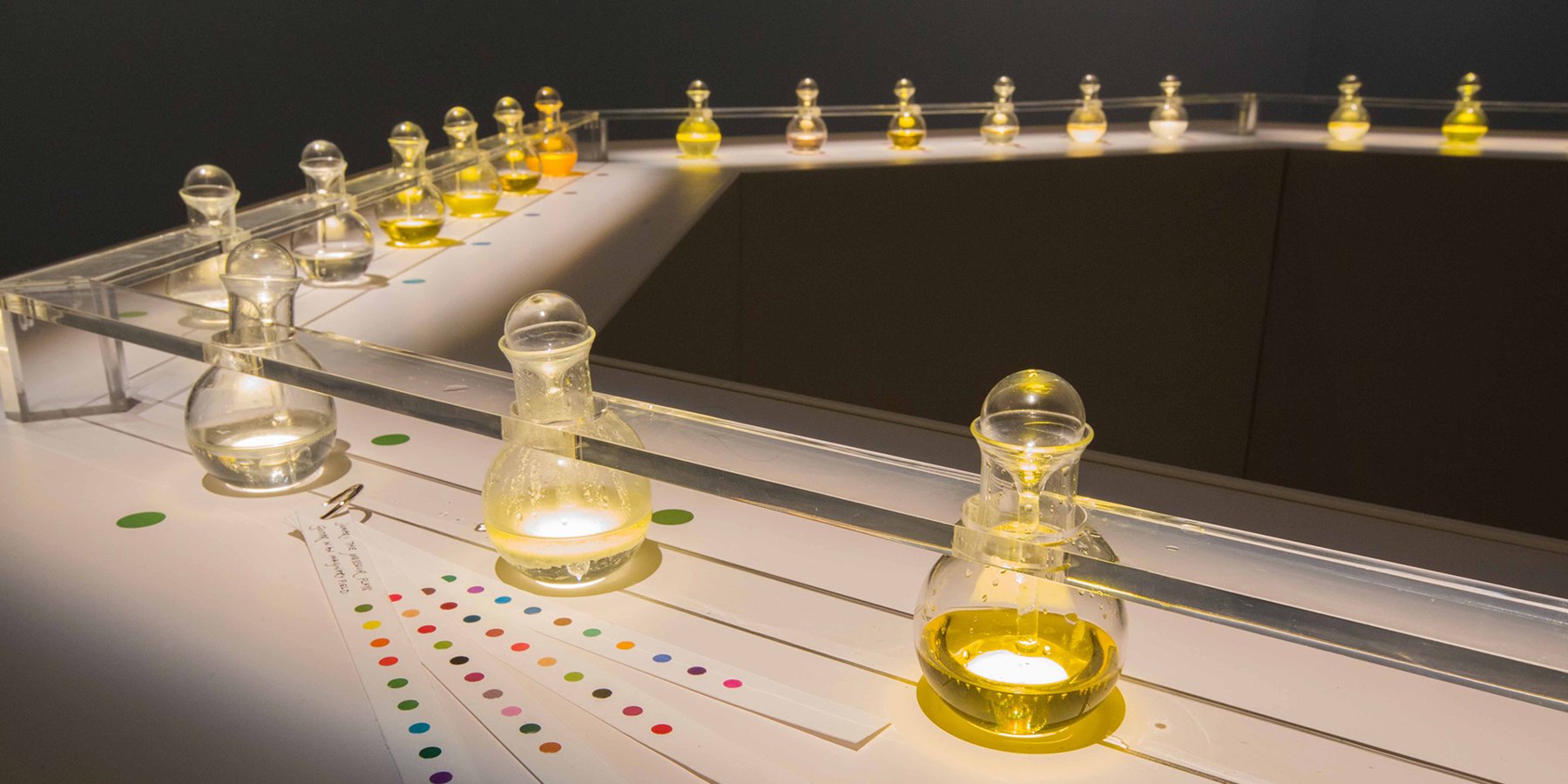
Smell was most present through Goldie Poblador, a Filipino artist whose practice turns on scent, glass, performance and the female body. Her work in Sensorium 360° was May Puno sa Dibdib ng Kamatayan, 2014, roughly: there is a tree in the heart of death.
Poblador built a kind of keyboard in which each key was a perfume. With it she composed scent arrangements in response to four songs and musical arrangements. Music has notes, chords, rhythm. Poblador tested whether smells could be ordered in a similar way. Her answer was yes, but each piece of scent music exists only while it is being smelled, and then it fades.
Poblador went on to work with scent and glass in many other projects, such as Fertility Flowers. At Sensorium 360°, her scents stood in a major museum of the region as an artistic language equal to image and sound.
The exhibition also included a Vietnamese artist. Bùi Công Khánh, born in 1972 in Da Nang, showed Chicken Rice in the Border, 2014. The title joins a dish known across Southeast Asia with the word border. Penta could not find a reliable description of how the work operated, so records only the title. But the title alone places taste in the middle of a story about the lines between countries.
More than ten years later, the question of Sensorium 360° still stands. Which senses do we use to understand the world, and why do museums still so often let only one of them through the door.
Olfactory Art