
Essays · Contemporary Art
Sheela Gowda. Behold.
A single hair can hold on to something.
Tate · Tate
Four kilometres of hair
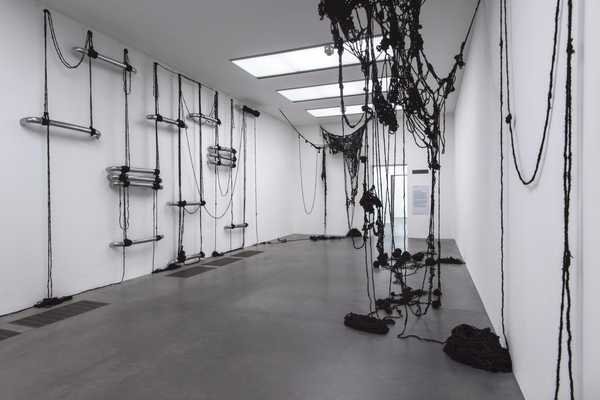
Behold is a large installation by Sheela Gowda, made in 2009. Tate describes it as around four kilometres of hand knotted rope and roughly twenty car bumpers. The rope is braided from human hair.
The bumpers hang on the wall, some alone, some in groups. The hair rope is knotted around the metal, then runs on between the bumpers in uneven loops, large and small. The rest gathers on the floor in piles and coils, and some of it can hang from the ceiling.
The work has no fixed size. It can take over a whole gallery or a single stretch of wall. Each installation is a new arrangement.
From a distance, the viewer sees soft black lines drawn across a white wall, broken by bright blocks of steel. Up close, the lines turn out to be hair.
Two talismans
Gowda lives in Bengaluru, in the southern Indian state of Karnataka. There, hair and bumpers are familiar things. Short strands of hair are often tied around a vehicle's bumper to ward off accidents and bad luck. It is an everyday habit, seen on the street.
Hair also has a life in the temple. Pilgrims shave their heads when fulfilling a vow, as a sign of humility. The hair is given to the temple, where some is woven into talismans and some is sold. Long, dark, untreated Indian hair is in demand for wigs and for keratin used in beauty products, much of it in the West.
The bumpers tell another story. Cars are spreading fast in Indian cities. A new car is a sign of rising up.
Gowda once described the pairing as a meeting of fear, superstition, belief and the need for some comforting act within modern life. The work does not take sides. It lets both be present.
Undone and braided again
According to the curator Trevor Smith, Gowda unpicks the short strands from the talismans and braids them into long ropes resembling the hair sold on the market. One charm is taken apart and joined into something else.
This takes a great deal of labour. Braiding, knotting, coiling. Four kilometres of rope are four kilometres of small repeated gestures. Yet Gowda does not want the effort to show at once. She has said she wants the material to speak while she still controls it, and that she prefers the process not to be immediately visible. The work looks simple. The weight is underneath.
Gowda studied at the Kala Bhavan school in Santiniketan under K.G. Subramanyan. She began as a figurative painter and moved to sculpture in the 1990s as her interest in local materials grew. In another work, And Tell Him of My Pain from 1998, she used sewing needles and red kumkum pigment.
Between abstraction and the body
Behold sits between two ways of seeing. The black lines on the wall read like an abstract drawing, free curves. But some coils are round like heads, and some loose loops look like entrails. The body keeps surfacing in shapes that seem to be about nothing.
The contrast of materials is sharp, and recalls how El Anatsui stitches bottle caps into metal cloth: everyday things carry the lives of the people who handled them. Steel is bright, clean, mass produced. Hair is dark, organic, each strand from one person. Trevor Smith argues that the work reverses the usual casting: normally the human body is the fragile partner to the machine, but here it is hair that holds the steel.
Behold was shown at the Venice Biennale in 2009 and the Singapore Biennale in 2011. Tate acquired it in 2014 and installed it at Tate Modern from 2016 to 2018.
The title is a call: look. Look closely and each length of rope is someone's hair, shaved in a vow, tied to a car in hope of safety. Those hopes now hang across a wall.
Contemporary Art