
Essays · Contemporary Art
Tunga. Trança.
A heavy thing holds a light gesture.
Tate · Tate
A braid of lead
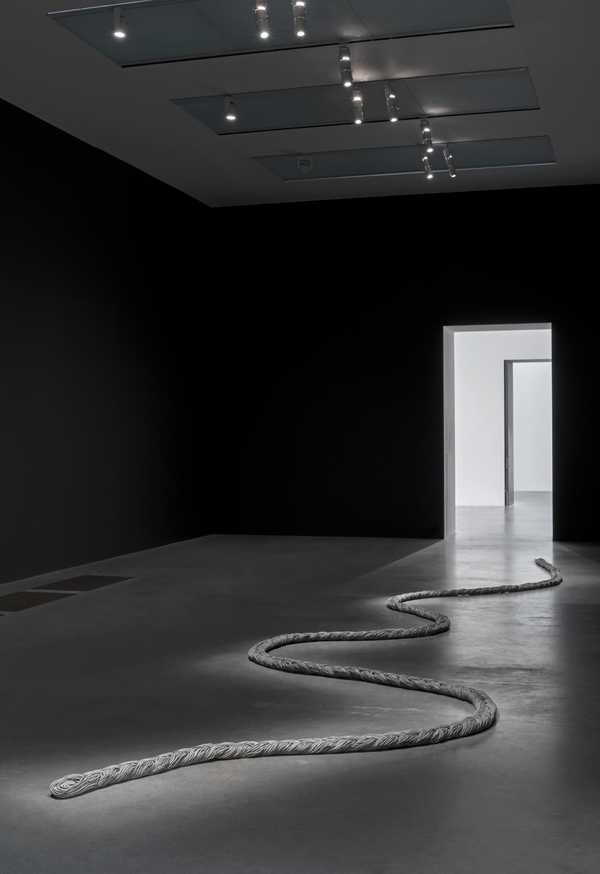
Tate's collection holds a work called Braid, in Portuguese Trança. It was made around 1983 by Tunga, a Brazilian artist. It is entirely lead.
It is a long braid, plaited from three strands as hair is plaited every day. Only here each strand is a mass of grey metal. According to Tate, the work can be shown in various configurations: curving across the floor, or snaking up the wall.
There is no single correct shape. Each time it is installed, the braid follows a different line. Visitors meet it as something caught mid movement, stopped just as they walked into the room.
Tate notes that it remains one of the earliest and largest of the braided sculptures Tunga made in the 1980s, in various sizes, from copper and other metals. The work is lent by Tate Americas Foundation, purchased in 2018 with assistance from the Latin American Acquisitions Committee, and has been part of the Materials and Objects display at Tate Modern.
Lead, the soft metal
Lead is a strange metal. Very heavy for its size. Also soft, soft enough to bend, beat and press into shape without much force. Grey, dull, quick to lose its shine. And toxic, something people have learned to keep away from.
Hair is the opposite in almost every way. Light. Alive with the body. Growing back when cut. Combed, stroked, touched every day. A braid is an intimate thing, tied to the hands of a mother, a lover, oneself before a mirror.
Tunga put both into one object. The eye sees hair and knows it is lead. It recognises something familiar while the body guesses at the weight. The two sensations refuse to give way. The work lives in that tension.
And because lead is soft, braiding it is not a complete paradox. The metal allows itself to be bent. Only each bend stays; it does not spring back as real hair does.
Between the real and the mythical
Tate describes Tunga as intrigued by the unexpected and the inexplicable. He drew on archaeology, mythology, philosophy, psychology and literature. His works are enigmatic, close to surreal.
Hair, and especially the braid, recurs across much of his work. Tate speaks of the magical properties Tunga found in hair: something that grows from the body yet can be separated from it, and remains after the person has gone.
In 1984 Tunga first staged a performance of twin girls joined by their hair, moving through a space. He also published an essay of the same title, loosely translated as Capillary Conjoined Twins Among Us, collecting strange occurrences he had lived through or found in newspapers and scientific articles.
In particular he retold the myth of Nordic twin girls joined by the hair, whose existence caused unease and conflict in their village. That uncanny image fed performances throughout his career. Tate notes that if you happen upon twin girls connected by the hair wandering the museum, it is a performance conceived by Tunga.
An object that stays
Placed beside those stories, the lead braid is no longer only an exercise in material. It looks like a relic from a tale no one has finished telling: part of some larger body, cut away, fallen, turned to metal.
Tunga does not say whose braid it is. He leaves it to the viewer. What kind of head would carry a braid so long? Who plaited it? Why is it here on a gallery floor and not on someone's shoulder?
There is no answer. Only the object, heavy, grey, bending along a line. Like other materials transformed by artists, like Mire Lee's fabric skins hanging on chains in the Turbine Hall, Trança shows that a hard material can take the shape of something soft, and a soft form can carry the weight of something hard.
Looking long enough, a viewer may catch a hand rising to their own hair. A small reflex. The work asks for nothing more.
Contemporary Art