
Essays · Contemporary Art
El Anatsui. Behind the Red Moon.
Mỗi nắp chai mang theo một lộ trình.
Each bottle top carries a route.
Tate Modern · Tate Modern
Một cánh buồm ở đầu dốc
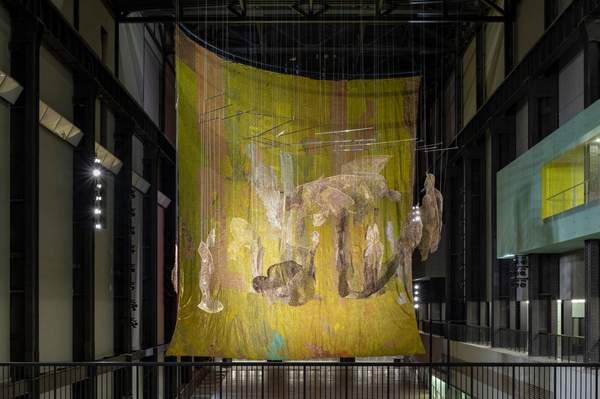
Ngày 10 tháng 10 năm 2023, người bước vào Turbine Hall của Tate Modern gặp một tấm màn khổng lồ ngay ở đầu dốc. Nó phồng về phía cửa như một cánh buồm gặp gió, gần phủ hết chiều cao và chiều ngang của sảnh. Giữa tấm màn là một vòng tròn đỏ lấm tấm vàng, quanh đó là màu đỏ sẫm. Người xem đi xuống dốc, đi ngay bên dưới nó.
Đó là màn thứ nhất của Behind the Red Moon, tác phẩm El Anatsui làm cho chương trình Hyundai Commission, trưng bày đến ngày 14 tháng 4 năm 2024. Tate gọi nó là một tác phẩm ba màn. Màn một: Mặt trăng đỏ. Màn hai: Thế giới. Màn ba: Bức tường.
Chất liệu là hàng nghìn nắp chai rượu và mảnh kim loại. Chúng được vò, được nén dẹt, rồi nối với nhau bằng tay bằng dây đồng. Những tấm nhỏ ghép thành tấm lớn, tấm lớn thành những mảng màu, mảng hình, mảng đường khổng lồ. Dù lớn như vậy, chúng vẫn mềm, vẫn gập được, vẫn đổi dáng được.
Anatsui nói Turbine Hall khiến ông nghĩ tới một con tàu. Ông nghĩ về chuyển động, về ý niệm một cánh buồm đỏ.
Mặt trăng, con tàu, đại dương
Cánh buồm dẫn về một lịch sử cụ thể. Trong thời buôn bán nô lệ xuyên Đại Tây Dương, người châu Phi bị bán, bị đổi lấy vàng, đường, rượu và những hàng hoá khác, rồi bị chở qua biển sang châu Mỹ. Nhiều người phải làm trên đồn điền mía, nguồn nguyên liệu của ngành rượu. Về sau, rượu làm ở vùng Caribe được chở sang châu Âu, rồi từ châu Âu sang Tây Phi.
Những nắp chai trong tác phẩm được lấy ở Nigeria. Chúng thuộc về một ngành hàng ngày nay, nhưng con đường của ngành ấy được vạch từ thời thuộc địa. Tate dẫn lời Anatsui: ông làm việc với thứ vật liệu đã có mặt từ lúc hai lục địa bắt đầu tiếp xúc.
Vòng tròn đỏ là một mặt trăng máu, thứ mặt trăng người ta thấy lúc nguyệt thực. Thuỷ thủ thế kỷ 18 có khi nhìn trăng để định hướng. Trăng cũng kéo thuỷ triều lên xuống. Một vật thể trên trời, một lực vô hình, và những con tàu chở người đi không trở lại.
Màn hai treo trước cây cầu giữa sảnh. Nhiều lớp hình rời, như một nhóm người lơ lửng, đang chuyển động. Đứng ở một điểm nhất định trên cầu, các mảnh ấy khớp lại thành một vòng tròn: trái đất. Những hình người này làm từ lớp màng mỏng lót trong nắp chai, nối thành một tấm lưới nửa trong suốt. Anatsui từng nói, đại ý, vỡ ra không phải là huỷ diệt, mà là điều cần để tạo hình lại.
Bức tường và đường
Màn ba là một bức tường đen, cao từ sàn tới trần. Dưới chân tường, kim loại dâng lên như sóng vỡ, như đá tai mèo. Đi vòng ra sau, mặt kia của tường lấp lánh bạc, phủ một lớp khảm nhiều màu.
Anatsui kể ý tưởng về bức tường bắt nguồn từ câu chuyện cổ về bức tường đất ở Notsie, nay thuộc Togo. Vua Agokoli dựng nó để giam giữ thần dân. Người Ewe nổi dậy, phá tường và thoát ra. Nhưng ông cũng nói tường là một cách giấu, và điều bị giấu khiến người ta tò mò, sự tò mò đưa trí tưởng tượng sang phía bên kia.
Có một câu Anatsui nói khiến tác phẩm quay về chính toà nhà. Ông kể rằng hồi nhỏ ở Gold Coast, đường Tate và Lyle là loại đường duy nhất nhà ông dùng. Lớn lên ông mới hiểu ngành đường mọc lên từ cuộc buôn bán xuyên Đại Tây Dương. Cái tên Tate trên bao đường và cái tên Tate trên cửa bảo tàng có chung một gốc: Henry Tate, nhà buôn đường đã lập nên phòng tranh này.
Hình không cố định
El Anatsui sinh năm 1944 ở Anyako, Ghana. Ông sống và làm việc giữa Tema ở Ghana và Nsukka ở Nigeria. Trong xưởng, hàng chục người phụ việc cùng khâu, cùng ghép các tấm bằng tay. Các mối nối hình thành dần giữa vật liệu, hình và màu, không theo một bản vẽ cố định từ đầu.
Anatsui gọi đó là hình không cố định. Một tấm treo có thể được treo theo cách khác ở mỗi nơi. Nó không có một dáng đúng duy nhất. Ông nói mỗi vật liệu có tính chất riêng, về vật lý và cả về tinh thần. Nắp chai giữ cả hai: độ mỏng, độ sáng của kim loại, và những cái tên thương hiệu in trên đó.
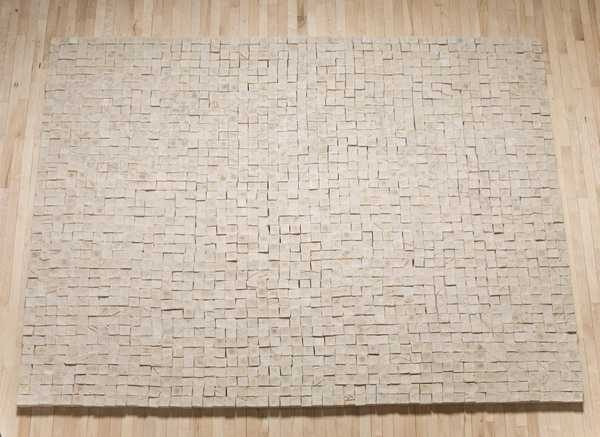
Cách làm này gợi đến một tác phẩm khác từng phủ kín cùng sảnh: Sunflower Seeds của Ai Weiwei, nơi hàng triệu vật nhỏ do rất nhiều bàn tay làm ra gom thành một mặt phẳng. Ở Anatsui, các vật nhỏ không nằm trên sàn. Chúng bay lên, phủ không gian, và có thể xếp lại.
Behind the Red Moon không kể lịch sử theo thứ tự năm tháng. Nó đặt người xem vào giữa ba màn, cho họ tự đi, tự dừng, tự thấy hình rồi thấy vật. Tate gọi đó là một điệu nhảy giữa thân thể và điêu khắc.
A sail at the top of the ramp
On 10 October 2023, visitors entering the Turbine Hall at Tate Modern met a vast hanging at the top of the ramp. It billowed toward the doors like a sail in wind, filling almost the full height and width of the hall. At its centre was a red circle flecked with gold, surrounded by deep crimson. Visitors walked down the ramp directly beneath it.
This was the first act of Behind the Red Moon, El Anatsui's Hyundai Commission, on view until 14 April 2024. Tate describes it as an artwork in three acts: The Red Moon, The World, The Wall.
The material is thousands of liquor bottle tops and metal fragments, crumpled, crushed and joined by hand with copper wire. Small sheets become large sheets, large sheets become vast fields of colour, shape and line. For all their size they stay supple; they fold and change shape.
Anatsui said the Turbine Hall reminded him of a ship. He was thinking about motion, and about the idea of a red sail.
Moon, ship, ocean
The sail points to a specific history. During the transatlantic slave trade, African people were sold and exchanged for gold, sugar, spirits and other goods, then shipped across the ocean to the Americas. Many were forced to work on sugar plantations that fed the alcohol industry. Later, spirits made in the Caribbean were shipped to Europe, and from Europe to West Africa.
The bottle tops in the work were sourced in Nigeria. They belong to a present day trade whose routes were drawn in colonial times. Tate quotes Anatsui describing them as the material that was there at the beginning of contact between two continents.
The red circle is a blood moon, the moon seen during an eclipse. Eighteenth century sailors sometimes steered by it. The moon also pulls the tides. A body in the sky, an invisible force, and ships carrying people who would not return.
The second act hangs before the bridge. Many separate layers, like a group of figures suspended in motion. From one spot on the bridge the fragments align into a single circle: the Earth. The figures are made from the thin seals inside bottle tops, wired into a semi transparent net. Anatsui has said that breaking is not destruction but a necessity for reforming.
The wall and the sugar
The third act is a black wall rising from floor to ceiling. At its base, metal swells up like breaking waves and rocky peaks. Walk behind it and the other face shimmers silver, covered in a many coloured mosaic.
Anatsui traces the wall to the old story of the earthen wall of Notsie, in present day Togo, built by King Agokoli to confine his subjects. The Ewe people rose up, tore it down and escaped. Yet he also speaks of walls as attempts to hide things, which provoke curiosity, and curiosity carries the imagination to the other side.
One remark turns the work back on the building itself. Anatsui recalls that Tate and Lyle sugar was the only brand used in his childhood in the Gold Coast, and that he came to understand the sugar industry grew out of the transatlantic trade. The Tate on the sugar bag and the Tate over the museum door share a root: Henry Tate, the sugar merchant who founded the gallery.
The non fixed form
El Anatsui was born in 1944 in Anyako, Ghana. He lives and works between Tema in Ghana and Nsukka in Nigeria. In his studio dozens of assistants stitch and assemble the sheets by hand. Connections form gradually between material, shape and colour, rather than following a fixed plan.
Anatsui calls this the non fixed form. A hanging can be installed differently in each place; it has no single correct shape. Each material, he says, has its properties, physical and even spiritual. A bottle top carries both: the thinness and shine of metal, and the brand names printed on it.
The method recalls another work that once covered the same hall: Ai Weiwei's Sunflower Seeds, where millions of small things made by many hands were gathered into one plane. In Anatsui's work the small things do not lie on the floor. They rise, fill the air, and can be arranged again.
Behind the Red Moon does not tell history in chronological order. It places visitors among three acts and lets them walk, pause, see the image and then the object. Tate calls it a dance between bodies and sculptures.
Contemporary Art