
Essays · Olfactory Art
Elaine Cameron-Weir. Who you are what looks out from behind you are is the thing that names what transforms…now, look what calms the captive by letting him sniff the perfume, like smell what smells like your masters crotch.
Mùi ấm là dấu vết của một cơ thể vắng mặt.
A warm smell is the trace of an absent body.
Một tên tác phẩm dài như một câu thoại
Tác phẩm có một cái tên dài bất thường, gần như một đoạn độc thoại: Who you are what looks out from behind you are is the thing that names what transforms…now, look what calms the captive by letting him sniff the perfume, like smell what smells like your masters crotch. Câu chữ vấp, lặp, rẽ hướng giữa chừng. Và nó dừng lại ở một hình ảnh rất trần: người bị giam được xoa dịu bằng cách cho ngửi một mùi, mùi của chủ nhân.
Tác phẩm được bày trong triển lãm cá nhân của Elaine Cameron-Weir tại Hannah Hoffman, Los Angeles, từ ngày 17 tháng 9 đến ngày 22 tháng 11 năm 2017. Bài điểm của ArtReview, số tháng 12 năm ấy, do Lindsay Preston Zappas viết, gọi tên các chủ đề chạy qua cả triển lãm: treo lơ lửng, trói buộc, bắt giữ và khoái cảm.
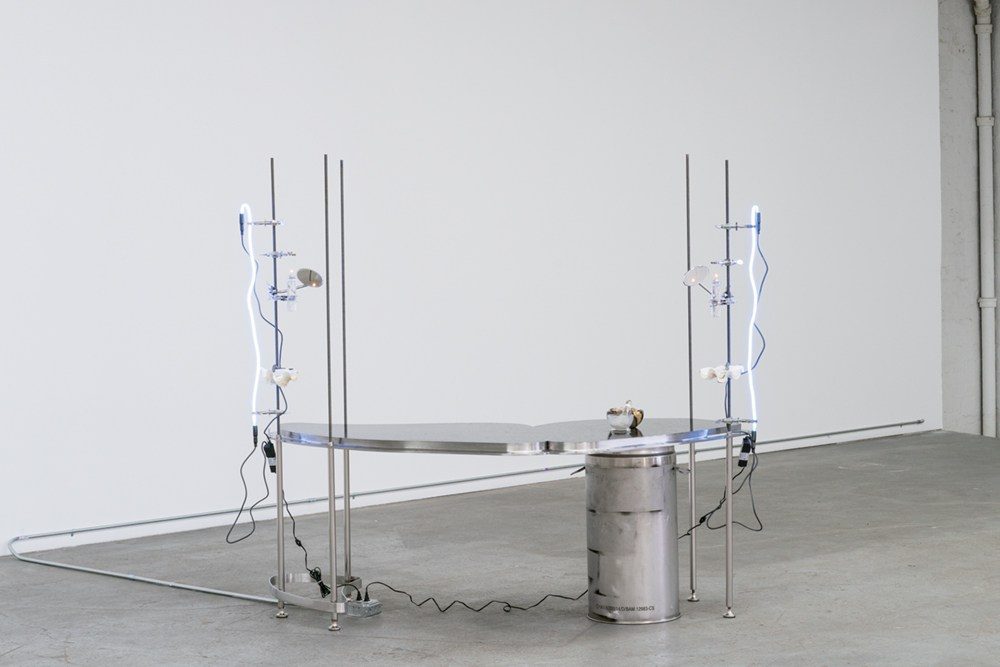
Vật thể thì giản dị hơn cái tên. Một khối nhựa labdanum được hâm nóng trên một bếp gia nhiệt dùng trong phòng thí nghiệm. Gần đó là một mảnh da được đúc thành hình, gợi đến chiếc mặt nạ của Zorro. Nhựa ấm lên và toả mùi. Mặt nạ không che gương mặt nào.
Labdanum, một mùi của da
Labdanum là nhựa thơm lấy từ cây hồng đá, một loại cây bụi mọc ở vùng Địa Trung Hải. Nhựa sẫm màu, dính tay. Mùi của nó ấm, hơi ngọt, có phần giống da thuộc, có phần giống da người sau một ngày dài. Trong ngành nước hoa, labdanum thường được dùng để tạo cảm giác ấm và gần.
Khi nguội, nhựa gần như đứng yên, mùi thoát ra chậm. Khi được hâm, nó mềm ra và mùi lan rộng hơn. Cái bếp của Cameron-Weir làm đúng việc ấy: giữ nhựa ở một nhiệt độ vừa đủ để mùi không ngừng toả. Như một thân thể được giữ ấm, không cho nguội đi.
Chọn labdanum cạnh một mặt nạ da không phải ngẫu nhiên. Da thuộc và nhựa này có mùi gần nhau. Mắt thấy da. Mũi ngửi thấy thứ gì đó như da. Hai giác quan xác nhận cho nhau, và chính sự xác nhận ấy khiến căn phòng có cảm giác như có người.
Những cơ thể không có mặt
Cả triển lãm được dựng quanh sự vắng mặt của cơ thể. Trong dressing for altitude, một tấm lưới xích treo từ trần, kèm những bộ phận cơ thể đúc bằng thiếc và dây đai da. Trong wave form walks the earth, hai bàn chân bằng thiếc treo từ một bộ đai da đã qua xử lý. FOR MAKE ADMIT THIS VOIDE là một chiếc áo cao su với dây da, đồ kim loại phẫu thuật bằng thép và những viên hổ phách thô. Hai tác phẩm treo tường khác dùng lụa dù, thép không gỉ và da. Bài điểm còn nhắc đến những mặt nạ dưỡng khí từ thời Thế chiến thứ hai và những miếng da đã cũ.
Đai, xích, mặt nạ, dây trói. Đó là đồ để giữ một cơ thể, để nâng nó lên độ cao, để buộc nó lại. Nhưng cơ thể thì không có. Chỉ còn những thứ từng ôm lấy nó.
Giữa những vật ấy, tác phẩm labdanum là thứ duy nhất có hơi ấm. Những vật khác cho ta thấy hình dáng của một cơ thể. Nhựa thơm cho ta cảm thấy nhiệt độ và mùi của nó. Đó là phần gần gũi nhất, và cũng là phần khó chịu nhất.
Mùi hương như một sợi dây
Câu cuối trong tên tác phẩm nói về việc làm dịu người bị giam bằng một mùi. Đây là điểm sắc nhất. Mùi hương thường được nghĩ là thứ tự do, bay đi, không bắt được. Cameron-Weir cho thấy chiều ngược lại. Một mùi quen có thể làm người ta yên, làm người ta ở lại, làm người ta phục tùng mà không cần dây xích.
Ham muốn, trong tác phẩm, không được trình bày như một điều đẹp đẽ. Nó gắn với quyền lực, với chủ và người bị giữ, với khoái cảm lẫn ràng buộc. Mùi là công cụ của cả hai phía.
Cameron-Weir còn nhiều tác phẩm khác dùng vật liệu thơm và dụng cụ kỹ thuật, như Sentry Tactical Like Prey with Evolutionary Eyes of a Predator on the Wing 2. Ở Los Angeles năm 2017, bà giữ mọi thứ ở mức rất nhỏ: một khối nhựa, một cái bếp, một mặt nạ. Người xem bước ra, mùi còn trên áo. Họ đã bị giữ lại một chút, dù không ai chạm vào họ.
A title as long as a line of dialogue
The work has an unusually long title, almost a monologue: Who you are what looks out from behind you are is the thing that names what transforms…now, look what calms the captive by letting him sniff the perfume, like smell what smells like your masters crotch. The words stumble, repeat, turn midway. And they end on a blunt image: a captive calmed by being allowed to smell something, the smell of the master.
It was shown in Elaine Cameron-Weir's solo exhibition at Hannah Hoffman, Los Angeles, from 17 September to 22 November 2017. ArtReview's December review, by Lindsay Preston Zappas, named the themes that ran through the show: suspension, bondage, capture and delight.
The object is simpler than its name. A lump of labdanum resin warmed on a laboratory heating mantle. Nearby, a piece of leather moulded into a shape that recalls Zorro's mask. The resin warms and gives off its smell. The mask covers no face.
Labdanum, a smell of skin
Labdanum is a resin taken from rockrose, a shrub of the Mediterranean. It is dark and sticky. Its smell is warm, slightly sweet, part leather, part skin at the end of a long day. Perfumers use it to give a sense of warmth and closeness.
Cool, the resin barely moves and its smell escapes slowly. Warmed, it softens and the smell spreads. Cameron-Weir's heater does exactly this: it holds the resin at just the temperature that keeps the smell coming. Like a body kept warm, not allowed to cool.
Setting labdanum beside a leather mask is not chance. The resin and tanned leather smell alike. The eye sees leather. The nose smells something like leather. Each sense confirms the other, and that confirmation makes the room feel occupied.
Bodies that are not there
The whole show was built around absent bodies. In dressing for altitude, chainmail hung from the ceiling with pewter body parts and leather harnessing. In wave form walks the earth, pewter feet hung from a treated leather harness. FOR MAKE ADMIT THIS VOIDE was a rubber jacket with leather straps, steel surgical hardware and raw amber. Two wall works used parachute silk, stainless steel and leather. The review also mentions Second World War oxygen masks and aged leather.
Harnesses, chains, masks, straps. These are things for holding a body, lifting it to altitude, tying it down. But the body is missing. Only what once held it remains.
Among these objects, the labdanum piece is the only one with warmth. The others show us the shape of a body. The resin lets us sense its temperature and its smell. It is the most intimate part, and the most unsettling.
Scent as a tether
The end of the title speaks of calming a captive with a smell. This is the sharpest point. Scent is usually thought of as free, drifting, impossible to hold. Cameron-Weir shows the other side. A familiar smell can quiet someone, keep them in place, make them yield, with no chain at all.
Desire here is not presented as something lovely. It is bound up with power, with master and captive, with pleasure and restraint together. Smell serves both sides.
Cameron-Weir has made other works with aromatic materials and technical equipment, such as Sentry Tactical Like Prey with Evolutionary Eyes of a Predator on the Wing 2. In Los Angeles in 2017 she kept it small: a resin, a heater, a mask. Visitors walk out with the smell on their clothes. They have been held a little, though no one touched them.
Olfactory Art