
Essays · Olfactory Art
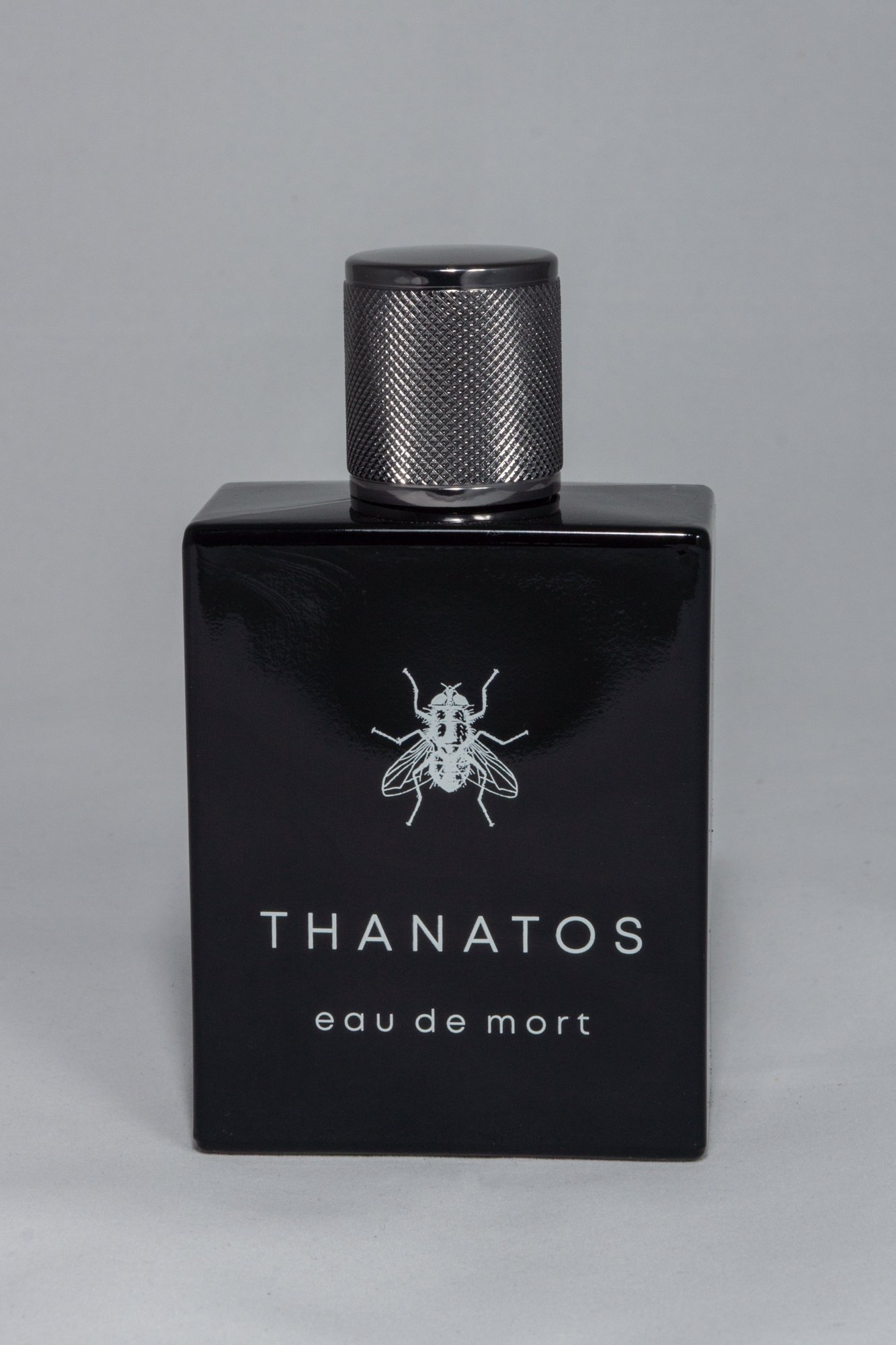
Eric Fong. Thanatos: Scent of Death Perfume.
Mùi của cái chết gần mùi của rừng hơn ta tưởng.
The smell of death sits closer to the forest than we think.
© Eric Fong · Eric Fong (official site)
Một chai nước hoa về cái chết
Thanatos là tên thần chết trong thần thoại Hy Lạp. Nghệ sĩ Eric Fong dùng cái tên ấy cho một chai nước hoa. Mùi của nó gợi đến một thi thể đang phân huỷ được tìm thấy trong một khu rừng.
Nghe thì giống một trò gây sốc. Thực tế, dự án được dựng trên nghiên cứu khoa học. Fong làm việc cùng nhà nhân chủng học pháp y Anna Williams, người đã nghiên cứu hơn 400 hợp chất hữu cơ dễ bay hơi sinh ra trong quá trình phân huỷ. Phần mùi do perfumer Euan McCall của Jorum Studio ở Scotland chế tác.
Chai nước hoa không chứa mùi tử thi nguyên vẹn. Nó chọn một số hợp chất phân huỷ, rồi đặt chúng cạnh mùi hoa và mùi gỗ. Người ngửi được dẫn từ khung cảnh một đồng cỏ mở, đi dần vào giữa một khu rừng khuất, nơi thi thể được phát hiện.
Khi phân tử của rừng và của xác chồng lên nhau
Ý tưởng cốt lõi của Thanatos là một sự trùng lặp. Nhiều hợp chất sinh ra khi cơ thể phân huỷ cũng có mặt trong những nguyên liệu mùi tự nhiên mà ngành nước hoa dùng từ lâu. Hoa, đất, gỗ đều chia nhau với cái chết một phần hoá học.
Sự trùng lặp đó đảo ngược một ranh giới quen thuộc. Ta xếp mùi thành hai nhóm: dễ chịu và ghê sợ. Nhưng ở cấp phân tử, hai nhóm ấy không tách bạch. Điều quyết định ta thích hay sợ một mùi nhiều khi là bối cảnh, là cái ta biết về nguồn gốc của nó, không chỉ là bản thân phân tử.
Thanatos đặt người ngửi vào đúng chỗ giao nhau đó. Mùi hoa và gỗ làm mũi yên tâm. Rồi một cái gì đó lạ xen vào. Người ngửi không chắc mình đang ngửi thấy rừng hay thấy xác. Chính sự không chắc ấy là tác phẩm.
Bàn khám nghiệm, phim và ảnh hiện trường
Chai nước hoa chỉ là trung tâm của một sắp đặt nhiều phần. Người xem ngửi mùi qua một điêu khắc dựa trên hình dáng bàn khám nghiệm tử thi. Chỗ đặt mũi trở thành chỗ đặt xác.
Đi kèm là The Search, một phim ngắn dựng không khí hồi hộp, kể việc tìm thấy một thi thể trong rừng. Trên tường là những bức ảnh hiện trường vụ án dàn dựng, lấy từ khoa Nhân chủng học pháp y của Đại học Teesside.
Năm 2020, sắp đặt được trưng bày ở Cube Gallery của trung tâm Phoenix tại Leicester, và ở Constantine Gallery thuộc Đại học Teesside tại Middlesbrough. Dự án được Arts Council England tài trợ bằng quỹ xổ số quốc gia. Sau đó, Thanatos lọt vào danh sách dài của giải Aesthetica Art Prize, và năm 2022 vào vòng chung kết giải Sadakichi của Institute for Art and Olfaction.
Vì sao phải ngửi cái chết
Xã hội hiện đại giấu cái chết khá kỹ. Người mất được đưa đi nhanh, được làm sạch, được đặt trong phòng lạnh. Mùi là thứ đầu tiên bị xoá. Với phần lớn người sống ở thành phố, mùi của cái chết là thứ họ chưa từng ngửi, chỉ từng nghe kể.
Thanatos đưa mùi ấy trở lại, nhưng trong một khung kiểm soát được: một gallery, một chai nhỏ, một câu chuyện có đầu có cuối. Nó không nhằm làm người xem ghê sợ. Nó nhằm cho thấy cái chết thuộc về cùng một chu trình với khu rừng mà ta vẫn thấy đẹp.
Có một lớp nữa. Với những người làm pháp y hay chó nghiệp vụ tìm xác, mùi phân huỷ là một thông tin, một manh mối. Tác phẩm cho người thường mượn tạm mũi của họ trong vài phút. Mùi, trong bối cảnh ấy, không còn là cảm giác. Nó là bằng chứng.
A perfume about death
Thanatos is the personification of death in Greek myth. The artist Eric Fong gave the name to a perfume. Its smell evokes a decomposing body found in a woodland.
It sounds like a stunt. In fact the project rests on science. Fong worked with the forensic anthropologist Anna Williams, whose research covers more than 400 volatile organic compounds released during decomposition. The scent was composed by the perfumer Euan McCall of Jorum Studio in Scotland.
The perfume does not reproduce the smell of a corpse. It selects certain decomposition compounds and sets them beside floral and woody notes. The wearer is led from an open meadow into the middle of a secluded forest, where a body is found.
Where forest and corpse share molecules
The core idea of Thanatos is an overlap. Many compounds released as a body breaks down also appear in natural materials perfumers have long used. Flowers, soil and wood share part of their chemistry with death.
That overlap unsettles a familiar boundary. We sort smells into pleasant and repellent. At the level of molecules the two groups are not cleanly separate. Whether we like or fear a smell often depends on context, on what we know of its source, and not only on the molecule itself.
Thanatos places the visitor at exactly that crossing. Flowers and wood reassure the nose. Then something strange slips in. The visitor cannot be sure whether they are smelling a forest or a body. That uncertainty is the work.
An autopsy table, a film, crime scene photographs
The perfume is the centre of a multipart installation. Visitors smell it through a sculpture modelled on an autopsy table. The place for the nose becomes the place for the body.
Alongside it runs The Search, a tense short film about finding a body in a forest. On the walls hang staged crime scene photographs from the Forensic Anthropology Department at Teesside University.
In 2020 the installation was shown at Cube Gallery, Phoenix, in Leicester, and at the Constantine Gallery, Teesside University, in Middlesbrough, with support from Arts Council England through National Lottery funding. Thanatos was later longlisted for the Aesthetica Art Prize and, in 2022, named a finalist for the Institute for Art and Olfaction's Sadakichi Award.
Why smell death at all
Modern society hides death carefully. The dead are removed quickly, cleaned, kept cold. Smell is the first thing erased. For most city dwellers the smell of death is something they have heard described, never smelled.
Thanatos brings that smell back, inside a frame that can be controlled: a gallery, a small bottle, a story with a beginning and an end. Its aim is not to disgust. It shows that death belongs to the same cycle as the forest we find beautiful.
There is one more layer. For forensic scientists and cadaver dogs, the smell of decomposition is information, a clue. The work lends ordinary people their nose for a few minutes. In that setting smell is no longer a feeling. It is evidence.


Olfactory Art