
Essays · Olfactory Art
Wolfgang Georgsdorf. Osmodrama / Smeller 2.0.
Mùi cũng có thể đến rồi đi, như một nốt nhạc.
A smell can arrive and leave, like a note.
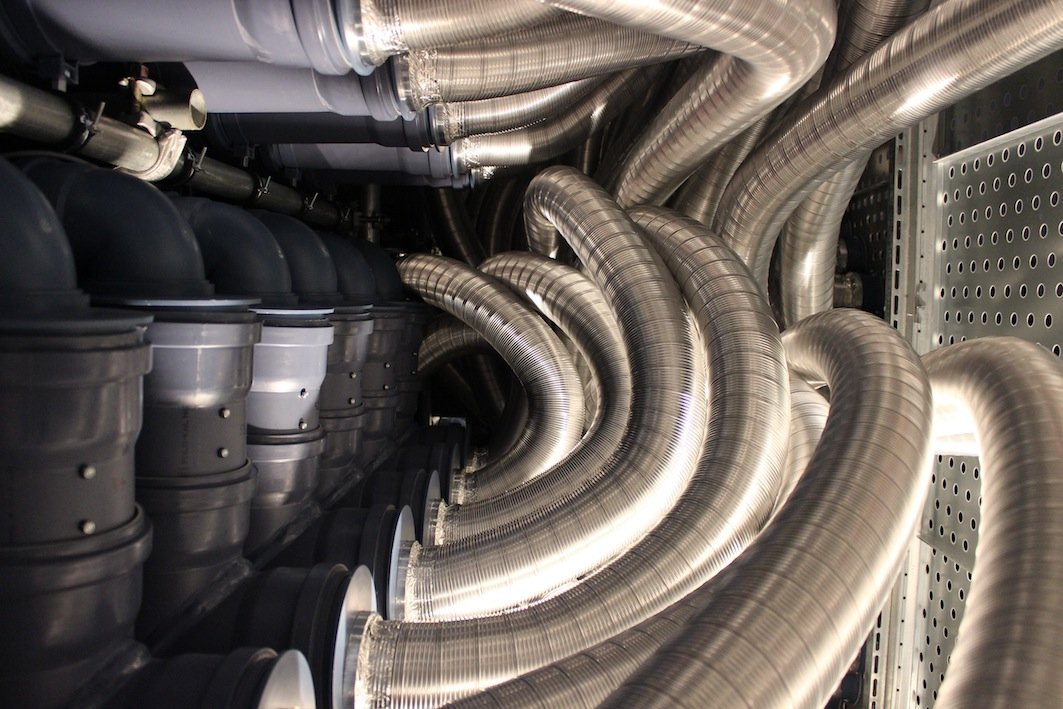
© Osmodrama / Wolfgang Georgsdorf · Osmodrama (official site)
Một cây đàn chơi bằng không khí
Smeller 2.0 là một cây đàn organ mùi điều khiển điện tử do nghệ sĩ người Áo Wolfgang Georgsdorf phát triển. Máy nặng khoảng 1,6 tấn và hiện có 64 kênh mùi. Qua mỗi kênh, một mùi đã được pha sẵn có thể được đưa vào phòng theo một trình tự định trước.
Georgsdorf không làm việc một mình. Theo trang của dự án, cỗ máy là kết quả làm chung với những người làm nước hoa, nhà nghiên cứu khứu giác, kỹ sư thông gió, kỹ sư cơ khí và lập trình viên. Mỗi nghề giải một phần của cùng một câu hỏi: làm sao để mùi vận hành được như hình ảnh trên màn chiếu.
Cách máy hoạt động khá giản dị khi nói ra. Một luồng khí liên tục đi qua phòng với tốc độ của người đi bộ. Mùi được thả vào luồng khí ấy, lan đều trong không gian, rồi theo luồng khí thoát ra qua một cửa sổ ở cuối phòng. Mùi không bị trộn lẫn ngoài ý muốn. Khi mùi mới đến, mùi cũ đã đi.
Theo mô tả của dự án, từ tám nhân tám mùi nền, về lý thuyết có thể tạo ra số tổ hợp lên tới hai mũ sáu mươi tư. Con số ấy không phải để khoe. Nó cho thấy người soạn có trong tay một bảng chất liệu gần như không có giới hạn.
Hai mươi năm từ nguyên mẫu đến nhà thờ
Ý tưởng có từ rất lâu trước khi máy chạy. Năm 1996, Georgsdorf giới thiệu Smeller 1.0, một nguyên mẫu vận hành cơ học, tại Bảo tàng bang Thượng Áo. Cũng từ lúc đó, ông hình dung ra một phiên bản điện tử có thể điều khiển chính xác từng mùi.
Phải mười sáu năm sau phiên bản ấy mới thành hình. Năm 2012, Smeller 2.0 lần đầu được lắp đặt và vận hành tại OK Center for Contemporary Arts ở Linz, trong khuôn khổ triển lãm Sinnesrausch. Năm 2013, Georgsdorf nhận giải Outstanding Artist Award cho lĩnh vực liên ngành tại Vienna.
Từ ngày 15 tháng 7 đến ngày 18 tháng 9 năm 2016, Osmodrama Festival diễn ra tại nhà thờ St. Johannes Evangelist ở trung tâm Berlin. Dự án gọi đây là liên hoan đầu tiên của trình diễn mùi theo thời gian. Georgsdorf làm việc cùng những nghệ sĩ như đạo diễn Edgar Reitz, nghệ sĩ Omer Fast và diễn viên Eva Mattes, tạo ra những tác phẩm mùi đứng riêng hoặc đi cùng âm thanh, âm nhạc, phim và văn chương.
Năm 2017, Osmodrama nhận giải Sadakichi của Art and Olfaction Awards, cùng với nhà làm nước hoa Geza Schön. Năm 2018, Osmodrama có mặt ở Martin Gropius Bau, Berlin, trong triển lãm Welt ohne Außen.
Kể chuyện bằng chuỗi mùi
Osmodrama là tên Georgsdorf đặt cho hình thức nghệ thuật mà cỗ máy làm ra: kể chuyện và soạn nhạc bằng chuỗi mùi. Mùi đến và đi như hình ảnh trên màn chiếu, lớn dần rồi nhỏ dần như âm thanh trong phòng hoà nhạc.
Ý tưởng mùi có thể được trình diễn theo thời gian không mới. Đầu thế kỷ trước, Sadakichi Hartmann đã thử một chuyến đi Nhật Bản bằng mùi trước khán giả. Những thí nghiệm như vậy thường vấp cùng một trở ngại: mùi ở lại quá lâu, các mùi chồng lên nhau, và câu chuyện nhoè đi sau vài phút.
Smeller 2.0 là câu trả lời kỹ thuật cho trở ngại ấy. Luồng khí đi đều, mùi được mang ra khỏi phòng, và vì vậy người soạn có thể đặt mùi thứ hai ngay sau mùi thứ nhất mà mũi vẫn phân biệt được. Mùi có nhịp. Có khoảng nghỉ. Có thứ tự.
Điều đáng nhớ ở Osmodrama không nằm ở kích thước cỗ máy. Nó nằm ở chỗ mùi được đối xử như một ngôn ngữ có ngữ pháp. Một mùi đứng riêng thì chỉ gọi tên một thứ. Khi mùi được xếp nối tiếp, chúng bắt đầu nói một điều gì đó mà không mùi nào nói được một mình.
An instrument played with air
Smeller 2.0 is an electronically controlled scent organ developed by the Austrian artist Wolfgang Georgsdorf. It weighs about 1.6 tonnes and currently has 64 smell channels. Through each channel a prepared smell can be released into a room in a predetermined sequence.
Georgsdorf did not work alone. According to the project, the machine was built together with perfumers, olfactory scientists, ventilation engineers, mechanical engineers and programmers. Each discipline solved part of one question: how to make smell behave like images on a screen.
The principle is simple to state. A continuous stream of air crosses the room at walking pace. Smells are released into that stream, spread evenly through the space, then leave with it through a window at the far end. Nothing mixes by accident. When a new smell arrives, the old one has gone.
The project notes that from eight by eight basic smells, in theory, the number of combinations reaches two to the power of sixty four. The figure is not a boast. It shows that the composer holds a palette with almost no limit.
Twenty years from prototype to church
The idea long preceded the machine. In 1996 Georgsdorf presented Smeller 1.0, a mechanically operated prototype, at the State Museum of Upper Austria, and first imagined an electronic version able to control each smell precisely.
It took sixteen years to build. In 2012 Smeller 2.0 was first installed and run at the OK Center for Contemporary Arts in Linz, as part of the exhibition Sinnesrausch. In 2013 Georgsdorf received the Outstanding Artist Award for Interdisciplinarity in Vienna.
From 15 July to 18 September 2016 the Osmodrama Festival took place in the St. Johannes Evangelist church in central Berlin, described by the project as the first festival of kinetic scent performance. Georgsdorf worked with figures such as the director Edgar Reitz, the artist Omer Fast and the actor Eva Mattes on smell compositions, alone or joined with sound, music, film and literature.
In 2017 Osmodrama received the Sadakichi Award from the Art and Olfaction Awards, shared with the perfumer Geza Schön. In 2018 it appeared at the Martin Gropius Bau in Berlin, in the exhibition Welt ohne Außen.
Telling stories in sequences of smell
Osmodrama is Georgsdorf's name for the art form the machine makes possible: storytelling and composition through sequences of smell. Smells come and go like images on a screen, swell and fade like sound in a concert hall.
Performing smell in time is not a new idea. Early in the last century, Sadakichi Hartmann attempted a trip to Japan by smell before an audience. Such experiments tended to meet the same obstacle: smells linger, pile up, and the story blurs within minutes.
Smeller 2.0 is a technical answer to that obstacle. The air moves steadily, smells are carried out of the room, and so a composer can place a second smell right after the first while the nose still tells them apart. Smell gains rhythm. Pauses. Order.
What stays with Osmodrama is not the size of the machine. It is that smell is treated as a language with a grammar. A smell on its own only names one thing. Placed in sequence, smells begin to say something none of them could say alone.


Olfactory Art