
Essays · Olfactory Art
Kai Althoff. and then leave me to the common swifts (und dann überlasst mich den Mauerseglern).
Một đời người, treo dưới lều vải, có mùi riêng.
A whole life, hung under fabric, with its own smell.
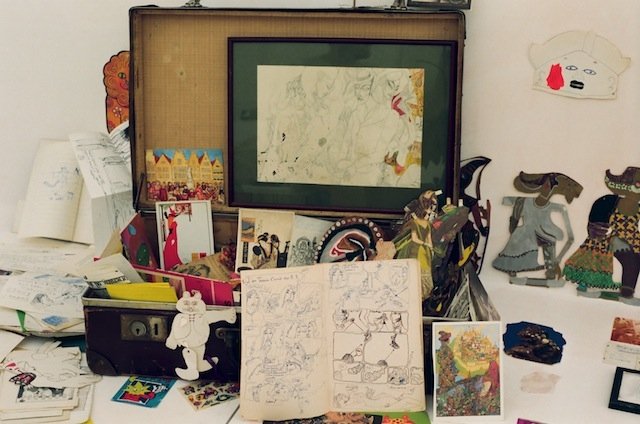
Kai Althoff, and then leave me to the common swifts, 2016 · ArtReview
Một dãy phòng dưới lều trắng
Từ ngày 18 tháng 9 năm 2016 đến ngày 22 tháng 1 năm 2017, Bảo tàng Nghệ thuật Hiện đại New York trao một dãy phòng cho Kai Althoff, nghệ sĩ người Đức. Triển lãm do Laura Hoptman, giám tuyển, và Margaret Ewing, trợ lý giám tuyển của khoa Hội hoạ và Điêu khắc, tổ chức.
Althoff không treo tranh lên những bức tường trắng quen thuộc của bảo tàng. Ông căng vải trắng thành những chiếc lều nối nhau, biến các phòng riêng rẽ thành một không gian liền mạch. Trong đó có những bức tường đứng tự do, những kệ gỗ chất các tác phẩm còn gói trong giấy nâu, những tủ kính.
Trong tủ kính: lọ nước hoa, khăn lông vũ, búp bê, ren. Ở một góc là mô hình một ngôi làng Trung Âu bị cháy sém, cạnh đó là những món đồ bọc nệm đã rách.
Nhạc do chính Althoff sáng tác phát nhẹ như tiếng nền. Và khắp không gian có một mùi nước hoa ngọt, cũng do chính nghệ sĩ pha. Người xem ngửi thấy nó trước khi kịp nhìn rõ bức tranh đầu tiên.
Từ thời thơ ấu đến hôm nay
Tác phẩm trưng bày trải dài từ những năm Althoff còn nhỏ đến những gì ông làm gần đây. Tranh, bản vẽ trên giấy và trên vải, đủ kích thước. Có cả những mảnh còn lại từ các sắp đặt lớn trước đây của ông, những đồ vật tìm được và đồ vật tự làm.
Nhân vật trong tranh là những người lạc thời: những hình người không rõ nam nữ, những người Do Thái Hasidic, sinh viên Đức thời Wilhelm, thanh niên nông thôn. Người xem có thể nhận ra dư âm của Emil Nolde, Egon Schiele, André Thomkins. Gần lối vào có một bức tranh mang dòng chữ Ich bins, nghĩa là: tôi đây.
Nhà phê bình Joshua Mack viết trên ArtReview rằng triển lãm có nhiều thứ đến mức không ai có thể xem hết. Đó có lẽ là một phần của ý định. Một đời người thì không xem hết được.
Tên triển lãm cũng là một câu dở dang: và rồi hãy để tôi lại với bầy chim yến. Loài chim ấy, tiếng Đức gọi là Mauersegler, gần như cả đời sống trên không trung, hiếm khi đậu xuống. Tên triển lãm như lời của một người muốn được bay đi, để lại phía sau những gì mình đã làm.
Mùi như chữ ký
Althoff từ lâu đã thử kết nối những chất liệu và định dạng khác thường để tạo nên những môi trường bao trùm: bản vẽ tỉ mỉ, cắt dán, vải, điêu khắc mềm, tranh, chữ viết, video, bài hát, và mùi hương. Ở MoMA, mùi là thứ nối tất cả lại.
Tranh đứng ở một chỗ. Tủ kính đứng ở một chỗ. Nhạc lan xa hơn nhưng vẫn có nguồn. Còn mùi thì ở khắp nơi cùng lúc, không có hướng. Nó khiến những thứ rất khác nhau, một búp bê, một ngôi làng cháy, một bức vẽ thời đi học, thuộc về cùng một người.
Một mùi nước hoa ngọt là thứ rất riêng. Nó thường gắn với một ai đó cụ thể: mẹ, bà, một người yêu cũ. Khi Althoff tự pha mùi cho triển lãm, ông cho căn phòng một thứ giống như mùi của chính mình. Người xem bước vào không chỉ nhìn tranh của ông, mà đứng trong không khí của ông.
Việc dùng mùi để vẽ chân dung một người có lịch sử riêng trong nghệ thuật khứu giác, như Clara Ursitti với Self Portrait in Scent. Althoff không gọi triển lãm của mình là chân dung. Nhưng khi rời khỏi phòng, người xem có thể quên nhiều bức tranh. Mùi ngọt thì có khi còn theo họ ra tới đường.
A suite of rooms under white tents
From 18 September 2016 to 22 January 2017, the Museum of Modern Art in New York gave a suite of galleries to the German artist Kai Althoff. The exhibition was organised by Laura Hoptman, curator, and Margaret Ewing, curatorial assistant, of the Department of Painting and Sculpture.
Althoff did not hang work on the museum's familiar white walls. He stretched white fabric into linked tents, turning separate rooms into one continuous space. Inside were freestanding walls, shelves stacked with works still wrapped in brown paper, and vitrines.
In the vitrines: perfume bottles, feather boas, dolls, lace. In one corner, a diorama of a charred Central European village, beside torn upholstered furniture.
Music Althoff composed played softly in the background. And throughout the space hung a sweet perfume, also made by the artist. Visitors smelled it before they could properly see the first painting.
From childhood to now
The works spanned from Althoff's early youth to recent years. Paintings and drawings on paper and canvas, in every size. There were also fragments of earlier large environments, objects found and objects made.
The figures in the pictures seem out of time: androgynous people, Hasidic Jews, Wilhelmine era German students, rural youths. Echoes of Emil Nolde, Egon Schiele and André Thomkins can be felt. Near the entrance hung a painting inscribed Ich bins: it's me.
Writing in ArtReview, the critic Joshua Mack noted there was so much that no one could see it all. That may be part of the point. A life cannot be seen in full.
The title itself is an unfinished sentence: and then leave me to the common swifts. The bird, Mauersegler in German, spends almost its whole life in the air and rarely lands. The title reads like the words of someone who wants to fly off, leaving behind what he has made.
Smell as signature
Althoff has long combined unusual materials and formats to build all encompassing environments: detailed drawings, collage, textiles, soft sculpture, paintings, writing, video, song, and scent. At MoMA, smell was what tied it all together.
A painting stays in one place. A vitrine stays in one place. Music travels further but has a source. Smell is everywhere at once, with no direction. It makes very different things, a doll, a burned village, a school drawing, belong to the same person.
A sweet perfume is personal. It often attaches to someone specific: a mother, a grandmother, a former lover. By making a scent for the show, Althoff gave the rooms something like his own smell. Visitors did not only look at his paintings; they stood inside his air.
Using smell to portray a person has its own history in olfactory art, as with Clara Ursitti's Self Portrait in Scent. Althoff did not call his show a portrait. But leaving the rooms, visitors might forget many paintings. The sweet smell might follow them out onto the street.


Olfactory Art