
Essays · Contemporary Art
Olafur Eliasson. The New York City Waterfalls.
Nước sông rơi xuống chính dòng sông.
River water falling back into the river.
Bốn thác nước trên East River
Từ ngày 26 tháng 6 đến ngày 13 tháng 10 năm 2008, người New York nhìn thấy bốn thác nước ở những chỗ trước đó không có thác. Chúng đổ xuống East River, con sông ngăn Manhattan với Brooklyn.
Thác thứ nhất dựng ở chân trụ neo của cầu Brooklyn, phía Brooklyn. Thác thứ hai nằm giữa Pier 4 và Pier 5 ở Brooklyn, gần lối đi bộ Brooklyn Heights. Thác thứ ba ở Pier 35, Lower Manhattan, phía bắc cầu Manhattan. Thác thứ tư ở bờ bắc đảo Governors Island.
Mỗi thác cao khoảng 27 đến 37 mét, tức 90 đến 120 feet theo số liệu của Public Art Fund, tổ chức đặt hàng tác phẩm và thực hiện cùng thành phố New York. Đứng ở bờ sông, trên cầu, hay trên phà, người ta đều có thể thấy ít nhất một thác.
Tác phẩm là của Olafur Eliasson, nghệ sĩ Đan Mạch gốc Iceland làm việc ở Berlin. Trước đó ông đã làm nhiều tác phẩm thác nước khác, nhưng chưa có cái nào đặt giữa một thành phố như thế này.
Giàn giáo, máy bơm, nước sông
Nhìn gần, các thác nước không giấu cách chúng được làm. Khung xương là giàn giáo xây dựng, loại vẫn dựng quanh các toà nhà đang sửa ở New York. Máy bơm đưa nước từ chính East River lên đỉnh giàn, rồi thả cho nước đổ trở lại sông.
Không có nước được chở từ nơi khác đến. Không có hồ chứa. Dòng sông vừa là nguồn, vừa là nơi nhận.
Dưới mỗi thác có những hồ lọc nước treo lơ lửng, để nước hút lên không kéo theo cá và sinh vật sống trong sông. Điện chạy máy bơm là điện từ nguồn tái tạo. Sau khi triển lãm kết thúc, giàn giáo được tháo ra và dùng lại cho những công trình khác.
Gần 200 người gồm nhà thiết kế, kỹ sư và thợ xây, làm việc cùng công ty Tishman Construction, đã dựng bốn thác nước. Khi trời tối, đèn LED chiếu sáng các cấu trúc. Khi gió quá mạnh, có bão, hoặc thiếu điện, thác tạm ngừng chảy.
Nhìn lại một dòng sông
Theo Public Art Fund, Eliasson muốn người New York xem xét lại mối quan hệ của họ với khung cảnh quanh mình, và cùng lúc tăng cảm giác rằng họ chia sẻ nó với nhau.
Một thác nước làm được điều đó theo cách rất đơn giản: nó cho mắt một thứ để đo. Nước rơi từ độ cao ba mươi mấy mét cần một khoảng thời gian để chạm mặt sông. Nhìn vào đó, người ta ước được chiều cao, rồi so với cầu, với toà nhà, với bờ bên kia. Tỉ lệ của thành phố hiện ra qua một cột nước.
Và vì có bốn thác ở bốn chỗ, người xem phải di chuyển. Đi bộ dọc bờ, đi phà, đứng trên cầu. Tác phẩm không nằm gọn trong một khung nhìn. Nó trải ra theo đường sông.
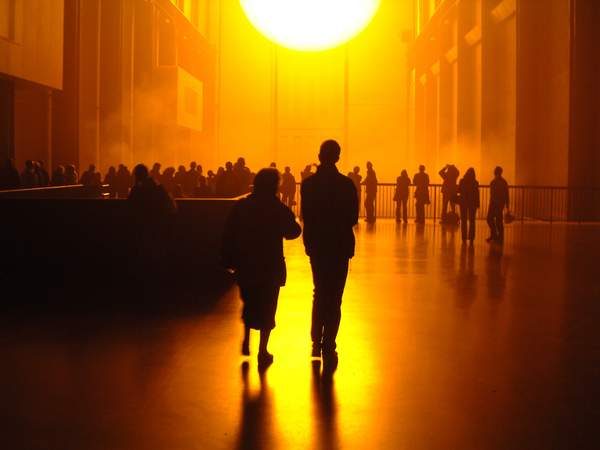
Cách làm này gần với mặt trời nhân tạo Eliasson treo trong Turbine Hall năm 2003. Ở đó cũng vậy, cơ chế không giấu đi. Người xem biết đó là đèn, là gương, là sương. Biết rồi mà vẫn đứng lại.
Một tác phẩm biết mình sẽ tháo
The New York City Waterfalls chỉ tồn tại hơn ba tháng. Nó được làm từ những thứ tạm: giàn giáo thuê, máy bơm, dòng điện. Ngay từ đầu, nó đã được lên kế hoạch để tháo.
Điều đáng nhớ không nằm ở kỹ thuật, dù kỹ thuật không hề nhỏ. Nó nằm ở chỗ tác phẩm không thêm vật gì mới vào thành phố. Nước là nước sông. Khung là khung xây dựng. Thứ duy nhất được thêm vào là sự chú ý.
Sau tháng 10 năm 2008, East River trở lại như cũ. Nhưng với những người từng đứng nhìn một cột nước rơi dưới cầu Brooklyn, con sông có lẽ không còn hoàn toàn vô hình nữa.
Four waterfalls on the East River
From 26 June to 13 October 2008, New Yorkers saw four waterfalls where there had never been any. They poured into the East River, the water between Manhattan and Brooklyn.
The first stood at the Brooklyn anchorage of the Brooklyn Bridge. The second sat between Piers 4 and 5 in Brooklyn, near the Brooklyn Heights Promenade. The third was at Pier 35 in Lower Manhattan, north of the Manhattan Bridge. The fourth was on the north shore of Governors Island.
Each rose some 90 to 120 feet, about 27 to 37 metres, according to Public Art Fund, which commissioned the work and presented it with the City of New York. From the riverbank, a bridge or a ferry, at least one of them was always in view.
The work was by Olafur Eliasson, the Danish Icelandic artist based in Berlin. He had made waterfall works before, but none set in the middle of a city like this.
Scaffolding, pumps, river water
Up close, the waterfalls did not hide how they were made. Their skeleton was building scaffolding, the kind that wraps New York buildings under repair. Pumps lifted water from the East River itself to the top, then let it fall back into the river.
No water was brought in. No reservoir. The river was both source and destination.
Beneath each fall hung intake pools that filtered the water so fish and other river life were not drawn up. The pumps ran on renewable power. When the show ended, the scaffolding was taken down and reused on other projects.
Nearly 200 designers, engineers and builders, working with Tishman Construction, put the four falls up. After sunset, LED lights lit the structures. In high winds, storms or power shortages, the water was shut off.
Looking at a river again
Public Art Fund says Eliasson wanted New Yorkers to reconsider their relationship with their surroundings, and at the same time to feel that they shared them.
A waterfall does this in a very simple way: it gives the eye something to measure with. Water falling thirty odd metres takes time to reach the surface. Watching it, people judge the height, then compare it with the bridge, the buildings, the far bank. The scale of the city appears through a column of water.
And because there were four falls in four places, viewers had to move. Walk the waterfront, take a ferry, stand on a bridge. The work did not fit into one view. It spread along the river.
The approach is close to the artificial sun Eliasson hung in the Turbine Hall in 2003. There too the mechanism was not hidden. Visitors knew it was lamps, mirrors, mist. They knew, and still they stopped.
A work that knew it would come down
The New York City Waterfalls lasted a little over three months. It was made of temporary things: hired scaffolding, pumps, electricity. From the start it was planned to be dismantled.
What stays is not the engineering, considerable as it was. It is that the work added nothing new to the city. The water was river water. The frame was a building frame. The only thing added was attention.
After October 2008 the East River went back to what it had been. But for those who had stood watching a column of water fall beneath the Brooklyn Bridge, the river was perhaps no longer quite invisible.
Contemporary Art