
Essays · Contemporary Art
Rachel Whiteread. Untitled (Stairs).
Một lối đi quen, xoay nghiêng, thành xa lạ.
A familiar way up, turned on its side, made strange.
Tate · Tate
Một cầu thang nằm nghiêng
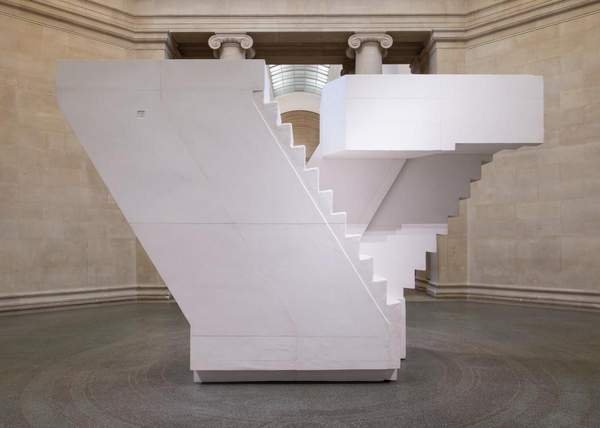
Trong phòng trưng bày có một khối lớn màu trắng ngà, cao gần bốn mét, dài gần sáu mét. Nhìn một lúc mới nhận ra: đó là một cầu thang. Hay đúng hơn, là khoảng không phía trên một cầu thang, được đúc lại thành khối.
Cầu thang gấp khúc đi xuống theo hình zíc zắc, qua ba chiếu nghỉ hình vuông. Nhưng Whiteread không dựng nó theo chiều người ta vẫn đi. Bà xoay nó chín mươi độ, để tác phẩm đứng trên một cạnh vốn là bức tường trong không gian thật. Bậc thang giờ chạy ngang, chạy dọc, theo những hướng không ai bước được.
Tác phẩm tên là Untitled (Stairs), làm năm 2001. Tate mua năm 2003 với sự hỗ trợ của Art Fund và hội viên Tate. Nó được trưng bày tại Tate Triennial năm 2003, trong triển lãm lớn của Whiteread tại Tate Britain năm 2017, rồi ở Belvedere 21 tại Vienna năm 2018.
Toà nhà từng là giáo đường
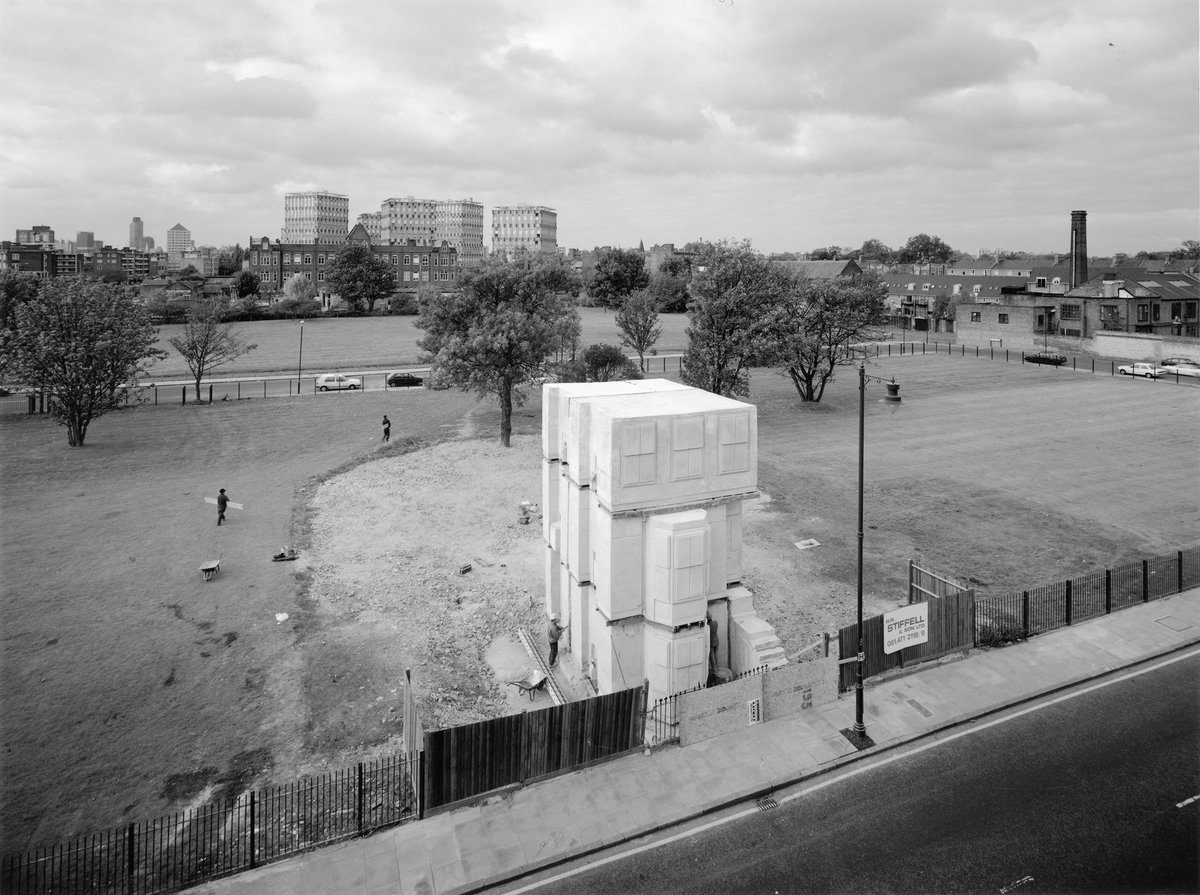
Cầu thang ấy nằm trong một toà nhà ở Bethnal Green, phía đông London. Năm 1999, Whiteread và người bạn đời mua nó để làm nhà ở và xưởng.
Toà nhà có một lịch sử dày. Ban đầu nó là một giáo đường Do Thái. Bị bom tàn phá trong Thế chiến thứ hai, nó được dựng lại vào những năm 1950. Khi cộng đồng Do Thái trong khu vực thưa dần, giáo đường không còn được dùng. Những năm 1970, một công ty dệt lấy làm kho hàng. Rồi nó bỏ trống nhiều năm, cho đến khi Whiteread tìm thấy.
Cùng lúc ấy, Bảo tàng Guggenheim mời bà làm tác phẩm cho một triển lãm đi qua các chi nhánh ở Berlin, Bilbao và New York. Ban đầu bà nghĩ đến kiến trúc của chính các toà Guggenheim. Rồi bà đổi ý, và quay về với kiến trúc của mình.
Bà đúc tầng hầm, đúc ba cầu thang, đúc hai căn hộ ở tầng một, đúc cả sàn giáo đường. Untitled (Stairs) là một trong ba cầu thang ấy. Một tác phẩm khác cùng đợt, Untitled (Rooms), cũng nằm trong bộ sưu tập Tate. Làm như vậy, bà giữ lại toà nhà đúng như lúc bà tìm thấy nó, trước khi sửa sang theo nhu cầu của mình.
Một khối đặc mà rỗng
Trước khi đúc, Whiteread làm một mô hình tỉ lệ một phần mười để hình dung khoảng không khi đã đông đặc sẽ trông ra sao, và nên đặt tác phẩm theo hướng nào.
Vật liệu là Jesmonite, một loại thạch cao gia cường polyme, bền hơn thạch cao thường, kết hợp nhiều lớp lưới sợi thuỷ tinh. Hỗn hợp được quét thẳng lên mặt bậc thang, lên tường, và lên những tấm ván ốp vào lan can để làm khuôn. Lớp đúc dày khoảng tám phân.
Tác phẩm gồm mười phần đúc riêng, bắt bu lông lại với nhau thành một khối. Nhìn từ ngoài, nó có vẻ đặc và nặng. Thật ra nó là một cái vỏ, rỗng bên trong.
Chi tiết ấy khớp lạ lùng với chính ý tưởng của tác phẩm. Whiteread đúc khoảng không, thứ vốn không có gì. Và cái khối biểu diễn khoảng không ấy, bên trong cũng không có gì.
Tám năm để lật một cầu thang
Trước đó Whiteread đã đúc ở quy mô kiến trúc. Ghost năm 1990 là một căn phòng trong một ngôi nhà thời Victoria ở bắc London. House năm 1993 là cả một căn nhà phố ở đông London, bị phá chỉ sau vài tháng, câu chuyện Penta đã kể trong bài về House. Nhưng cầu thang đặt ra một bài toán hình học khác hẳn.
Năm 2001, bà kể rằng mình đã muốn làm điều này khoảng tám năm. Điều khiến bà tò mò là cảm giác một cầu thang có thể xoay nghiêng. Bà không muốn minh hoạ một cầu thang, mà muốn lật kiến trúc đi một chút, để đổi cách người ta nghĩ về việc đi quanh hay đi xuyên qua một thứ.
Kết quả là một vật vừa quen vừa đố. Cơ thể nhận ra bậc thang ngay. Đầu thì phải làm việc: cố dựng lại trong trí cái cầu thang thật, chiều nào lên, chiều nào xuống, người ta từng đứng ở đâu. Không ai giải xong câu đố ấy hoàn toàn. Có lẽ vì thế mà người ta đứng trước nó lâu.
A staircase on its side
In the gallery stands a large ivory block, nearly four metres high and almost six metres long. It takes a moment to see: it is a staircase. Or rather, the space above a staircase, cast into a solid.
The stairs zigzag down through three square landings. But Whiteread did not set them the way people climb. She turned the cast ninety degrees, so it stands on an edge that was once a wall. The steps now run sideways and upwards, in directions no one could walk.
The work is Untitled (Stairs), 2001. Tate bought it in 2003 with help from the Art Fund and Tate Members. It was shown in the Tate Triennial of 2003, in Whiteread's major exhibition at Tate Britain in 2017, then at Belvedere 21 in Vienna in 2018.
A building that was a synagogue
The staircase was in a building in Bethnal Green, East London. In 1999 Whiteread and her partner bought it as a home and studio.
The building had a layered past. It began as a synagogue. Bombed in the Second World War, it was rebuilt in the 1950s. As the Jewish population of the area thinned, it fell out of use. In the 1970s a textile company used it as a warehouse. Then it stood empty for years, until Whiteread found it.
At the same moment the Guggenheim invited her to make work for an exhibition touring its Berlin, Bilbao and New York venues. She first thought of the Guggenheim buildings themselves. Then she changed her mind and turned to her own.
She cast the basement, three staircases, two flats on the first floor, and the synagogue floor. Untitled (Stairs) is one of the staircases. Another work from the same campaign, Untitled (Rooms), is also in Tate's collection. In this way she kept the building exactly as she had found it, before altering it for her own use.
Solid, yet hollow
Before casting, Whiteread made a model at one tenth scale, to imagine how the solidified space would look and how the sculpture should be placed.
The material is Jesmonite, a polymer reinforced plaster tougher than ordinary plaster, built up with layers of fibreglass matting. It was painted directly onto the stairs, the walls, and panels fitted against the banisters to form moulds. The cast is about eight centimetres thick.
The work is made of ten separate casts bolted together into one unit. From outside it looks dense and heavy. In fact it is a shell, empty inside.
That detail fits the idea strangely well. Whiteread cast empty space, something that was nothing. And the object that stands for that space has nothing inside it either.
Eight years to turn a staircase
Whiteread had cast at architectural scale before. Ghost, 1990, was a room in a Victorian house in North London. House, 1993, was an entire terraced house in East London, demolished within months, the story Penta tells in its essay on House. But a staircase posed a different geometric problem.
In 2001 she said she had wanted to do this for about eight years. What intrigued her was the sense that a staircase could be turned on its side. She did not want to illustrate stairs; she wanted to flip the architecture a little, and change how one thinks about moving around or through something.
The result is both familiar and puzzling. The body knows the steps at once. The mind has to work: rebuild the real staircase, which way was up, which way down, where people once stood. No one fully solves it. Perhaps that is why people stand before it so long.
Contemporary Art