
Essays · Contemporary Art
Richard Serra. The Matter of Time.
Thời gian không được nhìn. Nó được đi qua.
Time is not looked at. It is walked through.
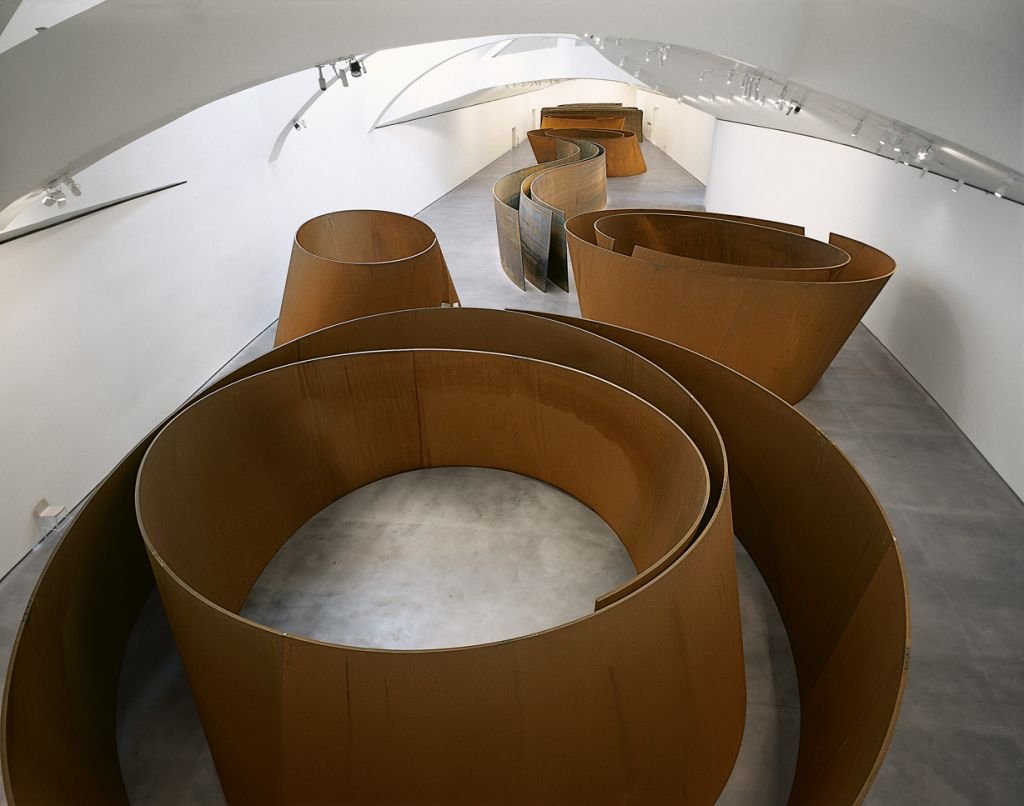
Guggenheim Museum Bilbao · Guggenheim Museum Bilbao
Tám khối thép trong một gian phòng
The Matter of Time là một nhóm tám tác phẩm điêu khắc của Richard Serra, làm từ năm 1994 đến năm 2005, đặt cố định trong gian 104 của bảo tàng Guggenheim Bilbao, Tây Ban Nha.
Vật liệu là thép chịu thời tiết. Loại thép này để ngoài không khí sẽ gỉ lên một lớp màu nâu cam, và chính lớp gỉ ấy giữ cho phần thép bên trong không bị ăn mòn thêm. Bề mặt của tác phẩm vì vậy luôn mang dấu thời gian, ngay cả khi nó đứng trong nhà.
Mỗi khối là những tấm thép khổng lồ uốn cong, cao vượt quá đầu người. Không khối nào có bệ. Không khối nào có mặt chính. Chúng đứng thẳng trên sàn, như những bức tường cong, để người xem đi quanh và đi vào bên trong.
Kích thước chung được ghi là thay đổi. Tác phẩm không đo bằng mét. Nó đo bằng thời gian một người cần để đi hết.
Từ elip đến xoắn ốc
Bảo tàng giải thích rằng tám khối được sắp theo một trình tự tiến hoá trong hình khối của Serra. Đầu tiên là những elip kép, tương đối đơn giản: hai vòng thép lồng nhau, chừa một lối đi hẹp ở giữa.
Sau đó là các xoắn ốc, phức tạp hơn. Những khối muộn nhất dùng các mảnh của hình xuyến và hình cầu. Những xoắn ốc xoắn làm trong hai năm 2003 và 2004 tạo ra những biến đổi không gian bất ngờ, khiến người đi bên trong có cảm giác như mặt đất đang chuyển động.
Đi dọc gian phòng từ đầu này sang đầu kia, người xem đi qua cả một thập kỷ làm việc của nghệ sĩ. Họ không đọc thông tin về quá trình ấy. Họ cảm nhận nó bằng chân, bằng vai, bằng tai khi tiếng bước chân dội lại khác nhau giữa các lớp thép.
Những hành lang không lường trước
Serra đặt các khối để dẫn người xem đi qua chúng và qua cả khoảng không bao quanh. Giữa các khối là những hành lang với tỷ lệ luôn thay đổi: rộng, hẹp, dài, bị nén, cao, thấp.
Trong một elip, bức tường thép nghiêng vào trong, rồi nghiêng ra ngoài. Người đi bên trong không thấy điểm cuối. Có lúc lối đi mở rộng thành một khoảng trống tròn. Có lúc nó ép sát tới mức vai gần chạm thép. Cơ thể phản ứng trước khi đầu kịp hiểu: chậm lại, nghiêng người, dừng.
Bảo tàng gọi đó là một cảm giác chóng mặt. Không gian không đứng yên mà co giãn theo từng bước. Mỗi lần đi qua cùng một khối, cảm giác lại khác, tuỳ tốc độ, tuỳ hướng, tuỳ có ai đi cùng.
Hai loại thời gian
Theo bảo tàng, tác phẩm chứa hai loại thời gian. Loại thứ nhất là thời gian theo đồng hồ: bao nhiêu phút để đi và nhìn từ đầu tới cuối. Loại thứ hai là thời gian của ký ức: những mảnh hình ảnh và cảm giác cơ thể, được ghép lại và sống lại khi người xem đi tiếp.
Ra khỏi một xoắn ốc, người ta vẫn mang theo cảm giác của lối đi hẹp vừa qua. Bước vào khối kế tiếp, cảm giác cũ và mới chồng lên nhau. Cuối gian phòng, không ai nhớ trọn vẹn đường mình đã đi. Chỉ còn những mảnh. Và mỗi người giữ một bộ mảnh khác nhau. Hai người đi cùng một lúc, qua cùng tám khối thép, sẽ bước ra với hai tấm bản đồ không trùng nhau. Tác phẩm đứng yên, nhưng thứ nó để lại trong mỗi người thì không giống nhau.
Đó là lý do tên tác phẩm đáng đọc chậm. The Matter of Time không kể chuyện về thời gian. Nó biến thời gian thành một thứ có trọng lượng, có bề mặt, có hướng đi. Một bài khác về thép, lần này đứng yên cạnh một tảng đá, là Relatum của Lee Ufan.
Eight forms in one gallery
The Matter of Time is a group of eight sculptures by Richard Serra, made between 1994 and 2005 and installed permanently in Gallery 104 of the Guggenheim Museum Bilbao in Spain.
The material is weathering steel. Left in the air, it develops a layer of brownish orange rust, and that layer protects the steel beneath from further corrosion. The surface of the work always carries the mark of time, even indoors.
Each piece is made of huge curved steel plates, rising well above head height. None has a plinth. None has a front. They stand directly on the floor like curved walls, for people to walk around and into.
The overall dimensions are listed as variable. The work is not measured in metres. It is measured in the time a person needs to walk through it.
From ellipse to spiral
The museum explains that the eight pieces follow the evolution of Serra's forms. First come double ellipses, relatively simple: two rings of steel, one inside the other, with a narrow path between.
Then come spirals, more complex. The latest pieces use sections of toruses and spheres. The torqued spirals of 2003 and 2004 produce sudden spatial shifts that make the walker feel the ground is moving.
Walking the gallery end to end, the visitor passes through a decade of the artist's work. They do not read about that process. They feel it in their feet and shoulders, and in their ears, as footsteps echo differently between the walls of steel.
Corridors you cannot predict
Serra arranged the pieces to move viewers through them and through the space around them. Between them run corridors of constantly changing proportion: wide, narrow, long, compressed, high, low.
In an ellipse the steel wall leans in, then out. From inside you cannot see the end. At times the path opens into a round clearing. At times it closes until your shoulder nearly grazes the steel. The body reacts before the mind catches up: it slows, leans, stops.
The museum speaks of vertigo. Space does not stay still; it expands and contracts with every step. Walking through the same piece twice feels different each time, depending on speed, direction, and who walks with you.
Two kinds of time
According to the museum, the work holds two kinds of time. The first is clock time: how many minutes it takes to walk and look from beginning to end. The second is the time of memory: fragments of image and bodily sensation, combined and lived again as the visitor moves on.
Coming out of a spiral, you still carry the feeling of the narrow passage behind you. Entering the next piece, old and new sensations overlap. By the end of the gallery nobody remembers the whole route. Only pieces remain. And each person keeps a different set. Two people walking together through the same eight forms come out with two maps that do not match. The work stays still; what it leaves in each person does not.
That is why the title deserves a slow reading. The Matter of Time does not tell a story about time. It turns time into something with weight, surface and direction. For steel of another kind, resting quietly beside a stone, read Lee Ufan's Relatum.

Contemporary Art