
Essays · Photography
Thomas Ruff. Photograms.
Một dấu vết không có vật nào chạm vào.
A trace that nothing ever touched.
Courtesy of the artist and David Zwirner Gallery, New York and London · Aperture
Ảnh không cần máy ảnh
Photogram là một trong những kỹ thuật lâu đời nhất của nhiếp ảnh. Không có máy ảnh, không có ống kính. Người ta đặt vật lên một tờ giấy nhạy sáng trong phòng tối, bật đèn trong một khoảnh khắc, rồi tráng. Chỗ nào vật che, giấy giữ màu sáng. Chỗ nào ánh sáng chạm tới, giấy sẫm lại. Kết quả là một cái bóng in thẳng lên giấy.
Kỹ thuật này có từ thế kỷ 19. Đến thập niên 1920, các nghệ sĩ tiên phong như Man Ray và László Moholy-Nagy biến nó thành một ngôn ngữ nghệ thuật. Họ đặt lên giấy lò xo, lăng kính, những tấm kính, những mảnh giấy cắt, và để ánh sáng quyết định phần còn lại. Moholy-Nagy còn thử làm photogram màu từ thập niên 1930.
Photogram luôn có một yếu tố may rủi. Vật hơi dịch đi, đèn hơi lệch, giấy hơi cũ, kết quả đã khác. Và kích thước của nó bị giới hạn bởi kích thước tờ giấy trong phòng tối.
Một phòng tối trong máy tính
Thomas Ruff là nhiếp ảnh gia người Đức thuộc thế hệ học ở Düsseldorf, nổi tiếng với những loạt ảnh dùng lại hình ảnh có sẵn: ảnh thiên văn trong Sterne năm 1989, hình máy móc công nghiệp trong maschinen năm 2003, ảnh từ tàu thăm dò Cassini năm 2008. Ông thường làm việc với những hình ảnh mà ông không tự chụp.
Ý tưởng cho Photograms đến từ một bộ sưu tập. Ruff sở hữu vài photogram của Art Siegel, một nghệ sĩ Mỹ giữa thế kỷ 20. Khoảng năm 2011, ông bắt đầu tự hỏi có thể làm photogram theo cách khác không.
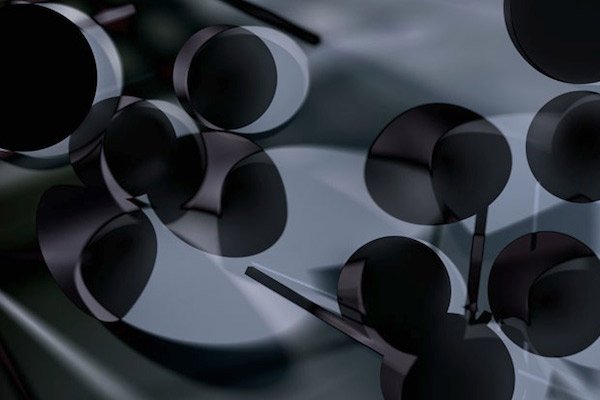
Câu trả lời của ông là dựng một phòng tối ảo bằng phần mềm 3D. Trong đó có giấy ảnh số, có vật, có nguồn sáng. Vật là những thứ quen thuộc của photogram: thấu kính, đôi đũa, dây xoắn, dải giấy. Ruff đặt chúng lên giấy, chỉnh vị trí đèn từ trên xuống, chọn màu cho ánh sáng. Rồi máy tính tính toán cái bóng.
Vì ánh sáng là ảo, ông có thể dùng màu. Nhưng ông dùng dè dặt. Theo ông, nếu quá nhiều màu, hình sẽ không còn giống photogram nữa, mà chỉ thành một bức tranh trừu tượng lạ lùng. Ông muốn hình vẫn phải đọc được là một cái bóng.
Bóng lớn hơn cả phòng tối
Một giới hạn lớn của photogram cổ điển là kích thước. Photogram của Ruff thì được in rất lớn, lớn hơn hầu hết những gì từng làm bằng kỹ thuật này. Đứng trước chúng, người xem thấy những đường xoắn to hơn cơ thể mình, những bóng trong suốt chồng lên nhau như thể được phóng đại từ một thế giới rất nhỏ.
Loạt ảnh ra mắt tại David Zwirner ở New York, trong triển lãm photograms and ma.r.s., từ cuối tháng 3 đến cuối tháng 4 năm 2013. Cùng triển lãm là ma.r.s., loạt ảnh Ruff làm từ ảnh chụp bề mặt sao Hoả.
Đặt hai loạt cạnh nhau, ta thấy một điều chung. Cả hai đều là ảnh về những nơi con người không thể đứng: bề mặt một hành tinh khác, và bên trong một phòng tối không tồn tại. Ruff không chụp thế giới. Ông hỏi nhiếp ảnh còn là gì khi không còn ai đứng sau ống kính.
Adam Fuss, trong My Ghost, dùng photogram để giữ lại khói, cánh bướm, những thứ có thật nhưng mong manh. Ruff đi theo hướng ngược lại. Ông giữ hình dáng của photogram, nhưng để trống chỗ của vật. Hai cách làm, cùng một kỹ thuật, và hai câu trả lời khác hẳn nhau cho câu hỏi: một dấu vết cần gì để là dấu vết.
Pictures without a camera
The photogram is one of photography's oldest techniques. No camera, no lens. Objects are placed on light sensitive paper in a darkroom, a light is switched on for a moment, and the paper is developed. Where the object blocks the light, the paper stays pale. Where light reaches it, the paper darkens. The result is a shadow printed directly onto paper.
The technique goes back to the nineteenth century. In the 1920s avant garde artists such as Man Ray and László Moholy-Nagy made it into an artistic language. They laid springs, prisms, glass, cut paper on the sheet and let light decide the rest. Moholy-Nagy also experimented with colour photograms in the 1930s.
A photogram always involves chance. An object shifts slightly, a lamp moves, the paper is a little old, and the result changes. Its size is limited by the size of the paper in the darkroom.
A darkroom inside a computer
Thomas Ruff is a German photographer of the Düsseldorf generation, known for series built from existing images: astronomical pictures in Sterne of 1989, industrial machinery in maschinen of 2003, pictures from the Cassini probe in 2008. He often works with images he did not take himself.
The idea for Photograms came from his own collection. Ruff owned some photograms by Art Siegel, an American artist of the mid twentieth century. Around 2011 he began to wonder whether photograms could be made another way.
His answer was a virtual darkroom built in 3D software. It contains digital photographic paper, objects and light sources. The objects are familiar from photogram history: lenses, chopsticks, spirals, strips of paper. Ruff places them, positions the light overhead, chooses its colour. Then the computer calculates the shadow.
Because the light is virtual, he can use colour. But he uses it sparingly. Too much colour, he has said, and the image no longer looks like a photogram, only strange and abstract. He wanted it still to read as a shadow.
Shadows larger than any darkroom
Classic photograms are limited in size. Ruff's are printed very large, larger than almost anything made with the technique before. Standing before them, viewers face spirals bigger than their own bodies, translucent shadows overlapping as if enlarged from a tiny world.
The series debuted at David Zwirner in New York in photograms and ma.r.s., from late March to late April 2013. Alongside it was ma.r.s., Ruff's series made from images of the surface of Mars.
Seen together, the two series share something. Both picture places no person can stand: the surface of another planet, and the inside of a darkroom that does not exist. Ruff does not photograph the world. He asks what photography still is when no one stands behind the lens.
Adam Fuss, in My Ghost, uses photograms to hold smoke and butterfly wings, real but fragile things. Ruff goes the other way. He keeps the photogram's shape but leaves the object's place empty. One technique, two very different answers to the question: what does a trace need to be a trace?
Photography