
Essays · Olfactory Art
Carrie Paterson. Beneath the Earth, the Sky.
To see the sky, sometimes you look down.
Institute for Art and Olfaction · Institute for Art and Olfaction
An exhibition turned upside down
The title is already an inversion. Beneath the earth, the sky. Usually the sky is above and the earth below. Carrie Paterson swaps them, and from that swap opens a series of questions about how people see the world.
Beneath the Earth, the Sky was Paterson's solo exhibition at The Institute for Art and Olfaction on Chung King Road, Los Angeles, from 26 April to 26 May 2024. It opened on the evening of 26 April. On 16 May the artist spoke with Christopher Michno in the gallery.
Inversion is a familiar principle in sculpture: solid becomes void, the inside shows on the outside, the base becomes the top. Paterson uses it to reflect on contemplative practices, the things people slow down for in order to look closely.
In the show, trees and stones are not only materials. They are treated as collaborators in what the gallery text calls an art and technology practice, concerned with memory, migration and sensation.
Slow practices
The exhibition refers to many contemplative practices. Bonsai, the art of growing small trees in pots. Miniature landscapes with rocks and plants. Skipping stones across water. Stargazing. Shrines. Incense.
Side by side they share one thing. All of them ask for time and attention. A bonsai needs years of pruning. A skipping stone needs the right angle of the wrist and the right stretch of water. A night sky only appears once the eyes adjust to the dark. A stick of incense burns at its own pace and cannot be hurried.
Paterson knows these practices from the inside. The artist volunteers at the bonsai nursery of the Huntington Gardens. Tending trees is part of Paterson's working life before it is ever an art material.
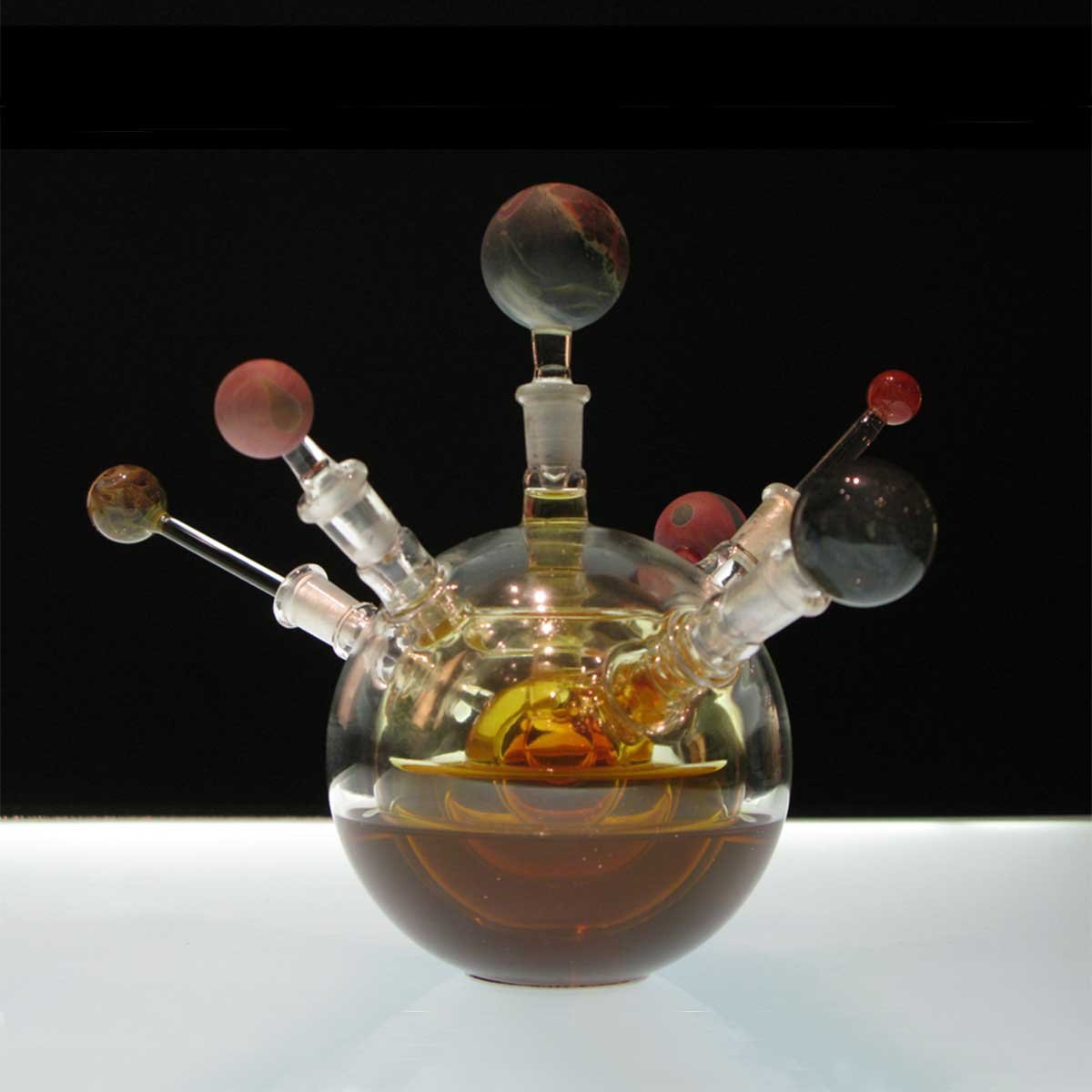
The materials in the room include plants, trees, stones, glass vessels, scented elements and images of flowers taken from a 2024 Chinese calendar. There are mixed media miniature landscapes, and an untitled memorial piece.
From a pot to the stars
The titles of the works pull visitors far from the pot. Copernican System No. 1 recalls the Copernican model, which placed the Sun at the centre, one of the great inversions in how people have pictured the universe. Three Body Harmony recalls the three body problem in physics, three masses pulling on one another through gravity. Chemisphere sounds like an atmosphere made of chemistry.
And there is Homesickness Kit for Spacefarers. The title may be the key to the whole show. If people one day live far from Earth, what will they take to remember home? A stone? A branch? A smell?
The question sounds like science fiction, but it is close to the lives of migrants. The gallery text names displacement, diaspora, gravity, decay and nomadic life among its themes. People who leave home carry small kits like this too; no one simply gives them a name.
Incense and a family's memory
Paterson was born in 1972 and grew up in a ski town in Colorado. The paternal side of the family were Viennese Jews who survived the Second World War. The maternal side were immigrant farmers from Schleswig Holstein. Paterson studied literature at Yale and took an MFA at UC Irvine in 2001.
A family like this carries many departures. Perhaps that is why small, portable things, the kind that can be set on a table in a new house, weigh so much in Paterson's practice. A potted tree, a stone, a stick of incense can be set up again anywhere.
Incense holds a particular place on that list. In many cultures people burn it at shrines to link the living with the dead, the ground with something above. Smoke is the only thing in the room that moves against gravity. In an exhibition about earth and sky, it is the line between the two.
Readers of Penta can find more on the craft of incense in Arianna Petrich's The Water and the Wind, on incense craft in Awaji, Japan. For Paterson, incense is not a trade. It is a small gesture, repeated, in order to remember.
Olfactory Art