
Essays · Contemporary Art
Cornelia Parker. Cold Dark Matter: An Exploded View.
Even an explosion can be kept.
Tate · Tate
A shed and the things you cannot throw away
In 1991 Cornelia Parker asked a company in Suffolk to build her a garden shed. She wanted an archetypal one, 8 by 12 feet, with windows. According to Tate, it was assembled from wood taken from various old sheds.
She had first gone round allotments looking for an existing shed. But each carried its owner's story. Blowing up a particular person's shed would make the work about that person's life. She needed everyone's shed, so it had to be built new.
Then she filled it. Tools, children's toys, books, odds and ends. Some were her own. Most were gathered over three months, from friends or car boot sales. For Parker a shed is like an attic: the place where things you cannot quite throw away collect. Toys, tools, outgrown clothes, records.
The British Army and an explosion
Parker asked the British Army for help. To her surprise they agreed readily. She was invited to the Army School of Ammunition and watched demonstrations of different explosives, used on a table and a car.
She chose plastic explosive, because it gave the most archetypal explosion: things simply blown apart, with no pyrotechnics or special effects. The shed and everything in it was blown up.
Afterwards the scattered wood and objects, twisted and blackened, were carefully collected. Some were never found, thrown too far or destroyed. Parker has said that seeing them laid out on the gallery floor felt like a morgue. Too much about death.
She had staged similar cartoon deaths before: silverware flattened by a steamroller, coins run over by a train. The explosion was the next step.
Hung around a light bulb
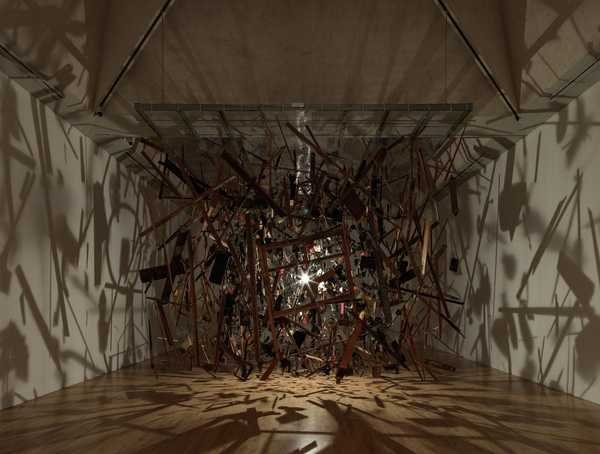
Parker decided not to leave the fragments on the floor. She hung them on transparent wire, one by one, as if flying out from the centre of the blast. At the very centre is a single light bulb.
Once suspended, the objects lost their air of death. In Parker's words recorded by Tate, they seemed reanimated, in limbo. The central light throws huge shadows on the walls, so the shed seems to explode again, or to come back together.
Viewers can walk around and look through the work, finding each piece. The spaces between fragments are part of it. Parker has said she has never made a solid sculpture. She cares about the space within and around the mass, about atmosphere.
A single light source can transform a room, as Olafur Eliasson later showed with an artificial sun at Tate Modern. In Parker's work the light does not warm. It makes what has broken appear larger on the wall.
Cold dark matter
The title comes from astrophysics. Parker explains that cold dark matter is the material in the universe we cannot see or measure. We know it is there but cannot quantify it.
The name puts a garden shed, something small and ordinary in British life, beside cosmic events. An explosion in a garden and the Big Bang. Old belongings and stars.
The work was presented to Tate by the Patrons of New Art through the Tate Gallery Foundation in 1995. It is one of Parker's best known pieces and returned in her major exhibition at Tate Britain.
Standing in the room, you do not see the explosion. That was long ago. You see what came after: a silence held in place, fragments that refuse to fall, shadows larger than the things that cast them.

Contemporary Art