
Essays · Photography
Francesca Woodman. Space².
The body leaves; the room keeps the shape.
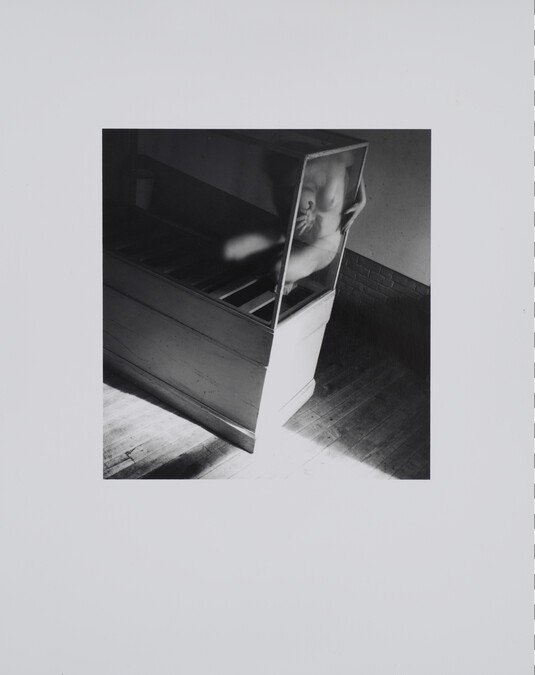
© Woodman Family Foundation / Artists Rights Society (ARS), New York · Hood Museum of Art, Dartmouth
A student and a room
Francesca Woodman was born in the United States in 1958 and died in 1981, at twenty two. Most of what she left behind was made in a few short years, much of it while she studied photography at the Rhode Island School of Design in Providence.
Space² is a series made in Providence around 1975 to 1976, when Woodman was in her first year. The title is a mathematical joke: space squared. Space multiplied by itself. The space of the room, and the flat space of the photograph.
The subject hardly changes from print to print: a body, usually Woodman herself, set in the corner of an old room. Peeling walls, wooden floors, a window, a cabinet. No story is told. There is only a person and the place where she stands.
The prints are small gelatin silver prints on 8 x 10 inch sheets. The one held by the Hood Museum of Art at Dartmouth is number eleven in an edition of forty.
The display case and the arm
The best known image of the series places Woodman inside a glass display case, the kind usually used to show specimens. She is nude, pressed against the glass, balanced on wooden slats inside the cabinet. Around her, darkness.
A case like this exists so that objects can be looked at. A stuffed bird, a mineral, a shard of pottery. Woodman puts herself in that position. But she does not lie still like a specimen. One arm reaches out past the frame of the case, beyond the boundary it draws.
The museum label observes that although she is nude, she does not appear vulnerable. She refuses to be an object on display. The arm is where that refusal becomes visible: the body is inside the box, but the decision is outside it.
The image is both funny and unsettling. Funny because a seventeen year old climbed into a vitrine to take a picture. Unsettling because the case recalls dead things kept for the living to look at.
Long exposure
The main technique of Space² is simple: leave the shutter open. During that time Woodman moves. The room is still, so it comes out sharp. The body becomes a smear, sometimes so transparent that the wall shows through.
The result is an inversion. In a portrait the person is usually the centre and the background recedes. Here the background is more solid than the person. The floorboards, the stains on the wall, the window frame all carry weight. The figure is a trace of smoke passing through.
Other pictures in the series use other ways of hiding. The body tucked behind furniture, flattened by a sheet of glass, merging into a corner. Critics have often said the series reminds us of something basic: every photograph is a distortion. A camera does not record the world. It records a span of time pressed into a flat surface.
Woodman used that limit as her material. Because film needs time to take in light, she let time appear in the picture, as a body dissolving. A few years later, Hiroshi Sugimoto left his shutter open for the length of a film in a cinema. Two artists, two methods, one idea: time is something a camera can record.
Why Space² is still looked at
Woodman died young, and her death often shadows the way her pictures are read. But in front of Space², the viewer does not need the biography. What is there is enough: a young artist testing how her body and a room might talk to each other through light.
Her work now sits in major museum collections. The Hood Museum acquired the display case print in 2013 and has shown it in exhibitions about the body and identity. It is worth noticing that the print is still small. The viewer has to step close and lean in, much as one would look into a real display case.
Space² does not tell the story of a person. It records the trace of a person in a place. The person is blurred, the place is sharp. And that blur is what stays with us.
Photography