
Essays · Olfactory Art
Irina Adam. Pitch Pine Pollen: A Transforming Forest.
A forest changing colour, kept in a vial of scent.
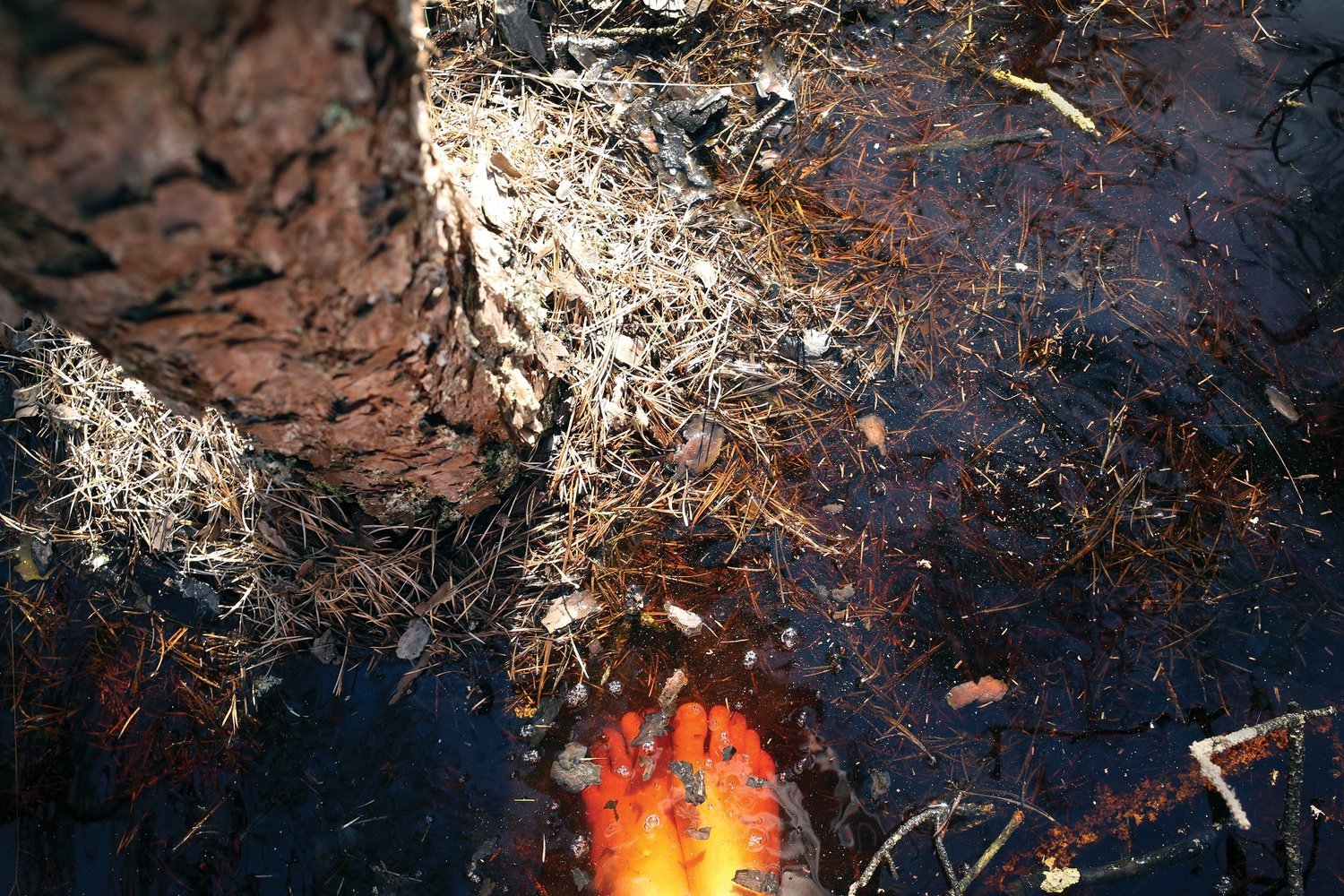
© Irina Adam · Olfactory Art Keller
A familiar trail
Irina Adam is a Brooklyn based perfumer and multimedia artist. Her work tends to centre on nature, and tends to invite the visitor in through several senses at once.
Pitch Pine Pollen: A Transforming Forest begins somewhere very personal: her favourite hiking trail. It lies in the Napeague area of the Long Island Pine Barrens, a sandy pine forest at the eastern end of Long Island, New York. According to the exhibition page, the name Napeague means land overflowed by the sea in Montaukett.
The dominant tree is the pitch pine, a species that tolerates poor soil, sea wind and fire. Adam walked there many times. Her aromatic extracts began as souvenirs of those walks: a way of bringing the forest home without breaking a branch or pulling up a plant.
Pollen, resin, needles
Her ingredients all came from the forest. Pine pollen suspended in alcohol. Pine resin, which the trees release to defend themselves against beetles. Needles. Green pollen tips. Beach plum flowers, from a shrub that grows along the dunes. Oak flowers.
From these wild materials she composed her latest perfume and named it Pitch Pine Pollen, after the exhibition.
The method sits closer to sampling than to composing. Each ingredient belongs to a season and a place. Pine pollen exists only when the trees release it. Beach plum blooms for a short time. The vial therefore carries its own date: it is the smell of that forest in the months she walked through it, not some generic smell of pine.
One small detail in that list deserves attention. Resin is the tree's response to an attacker. When beetles bore into the trunk, the tree pushes resin out to seal the wound. So part of the smell in the vial comes from the forest's own resistance. The person smelling it never sees the beetle, but smells what the tree used to push it away.
From green to red, then grey
Since 2022, the southern pine beetle has been devastating the pitch pines here. The beetle once lived further south and has been moving north as temperatures rise. The exhibition page describes what the artist witnessed as a sequence of colours: green needles turning red, then grey.
Adam photographed that change. The prints, archival inkjet on Hahnemühle paper at 18 by 24 inches, record the shapes of the forest and the quiet beauty of an ecosystem in transition. Photographs and scent were shown together at Olfactory Art Keller in New York from May 9 to 25, 2024, with an artist talk on May 17.
The two media record different things. The photographs show colour and form: which trees are still green, which have turned red, which are already grey. The scent records what a camera cannot hold: resin, pollen, the air between trunks. Side by side, they form a file on a place while it is changing.
A portion of sales went to the Long Island Pine Barrens Society, which works to protect the region. That detail keeps the exhibition from stopping at documentation. It turns back toward the forest that supplied its materials.
Some works about forests are made with fire, like Katie Paterson's To Burn, Forest, Fire. Pitch Pine Pollen is made from the pollen and resin of trees still standing.

Olfactory Art