
Essays · Olfactory Art
Katie Paterson. To Burn, Forest, Fire.
Fifteen minutes for three hundred million years.
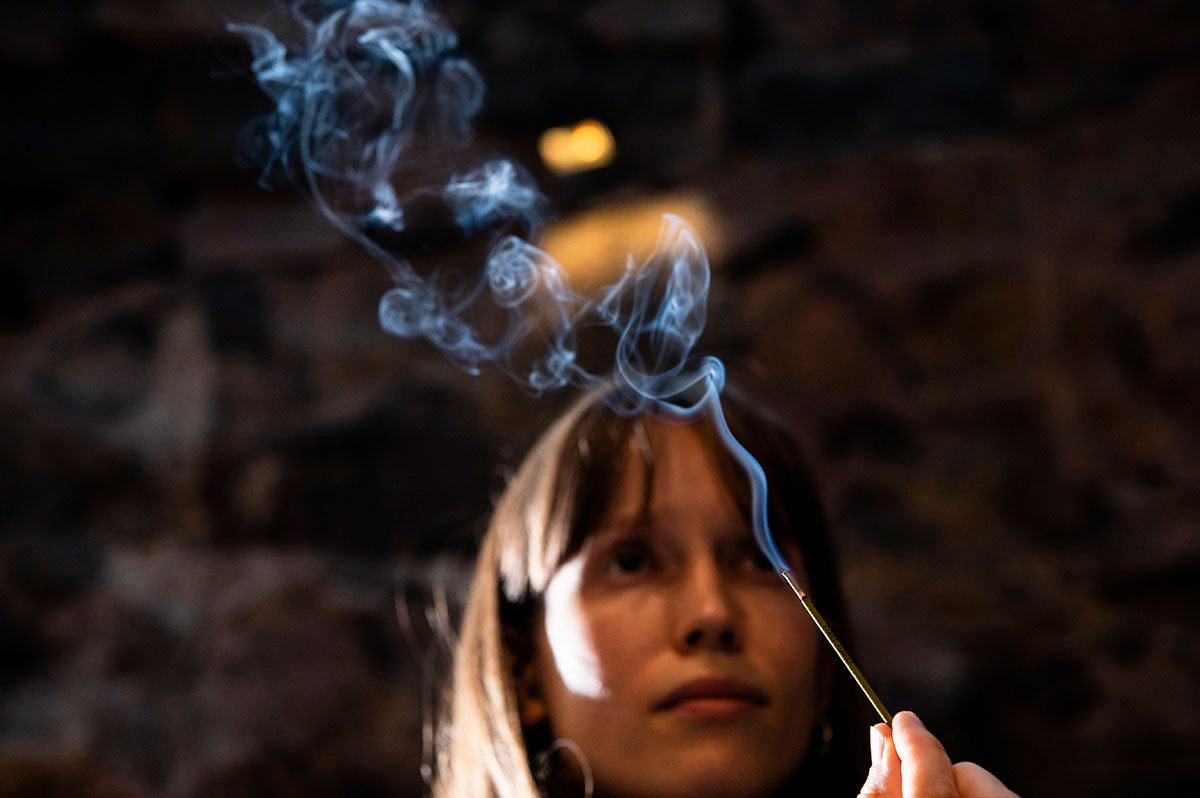
© Katie Paterson · Katie Paterson (official artist site)
The first forest, the last forest
In the Hudson Valley, New York State, scientists found traces of a very old forest, called the Cairo forest after a nearby town. Its roots are still printed in the rock. It once held Cladoxylopsida, a now extinct group of trees among the first on the planet. The forest dates back more than three hundred million years.
At the other end of time is the Amazon. The largest remaining rainforest, and gravely threatened. Katie Paterson calls it the last forest, not because it will surely be lost, but because it stands at the edge of an age of climate crisis.
To Burn, Forest, Fire is the smell of those two forests. Paterson, a Scottish artist, made the work in 2021 as a reminder of the sixth mass extinction, the one caused by humans.
She did not paint the forests. She did not photograph them. She made incense.
Rebuilding a smell no one has smelled
No one lived in the time of the Cairo forest. There is no record of its smell. To recreate it, Paterson had to start with science. She worked with the geologist Jan Zalasiewicz, J. Sakari Salonen of the University of Helsinki, the palaeobotanist Chris Berry and the biologist David George Haskell, who also wrote the accompanying essay.
Together they determined which forest was first, which was last, and what they held: trees, soil, water, air. That knowledge was then translated into scent with Shoyeido, a long established Japanese incense maker.
The first forest's scent tries to rebuild that atmosphere: the soil, water and air of hundreds of millions of years ago. The last forest's scent is described on the artist's site as close to a densely planted greenhouse: vegetation, moisture, soil, and decaying wood.
Each stick burns for about fifteen minutes. A very short time to hold very large numbers. The person beside the stick need not know any geological period. They only need to breathe, and let the nose do what a textbook cannot.
Burned across a city
The work was the IHME Helsinki Commission for 2021. That September, the incense was burned at more than ten indoor and outdoor sites around Helsinki with IHME's partners. One ceremony took place in the crypt of Helsinki Cathedral.
The form of incense is not incidental. Incense belongs to ritual and remembrance in many cultures. People burn it for the dead. Here, what is remembered is a forest already lost and one that may be lost. Japanese incense traditions, like the Awaji craft that Arianna Petrich documented, are bound up with wind, water and trees. Paterson borrows that language.
Incense also consumes itself. The work leaves nothing but ash and a smell that lingers in the room for a while. It is a direct way to speak of loss: visitors watch the thing burn away before their eyes.
Paterson often works with spans beyond a human life: light from dead stars, books to be read only a century later. To Burn, Forest, Fire brings that scale down to the smallest possible thing: a stick, a thread of smoke, a breath. The person in the room inhales a forest. Then it is gone.

Olfactory Art