
Essays · Contemporary Art
Jorge Otero-Pailos. The Ethics of Dust.
Dust is not dirt. It is time that has settled.
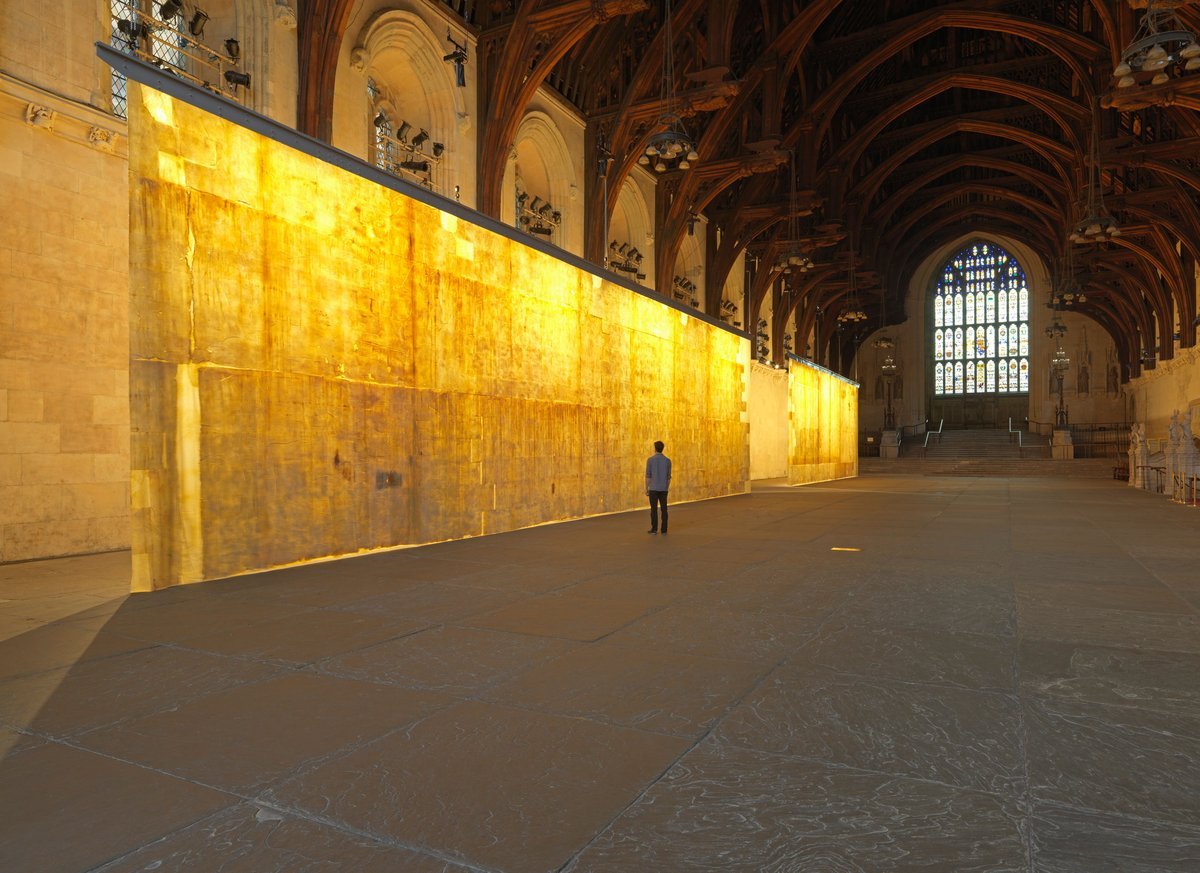
courtesy Artangel · Artangel
The oldest wall
Westminster Hall is the oldest surviving part of the Houses of Parliament. It was commissioned by William Rufus, son of William the Conqueror, and completed in 1099. Its timber hammer beam roof, added under Richard II, is the largest of its kind in Northern Europe.
The building has lived through a great deal. The fire of 1834. Bombing in the Second World War. The Great Smog of London in 1952. Each left something on the walls.
In 2016, with Artangel, the artist Jorge Otero-Pailos was allowed to work directly on the hall's east wall. He did not paint on it. He did not hang anything on it. He took something that was already there.
Spray on, peel off
The method is simple to describe. Liquid latex, translucent, was sprayed onto the stone. As it dried, it formed a skin. Then the skin was peeled away.
As it came off, the latex took with it whatever clung to the stone: dust, soot, pollution gathered over centuries. The wall was cleaned. The latex kept all of that grime, in the exact shape of each stone and each joint.
The finished cast was more than 50 metres long. It hung from the roof, parallel to the very wall it came from. Lit from behind, and by daylight from the high windows, it glowed amber.
Visitors stood between two things: the clean wall, and the sheet holding what had made it dirty. Two faces of one surface. On one side, stone; on the other, the time that had settled on it.
A conservator making art
Otero-Pailos was born in Madrid in 1971. He is both an artist and an architectural conservator, associate professor and director of historic preservation at Columbia University. This was not the first time he had done this. At the 2009 Venice Biennale he made similar casts from the walls of the Doge's Palace.
The title borrows from a book by John Ruskin, The Ethics of the Dust. Ruskin, the nineteenth century English critic, opposed heavy handed cleaning of old buildings. For him the surface of an old building carried its history, and over cleaning erased it.
Otero-Pailos takes that idea one step further. He cleans the wall, as a conservator would. But he does not throw away what was removed. He keeps it, shows it, and calls it the work.
Dust as an archive
According to Artangel, the dust in the latex carries traces of major events, including the Second World War and the smog of 1952. No one can read each particle. But visitors know they are there.
This changes how we think about dust. At home, dust is something to wipe. Here, it is an archive without words. It records the air of a city over centuries: what people burned, breathed out, released into the sky.
The work was on view from 29 June to 1 September 2016. Then the cast came down. The wall still stands, cleaner, and from that day began gathering new dust.
Like the glacier water columns in Roni Horn's Library of Water, this sheet is a specimen. It keeps something ordinary that usually vanishes without anyone noticing.
Contemporary Art