
Essays · Contemporary Art
Anya Gallaccio. preserve 'beauty'.
Bông hoa không được giữ lại. Nó được để cho đi hết đường của mình.
The flower is not kept. It is allowed to go all the way.
Tate · Tate
Một bức tường hoa đỏ
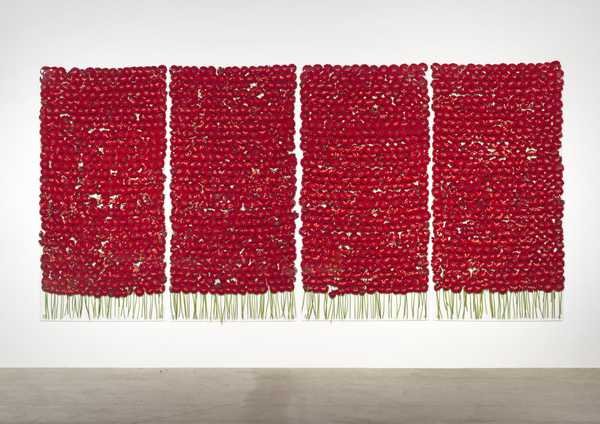
preserve 'beauty' gồm bốn tấm kính trong lớn đặt sát nhau trên tường. Phía sau kính là những hàng hoa đồng tiền đỏ, nhuỵ sẫm, ép thành một lớp duy nhất. Mặt hoa quay ra phía người xem. Cuống hoa chúc xuống, nên ở mép dưới mỗi tấm kính có một dải xanh, là cuống của hàng hoa cuối cùng.
Khi trưng bày ở Tate, cả bức tường rộng hơn năm mét, cao hơn ba mét. Số hoa mỗi lần dựng thay đổi theo cỡ bông, thường từ một nghìn sáu trăm đến hai nghìn bông.
Loại hoa được dùng là một giống đồng tiền lai có tên thương mại là 'Beauty'. Chữ trong ngoặc của nhan đề vì thế vừa là tên một giống hoa, vừa là một lời chơi chữ. Tác phẩm nói sẽ giữ lại vẻ đẹp. Rồi nó để vẻ đẹp ấy héo đi trước mắt mọi người.
Dựng lên để tàn đi
Anya Gallaccio, sinh năm 1963, làm tác phẩm này lần đầu năm 1991 cho khung cửa kính của Karsten Schubert, một gallery ở London. Lần ấy bà dùng tám trăm bông hoa, ép giữa cửa sổ gallery và một tấm kính, mặt hoa quay ra đường cho người đi ngang nhìn thấy.
Vì hoa tàn, tác phẩm không thể tồn tại lâu ở một hình dạng. Từ năm 1991, Gallaccio đã dựng lại nó nhiều lần, ở nhiều nơi. Mỗi lần là hoa mới.
Cách dựng được Tate ghi lại khá kỹ. Một tấm kính được đặt nằm trên sàn. Hoa được xếp thành hàng và buộc vào mặt sau tấm kính bằng chỉ nha khoa. Rồi tấm kính được dựng đứng thật nhanh, ép vào tường vừa đủ để hoa nằm yên. Chỉ được cắt và rút ra. Hoa ở lại, không còn gì giữ ngoài lực ép của kính.
Trong thời gian trưng bày, hoa co lại khi khô và mục, nên các tấm kính phải được chỉnh lại. Có bông rơi xuống sàn. Chúng được để nguyên ở đó, tiếp tục phân huỷ. Khi triển lãm kết thúc, toàn bộ hoa bị bỏ đi.
Hoa như một món hàng
Gallaccio thường làm việc với những vật liệu hữu cơ, dễ hỏng: băng, hoa, trái cây, đường. Ở một tác phẩm khác, Stroke, bà phủ tường bằng sô cô la. Theo nhãn trưng bày của Tate, preserve 'beauty' thách thức những ý niệm lãng mạn quanh bông hoa và quan hệ của con người với tự nhiên. Bà từng gọi hoa cắt là một món hàng sản xuất hàng loạt, dùng một lần.
Đặt hai nghìn bông hoa sau kính là một cách nhìn thẳng vào điều đó. Mỗi bông đồng tiền này đã được trồng, cắt, đóng thùng, chở đi. Ở tiệm hoa, nó sống vài ngày trong bình rồi vào thùng rác. Ở đây, nó sống cùng quãng đời ngắn ấy, nhưng không ai mang nó đi khi nó xấu đi. Người xem phải đứng trước cả phần đời mà ta thường không nhìn.
Màu đỏ sẫm lại, rồi chuyển nâu. Cánh hoa quăn, dẹt ra, dính vào kính. Mùi cũng đổi. Tate ghi rằng người xem nhận ra tác phẩm qua khứu giác: họ gặp mùi hoa tươi hay mùi hoa mục, tuỳ vào việc tác phẩm đã được dựng bao lâu.
Một màn diễn với vật liệu
Gallaccio gọi công việc của mình là một màn diễn giữa bà và vật liệu. Bà cũng nói đây là một sự cộng tác với người xem, những người gặp tác phẩm trong một khoảng thời gian có hạn. Không ai thấy toàn bộ preserve 'beauty'. Mỗi người chỉ gặp một đoạn của nó.
Tate nhận tác phẩm năm 2004, do một nhà tài trợ giấu tên tặng. Điều mà bảo tàng sở hữu không hẳn là một vật. Đó là một cách làm: loại hoa, số lượng, cách buộc, cách dựng, và lời dặn để mặc cho hoa tàn. Mỗi lần trưng bày, tác phẩm được sinh ra lại, rồi đi hết đường của nó.
Đó là lý do tác phẩm này đáng nhớ. Nó không cho người xem một hình ảnh đứng yên để mang về. Nó cho một khoảng thời gian, và một mùi thay đổi trong khoảng thời gian ấy.
A wall of red flowers
preserve 'beauty' consists of four large sheets of clear glass set side by side on a wall. Behind the glass are rows of red gerberas with dark centres, pressed into a single layer. The flower heads face the viewer. The stems point down, so the lower edge of each panel carries a band of green: the stems of the bottom row.
Displayed at Tate, the wall is more than five metres wide and more than three metres high. The number of flowers varies with the size of the heads, usually between sixteen hundred and two thousand.
The flower is a hybrid gerbera sold under the name 'Beauty'. The word in quotation marks is both the name of a variety and a pun. The work says it will preserve beauty. Then it lets that beauty wither in front of everyone.
Built in order to decay
Anya Gallaccio, born in 1963, first made the work in 1991 for the window of Karsten Schubert, a gallery in London. That time she used eight hundred flowers, pressed between the gallery window and a sheet of glass, facing outward for people passing in the street.
Because the flowers die, the work cannot last in one form. Since 1991 Gallaccio has rebuilt it many times, in many places. Each time with new flowers.
Tate records the installation in detail. A glass panel is laid flat on the floor. The flowers are arranged in rows and tied to the back with dental floss. The panel is raised quickly and fixed to the wall, pressing just enough to hold the flowers. The floss is cut and drawn out. The flowers stay, held only by the glass.
During the display the flowers shrink as they dry and rot, so the panels must be adjusted. Some fall to the floor and are left there to keep decomposing. When the display closes, all the flowers are thrown away.
The flower as a commodity
Gallaccio often works with organic, perishable materials: ice, flowers, fruit, sugar. In another work, Stroke, she covered walls with chocolate. Tate's label says preserve 'beauty' challenges romantic ideas about flowers and our relationship with nature. She has called cut flowers a mass produced, disposable commodity.
Placing two thousand flowers behind glass is a way of looking straight at that. Each gerbera was grown, cut, boxed and shipped. In a florist it lives a few days in a vase and then goes in the bin. Here it lives the same short life, but no one removes it when it turns ugly. The viewer has to face the part of its life we usually do not look at.
The red darkens, then browns. Petals curl, flatten, stick to the glass. The smell changes too. Tate notes that visitors meet the work through smell: fresh flowers or rotting ones, depending on how long it has been up.
A performance with material
Gallaccio calls her work a performance between herself and the material. She also describes it as a collaboration with the people who come to see it during its limited life. No one sees all of preserve 'beauty'. Each visitor meets only one stretch of it.
Tate received the work in 2004 as a gift from an anonymous donor. What the museum owns is not quite an object. It is a method: the variety of flower, the number, the tying, the raising, and the instruction to let them die. Each display, the work is born again and runs its course.
That is why it stays in the mind. It does not give the viewer a still image to take home. It gives a span of time, and a smell that changes within it.
Contemporary Art