
Essays · Modern Art
Barnett Newman. Adam.
Con người đầu tiên mang tên của đất.
The first man carries the name of the earth.
Tate · Tate
Nâu và đỏ
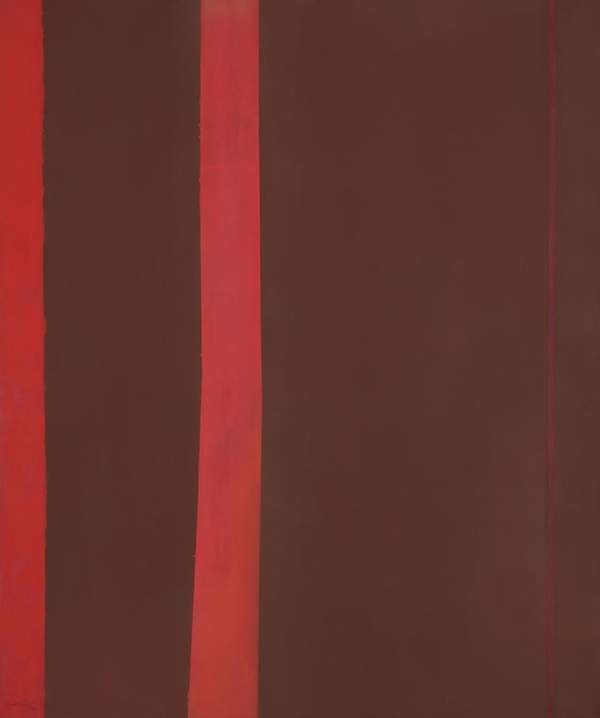
Adam là một bức tranh sơn dầu khổ lớn, cao khoảng 243 cm, rộng khoảng 203 cm. Gần như toàn bộ mặt tranh là một màu nâu đất. Chạy dọc từ trên xuống dưới là những dải đỏ: một dải mềm mép ở bên trái, một dải rộng và nặng ở lệch trái giữa, hơi cong về phía đáy, và một dải rất mảnh ở bên phải.
Những dải dọc như vậy là dấu hiệu nhận ra Newman. Người ta gọi chúng là zip. Chúng không chia bức tranh thành nhiều ô. Chúng làm ngược lại: khiến cả mặt màu trở thành một khối liền, có một đường ánh sáng chạy qua.
Đứng gần, bức tranh vượt khỏi tầm nhìn. Mắt không thấy được mép tranh cùng lúc. Người xem không nhìn một hình, mà đứng trong một màu.
Bức tranh vẽ hai lần
Adam và Eve là hai bức tranh cuối cùng Newman hoàn thành trước triển lãm cá nhân thứ hai của ông tại phòng tranh Betty Parsons ở New York, tháng 4 và tháng 5 năm 1951. Lúc ấy, Adam chỉ có hai dải: dải đỏ mềm mép bên trái và đường zip mảnh bên phải.
Năm sau, Newman thêm dải đỏ rộng ở gần giữa. Vì thế tranh mang hai năm, 1951 và 1952, và chữ ký của ông ghi đúng như vậy.
Báo cáo kỹ thuật của Tate cho thấy ông làm việc cẩn trọng thế nào. Trên nền trắng, ông quét một lớp đỏ thắm mỏng. Khi khô, ông dán băng keo đánh dấu các dải, rồi phủ màu nâu lên tới mép băng, dùng dao làm sắc lại mép. Có chỗ băng không bám chặt, màu đỏ lọt ra ngoài, và ông lại lấy nâu phủ lên cho gọn. Khi thêm dải thứ ba, ông chà mỏng lớp nâu, có chỗ xuống tới vải toan, rồi mới vẽ lớp đỏ mới. Dải ấy hơi bóng hơn phần còn lại. Tranh không phủ vecni.
Bức tranh vì thế không phẳng lặng như vẻ ngoài. Nó mang dấu của một lần quay lại.
Tên của con người đầu tiên
Newman đặt tên tranh sau khi vẽ xong. Trong một cuộc phỏng vấn năm 1967 với David Sylvester, ông giải thích rằng ông chọn cái tên gợi được nội dung cảm xúc của bức tranh, một kiểu ẩn dụ tương ứng với cảm giác của nó.
Từ khoảng năm 1946, sau gần năm năm gần như ngừng vẽ, Newman bắt đầu lại và muốn nghĩ lại hội hoạ từ đầu. Ông hay chọn những cái tên về sự sáng thế, như The Beginning, Genetic Moment, hay tên các nhân vật Cựu Ước, như Abraham, Joshua. Adam, con người đầu tiên, nằm trong mạch ấy.
Theo Tate, chữ adam trong tiếng Do Thái nghĩa là con người, bắt nguồn từ adamah, đất. Chữ adom nghĩa là đỏ, và dam là máu. Nâu và đỏ trong tranh vì thế có thể đọc như sự gắn bó của con người với đất. Vợ ông, Annalee Newman, xác nhận từng nghe ông nói về những nghĩa này của chữ adam, dù ông chưa bao giờ nói với bà về chúng trong liên hệ với bức tranh.
Tate cũng ghi rằng những dải dọc trong tranh Newman có thể liên quan đến những truyền thống thần bí Do Thái, nơi Thượng đế và con người được hình dung như một tia sáng duy nhất.
Adam, Eve, và một người bạn
Eve, vẽ năm 1950, hẹp hơn Adam, gần như toàn một màu đỏ tươi với một dải tím mảnh ở mép phải. Hai bức có chung tên gọi từ Sáng thế ký, nhưng theo Tate, Newman không coi chúng là một cặp. Ngày nay cả hai đều thuộc bộ sưu tập Tate.
Người mua Adam đầu tiên là nhà sưu tập Ben Heller. Theo bà Annalee, chính Jackson Pollock đã giới thiệu Heller với Newman. Năm 1957, Heller mua Adam trực tiếp từ tay hoạ sĩ, và về sau mua cả Vir Heroicus Sublimis. Tate mua lại Adam từ vợ chồng Heller năm 1968.
Chi tiết ấy nối hai hoạ sĩ rất khác nhau của cùng một thế hệ. Pollock để lại những đường sơn chạy ngang, đầy chuyển động. Newman để lại những mặt màu đứng yên, có một đường sáng chạy dọc. Cạnh những bức tranh tối trong nhà nguyện của Rothko, Adam cho thấy một lối khác của hội hoạ Mỹ thời ấy: không kể chuyện, chỉ đặt người xem đứng trước một màu, và một cái tên.
Brown and red
Adam is a large oil painting, about 243 centimetres high and 203 wide. Almost the whole surface is an earthy brown. Running from top to bottom are red bands: a soft-edged one at the left, a broad heavy one left of centre that bends slightly towards the base, and a very thin one on the right.
Vertical bands like these are Newman's signature. They are called zips. They do not divide the painting into compartments. They do the opposite: they make the whole field one continuous body, with a line of light running through it.
Up close the painting exceeds the field of view. You cannot see both edges at once. The viewer does not look at a shape but stands inside a colour.
A painting made twice
Adam and Eve were the last two paintings Newman finished before his second solo show at the Betty Parsons Gallery in New York in April and May 1951. At that point Adam had only two bands: the soft red one at the left and the thin zip at the right.
The following year Newman added the broad red band near the centre. So the painting carries two dates, 1951 and 1952, and his inscription says exactly that.
Tate's technical notes show how carefully he worked. Over a white ground he laid a thin crimson wash. When it dried he masked the bands with tape, brushed brown up to the tape and sharpened the edge with a knife. Where the tape did not hold, red escaped, and he covered it again with brown. For the third band he rubbed the brown down, in places to the bare cotton, before painting the new red. That band is slightly glossier than the rest. The painting is unvarnished.
It is less calm than it looks. It carries the mark of a return.
The name of the first man
Newman titled his paintings after finishing them. In a 1967 interview with David Sylvester he explained that he chose names that evoked the emotional content of the work, a kind of metaphor corresponding to its feeling.
From around 1946, after some five years of barely painting, he started again and wanted to rethink painting from the beginning. He often chose titles about creation, such as The Beginning and Genetic Moment, or Old Testament names such as Abraham and Joshua. Adam, the first man, belongs to that line.
Tate notes that the Hebrew adam means man and derives from adamah, earth, while adom means red and dam means blood. The brown and red may therefore be read as mankind's closeness to the earth. His wife Annalee Newman confirmed that she had heard him speak about these meanings of adam, though never in connection with the painting.
Tate adds that Newman's vertical bands may relate to mystical Jewish traditions in which God and man are imagined as a single beam of light.
Adam, Eve and a friend
Eve, painted in 1950, is narrower than Adam: a field of bright red with a thin purple band at the right edge. The two share names from Genesis, but according to Tate Newman did not think of them as a pair. Both are now in Tate's collection.
Adam's first owner was the collector Ben Heller. According to Annalee Newman, it was Jackson Pollock who introduced Heller to Newman. In 1957 Heller bought Adam directly from the studio and later acquired Vir Heroicus Sublimis as well. Tate bought Adam from the Hellers in 1968.
That detail links two very different painters of one generation. Pollock left paint running sideways, full of motion. Newman left still fields with a line of light running upward. Beside the dark canvases of Rothko's chapel, Adam shows another path in American painting of the time: no story, only a viewer standing before a colour, and a name.
Modern Art