
Essays · Olfactory Art
Dineo Seshee Bopape. sa ____ ke lerole, (sa lerole ke ___).
Đất cũng có trí nhớ. Nó giữ lại bằng mùi.
Earth has a memory. It keeps it as smell.
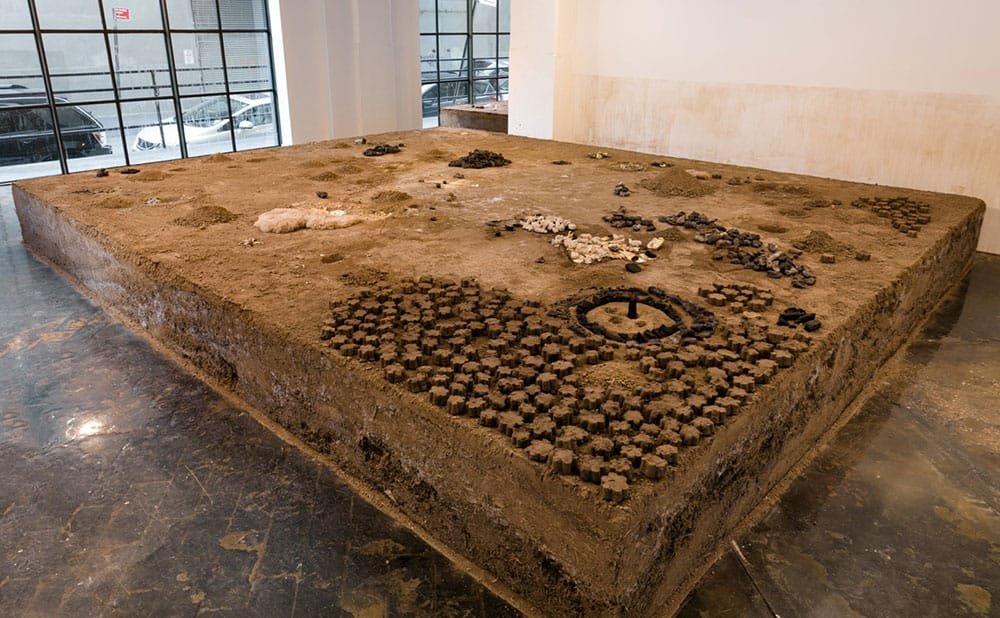
Photo by Charles Benton, courtesy the artist and Art in General · Hyperallergic
Một căn phòng đầy đất
Cuối năm 2016, Art in General, một tổ chức nghệ thuật phi lợi nhuận ở khu Dumbo, Brooklyn, mở triển lãm cá nhân đầu tiên tại Mỹ của Dineo Seshee Bopape. Tác phẩm được làm trong chương trình New Commissions của tổ chức này và kéo dài tới giữa tháng 1 năm 2017.
Người bước vào gặp trước hết là mùi. Mùi xô thơm vừa đốt, thứ khói người ta dùng để xông một căn phòng trước khi làm lễ. Rồi mùi đất, ấm và tròn, bốc lên từ những khối đất nén lớn đặt ở nhiều góc của phòng trưng bày. Chúng có hình vuông vức, như những mảnh ruộng bị cắt ra khỏi mặt đất và mang vào trong nhà.
Trên mặt đất là rất nhiều thứ nhỏ. Cánh hoa hồng nhiều màu. Một ngọn nến. Những cụm xô thơm. Những nắm đất sét còn in dấu bàn tay của nghệ sĩ. Len, than, lông chim, tro. Vỏ ốc cowrie, đá cuội, những mẩu vàng. Có những ụ bột trắng nhỏ. Có một bức tượng thỏ nhỏ màu vàng. Những mảnh gỗ cháy dở nằm lẫn trong đất.
Nghệ sĩ và mảnh đất
Dineo Seshee Bopape sinh năm 1981 ở Polokwane, Nam Phi, và sống, làm việc ở Johannesburg. Bà thường dùng video, âm thanh, vật tìm được và vật liệu thô. Trong những năm gần triển lãm này, đất trở thành chất liệu chính của bà.
Tên tác phẩm viết bằng tiếng Sepedi, một ngôn ngữ ở Nam Phi. Có thể dịch sát là: thứ thuộc về ___ là bụi, (thứ thuộc về bụi là ___). Những khoảng trống trong tên được để ngỏ. Người xem tự điền vào, hoặc để nguyên.
Theo giới thiệu của Art in General, tác phẩm tiếp nối phần Bopape trình bày tại Bienal de São Paulo lần thứ 32, cùng năm 2016. Bà nhìn đất từ nhiều phía cùng lúc: giới, ký ức, lịch sử, chính trị của nơi chốn, và câu hỏi về sự tồn tại của chính vật chất.
Ở Nam Phi, đất chưa bao giờ là một chủ đề trung tính. Ai sở hữu đất, ai bị đuổi khỏi đất, ai làm việc trên đất của người khác. Bopape không viết những câu ấy lên tường. Bà đặt đất vào phòng và để nó tự nói.
Trò chơi trong đất
Nhìn kỹ, mặt những khối đất không phẳng. Chúng có những vết lõm và lỗ nhỏ, trong đó đặt vỏ ốc, đá và vàng. Cách sắp xếp gợi đến Morabaraba và Diketo, hai trò chơi dân gian ở miền nam châu Phi. Morabaraba chơi bằng quân trên một bàn kẻ ô, thường vạch ngay trên đất. Diketo là trò tung và nhặt đá nhỏ.
Trò chơi là một cách người ta dùng đất hằng ngày, không để trồng trọt, không để sở hữu, chỉ để ở cùng nhau. Đặt trò chơi vào trong những khối đất bị cắt ra, Bopape cho thấy đất không chỉ là tài nguyên. Nó từng là nơi của nghi lễ, của cuộc sống chung, của trẻ con.
Nhà phê bình Seph Rodney của Hyperallergic viết rằng căn phòng khiến ông nghĩ đến những đồ vật nghi lễ bị bỏ quên, và đến sức sống của đất đang cạn dần dưới bàn tay con người. Xô thơm đã cháy. Hoa đã héo. Đất đang khô thành bụi.
Thứ còn lại là bụi
Phần lớn tác phẩm điêu khắc được làm để tồn tại lâu. Đá, đồng, gỗ đã xử lý. Tác phẩm của Bopape đi theo hướng ngược lại. Nó bắt đầu ẩm, có mùi, rồi khô dần. Người đến xem trong tuần đầu và người đến trong tuần cuối không ngửi thấy cùng một căn phòng.
Mùi ở đây không phải hiệu ứng thêm vào. Nó là bằng chứng rằng vật liệu còn sống. Khi mùi nhạt đi, người xem biết rằng đất đang mất nước, nghi lễ đang xa dần.
Cái tên đã nói điều đó từ đầu. Thứ gì thuộc về đất cũng sẽ thành bụi. Và bụi, đến lượt nó, lại thuộc về một thứ gì đó mà ta chưa biết tên. Bopape để trống chỗ ấy.
Đất và mùi còn gặp nhau ở nhiều tác phẩm khác, như nước mắt, đất và hoa cúc của Karola Braga. Ở Bopape, đất không được làm cho thơm. Nó chỉ được để yên cho tới khi thành bụi.
A room full of earth
In late 2016, Art in General, a nonprofit art space in Dumbo, Brooklyn, opened Dineo Seshee Bopape's first solo exhibition in the United States. The work was made through the organisation's New Commissions program and stayed on view until mid January 2017.
What met visitors first was smell. Freshly burnt sage, the smoke used to clear a room before a ceremony. Then earth, warm and round, rising from large blocks of compacted soil placed around the gallery. They were squared off, like plots of field cut out of the ground and carried indoors.
On the surface of the soil lay many small things. Rose petals in several colours. A candle. Bundles of sage. Lumps of clay still holding the prints of the artist's hands. Wool, charcoal, feathers, ash. Cowrie shells, pebbles, bits of gold. Small white mounds of powder. A little gold rabbit. Charred wood chips mixed into the earth.
The artist and the land
Dineo Seshee Bopape was born in 1981 in Polokwane, South Africa, and lives and works in Johannesburg. She has worked with video, sound, found objects and raw materials. In the years around this show, soil became her main material.
The title is in Sepedi, one of South Africa's languages. A close translation: that which is of ___ is dust, (that which is of dust is ___). The blanks are left open. Visitors can fill them in, or leave them empty.
According to Art in General, the commission grew partly out of Bopape's presentation at the 32nd Bienal de São Paulo, held the same year. She looks at land from several sides at once: gender, memory, history, the politics of place, and the question of what matter itself is.
In South Africa, land has never been a neutral subject. Who owns it, who was driven off it, who works someone else's ground. Bopape does not write those sentences on the wall. She puts the soil in the room and lets it speak.
Games in the soil
Up close, the blocks are not flat. They carry dents and small holes filled with shells, stones and gold. The arrangement recalls Morabaraba and Diketo, two games played across southern Africa. Morabaraba is played with pieces on a grid, often scratched straight into the ground. Diketo is a game of tossing and catching small stones.
A game is one way people use earth every day: not to farm it, not to own it, only to be together on it. By setting games into blocks of soil that have been cut away, Bopape shows land as more than a resource. It was once a place of ritual, of shared life, of children.
Writing for Hyperallergic, the critic Seph Rodney said the room made him think of ritual objects left behind, and of the vitality of soil running down under human care. The sage has burned. The flowers have wilted. The earth is drying into dust.
What remains is dust
Most sculpture is made to last. Stone, bronze, treated wood. Bopape's work runs the other way. It begins damp and full of smell, then slowly dries. Someone who visited in the first week and someone who came in the last did not smell the same room.
The smell here is not an added effect. It is evidence that the material is still alive. As it fades, the visitor knows the soil is losing water and the ritual is receding.
The title said so from the start. Whatever belongs to earth becomes dust. And dust, in turn, belongs to something we have not yet named. Bopape leaves that space blank.
Earth and smell meet in other works too, such as the tears, earth and chrysanthemums of Karola Braga. In Bopape's room the soil is not made to smell good. It is simply left alone until it turns to dust.
Olfactory Art