
Essays · Modern Art
Eva Hesse. Addendum.
Phía trên là con số. Phía dưới là trọng lực.
Above, the numbers. Below, gravity.
Tate · Tate
Mười bảy bán cầu và những sợi dây
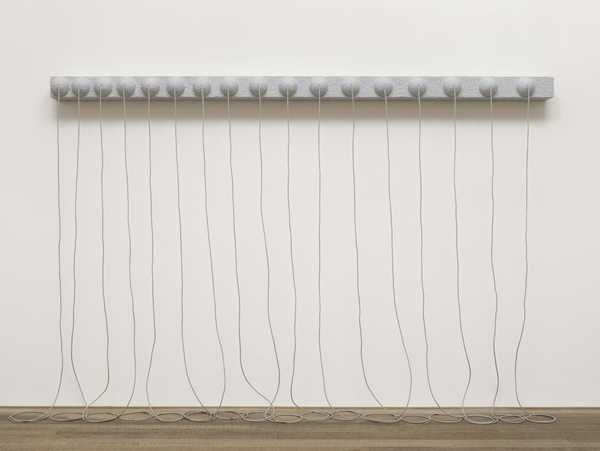
Addendum là một tác phẩm điêu khắc treo tường. Một thanh gỗ dài hơn ba mét, phủ cùng lớp giấy bồi, được treo nằm ngang. Trên thanh là mười bảy bán cầu giấy bồi màu xám nhạt. Từ tâm mỗi bán cầu, một sợi dây thừng sơn xám rủ xuống, chạm sàn, rồi cuộn thành những vòng không đoán trước.
Nhịp ngang của thanh gỗ và các bán cầu trái hẳn với dòng rơi dọc của những sợi dây. Bán cầu trông như một hình hữu cơ. Dây thừng là đồ công nghiệp. Tác phẩm vì vậy như đặt cạnh nhau một thứ tự nhiên và một thứ do người làm ra.
Bề mặt thanh gỗ và các bán cầu gồ ghề, cho thấy bột giấy được đắp thêm từng lớp. Hesse không làm phẳng, không che dấu vết của quá trình làm. Dấu vết ấy trở thành một phần của bố cục. Qua thời gian, lớp sơn đã nứt và ngả màu.
Eva Hesse, sinh năm 1936 tại Đức, làm việc ở Mỹ, mất năm 1970, làm Addendum năm 1967, khi đang sống và làm việc trong một xưởng gác mái ở số 134 Bowery, New York.
Một dãy số và một câu đùa
Các bán cầu không cách đều nhau. Chúng được đặt theo những khoảng tăng dần, theo một dãy số cố định mà Hesse tự mô tả: một phần tám, ba phần tám, năm phần tám, bảy phần tám, rồi tiếp tục. Thời ấy, nhiều nghệ sĩ dùng hệ thống chuỗi như vậy để dựng tác phẩm mà không phải dựa vào biểu cảm cá nhân.
Hesse chọn ba đơn vị khác nhau hết mức có thể: dây, hình chữ nhật, bán cầu. Bà thống nhất chúng bằng cách đặt nối tiếp, bằng sự lặp lại, và bằng cùng một màu xám nhám phủ lên tất cả.
Rồi bà cố ý làm lệch sự cân bằng ấy. Bà dặn tác phẩm phải treo cách sàn bảy feet. Dây bắt đầu rơi thành những đường song song, nhưng vì quá dài, chúng đổ sụp thành một khối ngẫu nhiên dưới sàn.
Hesse kết thúc lời giải thích về tác phẩm bằng một câu: "Serial art is another way of repeating absurdity." Nghệ thuật chuỗi là một cách khác để lặp lại sự phi lý. Câu này được lặp đi lặp lại nhiều lần, và ban đầu bà định để nó là lời bình duy nhất.
Art in Series, 1967
Addendum được trưng bày lần đầu trong triển lãm Art in Series tại Finch College Museum of Art ở New York, từ tháng 11 năm 1967 đến tháng 1 năm 1968. Triển lãm do Elayne Varian và nghệ sĩ Mel Bochner tổ chức. Mọi tác phẩm đều dựa trên cấp số hay chuỗi số học. Cùng tham gia có Donald Judd, Dan Flavin, Robert Smithson và Sol LeWitt.
Triển lãm không có catalogue. Các nghệ sĩ thu âm lời giải thích cho máy hướng dẫn. Trong bản thu của mình, Hesse nói tên tác phẩm là Addendum, nghĩa là một thứ được thêm vào hoặc sẽ được thêm vào. Bà nói nhan đề đến sau tác phẩm, và lời giải thích cũng vậy. Tác phẩm chỉ tồn tại cho chính nó.
Viết về triển lãm trên tờ Village Voice, nhà phê bình John Perreault cho rằng trong cả cuộc trưng bày, chỉ Hesse vừa nhìn ra, vừa chất vấn, vừa có phần thích thú những hệ quả phi lý của khuôn mẫu mới ấy. Ông mô tả những sợi dây xám rơi xuống sàn và rối vào nhau.
Tối giản, nhưng mềm
Addendum là một trong những tác phẩm tối giản nhất của Hesse. Nó có hàng lối, có con số, có màu duy nhất. Nhưng nó vẫn giữ một vẻ hữu cơ, không nghiêm ngặt như tác phẩm của nhiều người cùng triển lãm. Tate ghi nhận rằng dù quan tâm đến ý niệm chuỗi, công việc của Hesse luôn nghiêng về phía biểu cảm.
Kích thước và độ cao của tác phẩm, cùng những cuộn dây tràn vào không gian người xem đứng, tạo cho Addendum một sự hiện diện áp đảo. Người xem không chỉ nhìn một hàng bán cầu trên tường. Họ phải để ý bước chân, tránh đống dây dưới sàn.
Tate mua tác phẩm năm 1979. Hơn nửa thế kỷ sau, điều làm Addendum đáng nhớ vẫn là khoảnh khắc đơn giản ấy: một hệ thống được tính kỹ, và trọng lực lặng lẽ làm mềm nó.
Seventeen hemispheres and their cords
Addendum is a wall sculpture. A wooden bar just over three metres long, coated in the same papier mâché, hangs horizontally. Along it sit seventeen pale grey papier mâché hemispheres. From the centre of each, a length of grey painted rope falls to the floor and coils into unpredictable loops.
The horizontal rhythm of bar and hemispheres works against the vertical fall of the cords. The hemispheres look organic; the rope is manufactured. The piece seems to set a natural form beside a man made one.
The surfaces of bar and hemispheres are uneven, showing pulp added layer upon layer. Hesse did not smooth them or hide the process. That record became part of the composition. Over time the paint has cracked and discoloured.
Eva Hesse, born in Germany in 1936, worked in the United States and died in 1970. She made Addendum in 1967, while living and working in a loft studio at 134 Bowery, New York.
A number series and a joke
The hemispheres are not evenly spaced. They sit at increasing intervals, following a fixed series Hesse herself described: one eighth, three eighths, five eighths, seven eighths, and on. At the time many artists used serial systems as a way to compose without relying on personal expression.
Hesse chose three units as different in shape as possible: rope, rectangle, hemisphere. She unified them by sequence, by repetition, and by the same rough grey over everything.
Then she deliberately tipped the balance. She specified that the work hang seven feet from the floor. The cords start down in parallel lines, but because of their length they collapse into a random mass on the ground.
Hesse closed her statement on the work with one sentence: "Serial art is another way of repeating absurdity." It was repeated several times, and at first she had meant it to be her only comment.
Art in Series, 1967
Addendum was first shown in Art in Series at the Finch College Museum of Art in New York, November 1967 to January 1968. The show was organised by Elayne Varian and the artist Mel Bochner. Every work was based on arithmetical or serial progressions. Other participants included Donald Judd, Dan Flavin, Robert Smithson and Sol LeWitt.
There was no catalogue. The artists recorded statements for an audio guide. In hers, Hesse said the title meant a thing added or to be added. A title, she said, comes after the fact, and so do explanations. The work exists only for itself.
Reviewing the show in the Village Voice, the critic John Perreault wrote that only Hesse saw, questioned and in a way relished the absurd implications of the new formula. He described the grey cords falling to the floor and tangling together.
Minimal, but soft
Addendum is among Hesse's most minimal works. It has rows, numbers, a single colour. Yet it keeps an organic informality that sets it apart from the austere pieces of many fellow exhibitors. Tate notes that despite her interest in serial ideas, her work always leaned towards the expressive.
The size and height of the piece, and the coils spilling into the viewer's space, give it an imposing presence. You do not just look at a row of domes on a wall. You watch your step around the rope on the floor.
Tate bought the work in 1979. More than half a century on, what makes Addendum stay is that simple moment: a carefully counted system, and gravity quietly softening it.

Modern Art